
Back to reports search page

‘Anata-Shuafat, Abu Dis, Ras Abu Sbitan (Olive Terminal), Sheikh Saed, Tue 27.12.11, Morning

Tags: Children
Observers: Idit S., Shira V., Katia (a guest), Anat T. (reporting)
Dec-27-2011
| Morning


7:20 Sheikh Saed
 
Palestinian children are on a fortnight's winter holiday, with the exception of those attending institutions of the Waqf — mostly little ones, as far as we could tell.  Even so, things move slowly at the checkpoint.  We are told this is because there's a new Company in charge since last week.  On our previous shift at Sheikh Saed (Hanna B, Idit S, and myself) we encountered a border policeman who created unnecessarily harsh confrontations with those crossing.  Hanna B. complained to the B.P. spokeswoman about his inappropriate behaviour, and we hope the matter has been dealt with.
 
When we disembark our papers are carefully examined, and we're sent off to fetch Shira's document forgotten in the car.  Meanwhile we miss the turning away of a 10 year old : a resident of Abu Dis with birth certificate and school permit, but without the DCO permit, who is not allowed to cross the neighbourhood  checkpoint.  He fails to meet the regulations twice over: neither a resident of Sheikh Saed, nor the carrier of a DCO permit.  We try to persuade the checkpoint commander that a 10-year old whose school-bag has been checked, is not a security threat, and how can he reach the Olive Terminal alone?  Unfortunately the child had left by then.  The commander retracted a little from his claim that orders are orders are order… but just a little.
 
8:00  Drive around the Abu Dis area and observation from the Olive Terminal of the expected traffic changes
 
 
From the shoddy American Route we turn west to Silwan and drive up Ein Hilweh St.  Major municipality work is proceeding on the slope (near the Shiloah spring).  It is only in the evening that we learn of the collapse two days ago of the tunnel for an archaeological dig near a mosque, and of the "Peace Now" request to stop all underground digs in Silwan until an exhaustive and independent engineering report of all the tunnels is made.  We also learned that today the local committe of the Jerusalem Municipality will consider two building plans submitted by the Elad organisation: a large building in the former Givati parking lot, and the development of "Beit Ha-ma'ayan at the bottom of Silwan.  Local residents are protesting.  After a short drive around the closed lazarus checkpoint (next to the monastery which houses a kindergarden), we continue to the Olive Terminal to observe the system of new roads breaking out of Az-za'ayyem to Hizmeh through the new intersection under construction opposite Issawiya.  We read about it in the piece by Haim Levinson in Friday's Ha-aretz, but it all becomes clearer after a short internet search in the "Ir Amim" site which shows a map of the planned Route 45 from 2009.  The idea is to created a separate system of roads for Palestinians, linking the south of the West Bank (Bethlehem) with the north (Ramallah) by means of bridges and tunnels, eliding the roads approaching Jerusalem, and thus allowing checkpoint-free passage for Israeli residents from Ma'aleh Adumim to Jerusalem, and enabling construction in E1 to create urban continuity between these places.  See map of roads planned on:
 
 
Drive along the new roads, the new Shuafat checkpoint, and Beit Hanina
 
We drove along the new roads as far as the spot where they are blocked with locked gates.  Through a checkpoint and an under-road crossing to As-za'ayyem we drove along Route 45 (the road with a wall in its heart) on the Palestinian side, and found it blocked, but continuing, further on, to Anatot.  We then returned through the vehicular crossing in Az-za'ayyem and continued towards French Hill on Route 1 as far as the new roundabout with the turning to Metzudat Adumim. We expect that this is where the road to the new vehicular crossing in Shuafat will pass, channneling Palestinian traffic allowed to enter Jerusalem by car. (Will that include Palestinians holding blue IDs? Probably)
 
We continued to the new Shuafat checkpoint, although it was already late, to observe morning traffic.  The checkpoint was fairly empty, the walk to it and back unreasonably long.   From a piece in the "Bamahane" link we learn that from March 2011 this is the site planned to be the largest crossing in the West Bank, built according the demand of the High Court to confirm the route of the separation fence, along which are planned offices of various delegations, government offices and more.  See
 
Meanwhile the military police check documents at the single pedestrian crossing operating, without benefit of x-ray machines.  We did not see any representatives of government offices yet, but the squeaky clean toilets were opened especially for our use.  In answer to our question whether Paletinians were allowed to enter these premises we were told "only if they desperately need to…"
 
We ended this survey in Beit Hanina.  We drove from the Shuafat checkpoint to Pisgat Ze'er, turned to Beit Hanina,  and at the first roundabout north of the Light Rail terminal we  found a roundabout from which the road will lead from Pisgat Ze'ev to the Begin highway (continuing from Route 443).  We reahed the large interchange under construction, the route changed because of one home which gets in the way and cannot be moved.  We reflected on how all these plans — proceding stealthily and silently through various committees — surprise us, and eventually come true, unlike dreams of a better life for both out peoples.

  • Abu Dis / Lazarus gate (formerly The Wicket)

    See all reports for this place
    •  

      Abu Dis / Lazarus Checkpoint/Gate (east of the former “wicket”)

      Construction of the wall in the Abu Dis area blocked all the gaps that allowed people to cross from al-Ezariya to the neighbourhoods of Abu Dis and Ras al 'Amud that are located within Jerusalem’s municipal boundary. The Lazarus checkpoint is a gate in the wall adjacent to the Lazarus Monastery. Until 2011 it had a door for pilgrims to al-Ezariya and for the monastery’s kindergarten pupils from al-Ezariya. The crossing is currently closed, but the site has infrastructure for conducting inspections.

  • Checkpoint Shu'afat camp / Anata-Shu'afat (Jerusalem)

    See all reports for this place
    • The Shu’afat checkpoint is located in the northern part of East Jerusalem at the exit from the village of Anata and the Shu’afat refugee camp, which are located in the area annexed to Jerusalem in 1967. The refugee camp borders the Shu’afat neighborhood to the west, Pisgat Ze’ev to the north, the French Hill neighborhood to the south and the planned expansion of Ma’aleh Adumim to E-1 in the east.  It was established in 1966 for 1948 refugees from the West Bank and was populated after the Six Day War by persons who had been expelled from the Jewish Quarter.  Today its population comprises some 25,000 people holding blue ID cards and some 15,000 people with Palestinian ID cards.  The camp lacks adequate infrastructure and services, and suffers from poverty, neglect and overcrowding.  All its buildings are connected to the public electricity and water infrastructure, but not all are connected to the sewer system.  The camp’s services are provided by UNRWA, except for those such as health clinics and transportation of pupils to schools in Jerusalem.  In 2005, the Israeli High Court of Justice rejected a suit by the residents requesting that the route of the separation fence be drawn such that the camp would remain on the Israeli side, but conditioned its approval of the route on the establishment of a convenient and rapid crossing facility for the inhabitants of the neighborhood, most of whom are residents of Jerusalem.

      A temporary checkpoint operated there until December, 2011.  It was extremely congested during rush hours, and dangerous for pedestrians (especially children) because of inadequate safety provisions.  The new checkpoint was  inaugurated south of the old one, for public and private transportation and for pedestrians, intended solely for the residents of the camp – holders of blue ID cards, and those with Palestinian ID cards who possess appropriate permits.  There are five vehicle inspection stations at the checkpoint, and two for pedestrians (one of which is currently closed) where scanners have been installed but are not yet operating.  According to the army, representatives of government agencies will also be present to provide services to residents of the neighbourhood.  The pedestrian lanes are very long, located far from the small parking lots, and accessible through only a single revolving gate.
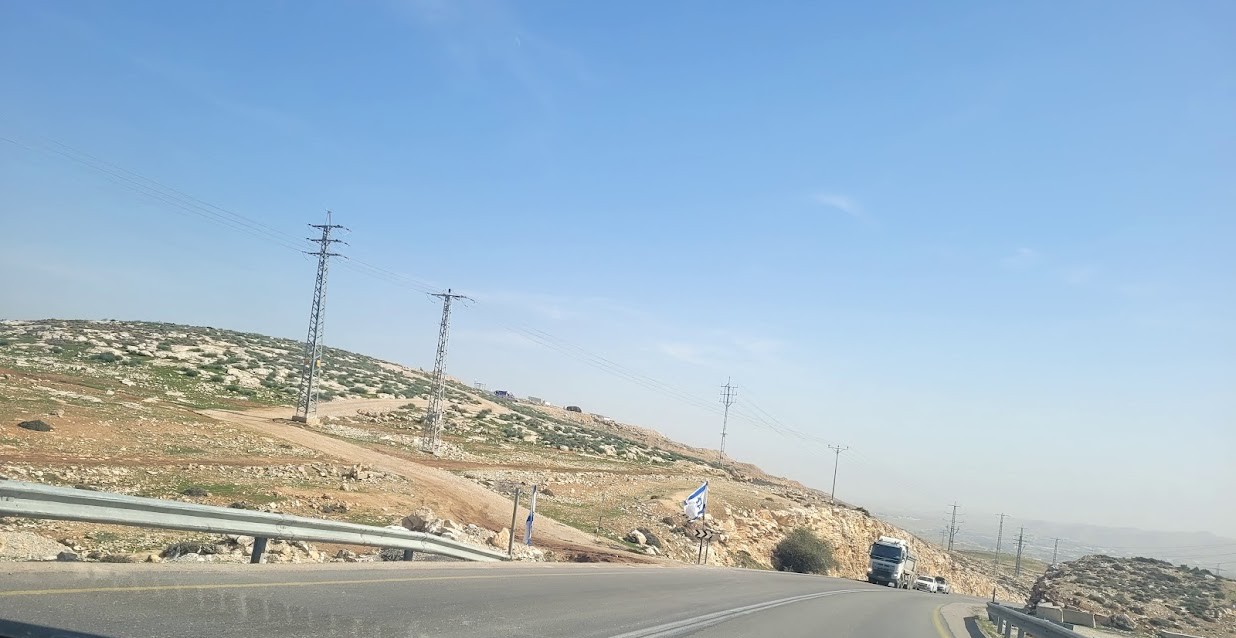
       

      ענאתא: מאחז חדש קם דרומה לצומת
      Anat Tueg
      Jan-25-2026
      Anata: A new outpost has been built south of the junction
  • Ras Abu Sbitan (Olive Terminal)

    See all reports for this place
    • A large checkpoint/crossing to the area of a-Tur, Abu Dis and the Old City; only for pedestrians. Located on Jerusalem’s municipal boundary.

      One of the major crossings in Jerusalem’s central sector. It is located on the separation fence between the northern portion of the al-Ezariya neighborhood and the neighborhood of a-Tur and the rest of East Jerusalem. It is manned by Border Police soldiers and private security companies and operates 24 hours a day. Palestinians are forbidden to go through, other than permanent residents of East Jerusalem (holders of blue ID cards) and holders of work and commercial permits who are allowed through only on foot.

  • Sheikh Sa'ed

    See all reports for this place
    • A checkpoint limited to pedestrians, located on Jerusalem’s municipal boundary.

      The checkpoint sits on the separation fence at the entrance to Sheikh Sa’ad, dividing it from its neighbourhood of Jabel Mukkabar. It’s manned by Border Police soldiers and private security companies and operates 24 hours a day. Palestinians are forbidden to go through, other than residents of Jabel Mukkabar or Sheikh Sa'ad who have permits. Both groups are permitted through only on foot. Residents of East Jerusalem who don’t live in Jabel Mukkabar are also allowed to cross to Sheikh Sa’ad, but not in the opposite direction; they must return through the Sawahira ash Sharqiya checkpoint.
      ירושלים, שער שכם: קהל ממהר לתפילה
      Avital C
      Feb-27-2026
      Jerusalem, Damascus Gate: Crowd rushing to prayer
Donate
