
'Anata-Shu'afat, Bethlehem (300), Ras Abu Sbitan (Olive Terminal)


Bethlehem checkpoint, Zeitim checkpoint, Shuafat refugee camp checkpoint
The morning after the attack in the David’s Tomb complex in the Old City, senior commanders showed up at all the checkpoints we were at. The workers went through as usual and no special stress was evident. The Olive and Shuafat checkpoints are very neglected. We received a serious complaint about a Jerusalem family being prevented from crossing the Shuafat refugee camp checkpoint to Jerusalem for a funeral.
7:20 Bethlehem checkpoint
Outside the barrier there is a tense atmosphere, of restlessness and everything is mixed with a depressing complacency. Dozens of male and female workers flock to the shuttles to Jerusalem and even a minibus or two announce their destination as Tel Aviv. There are also many who are sitting on the fence waiting to be picked up – some of them already have work and some are simply hoping that a contractor who needs labor this week will come by. Men and women we spoke to said that there was a large crowd on the Palestinian side earlier. From 4-7 the pressure is great. Now it’s quite empty at the exit on the Israeli side – only the far stations are open.
The police officer who was called to meet us (as usual the security guards said we had no right to be there) says that the humanitarian crossing was open until 7 in the morning for the passage of women, the elderly and the sick and now it is closed. Could it be that Hanna Barag’s complaints started to work? There is a feeling that they are really making an effort today to show that everything is fine even though more than 13,000 workers have already passed. And it really seems so. Only the recurring argument that we need to be guarded, because the checkpoint is a dangerous military area!!!.
We meet with M. from Bethlehem (Tuqu’a) who is trying to find a job in Jerusalem to support 3 children. Her husband left her. Anything, she says. The problem is that she does not speak Hebrew or English at all. We promised to help, and today they announce to her that there is a company that needs her for a project of a few days. We will have to bring her the first time. Let’s hope it goes well.
Ras Abu Sbitan CP (The olive checkpoint)
It’s already late, 8:30. There are no few workers . As in the previous shift, we encountered a problem of the use of the humanitarian gate. Two women and an elderly man with a huge suitcase press the bell to open the gate instead of the turnstile that will not pass the suitcase. To our surprise, although not a word was heard from the other side, after a few minutes the door responds to a push and opens. Several people are waiting for the checkpoint, and there is a mess how things are being handled. Two senior policemen, a soldier and two female soldiers take a long time to let the people pass through. Someone needs to be physically examined, and even though there are enough soldiers to do so, in the meantime no one is allowed to pass. The communication device doesn’t work either and neither soldiers nor Palestinians can hear one another. When we ask to open, to transfer, the senior policeman gets angry with us – “Enough, we’ve been here since four in the morning”. We are marked as enemies. And when we leave, we think that we would like to convince them to treat the Palestinians at the checkpoint like human beings who are rushing for their lives, not to cause a backlash. How do you do that?
Shuafat refugee camp checkpoint
Garbage and neglect. Outside the checkpoint and inside it – at the pedestrian crossing. The x-ray machne does not work (we asked since when, they hesitated and said since yesterday). In front of us, a woman takes one item after another out of her bag in front of the soldier behind the armored glass.
Lots of policemen, security guards, border guards outside. The truth is, there is always an abundance of personnel here, Today after the attack last night there is also a lieutenant colonel of the Border Police. I take a picture from a distance at the exit of the checkpoint, and immediately almost all the security guards rush over to us. “It is forbidden to take pictures here – it is a classified security area.” They take my ID (“They are in the police database” allthough I had already been checked – ah, I get the Palestinian treatment of being searched). They arrive with the tablet of taxes and fines and return the ID as we are not criminals. In the distance, I photograph again, and a woman soldier screams at me. They calm her down. Again, as always , we are the enemies of the chosen people.
More importantly – I am attaching a video that we received from a familiar and reliable person, which describes what happened at the checkpoint last week in the afternoon. A family member died and they were on their way to the burial in the old city. The whole family is from Jerusalem – they have blue certificates. In any case, after the ambulance with the body, the family was prevented from passing. They argued, one of the boys cursed, one of the boys scolded – gas grenades were thrown. The son was detained for several hours. The family eventually moved.
Bethlehem (300)
See all reports for this place-
Located adjacent to the Separation Wall ("Jerusalem Wrap") at the north entrance to Bethlehem, this checkpoint cuts off Bethlehem and the entire West Bank from East Jerusalem, with all the serious implications for health services, trade, education, work and the fabric of life. The checkpoint is manned by the Border police and private security companies. It is an extensive infrastructure barrier and is designated as a border terminal, open 24 hours a day for foreign tourists. Israeli passport holders are not allowed to pass to Bethlehem, and Palestinian residents are not allowed to enter Jerusalem, except those with entry permits to Israel and East Jerusalem residents. Israeli buses are allowed to travel to Bethlehem only through this checkpoint.The checkpoint, which demonstrated harsh conditions of crowding and extreme passage delays for years, started employing advanced electronic identification posts and has upgraded its gates' system as of the middle of 2019 - and conditions improved.Adjacent to the checkpoint, in an enclosure between high walls and another passage, is the historic Rachel's Tomb, which is now embedded within a concrete fortified building. It contains prayer and study complexes for Jews only, as well as a residential complex. updated November 2019 .
-
Checkpoint Shu'afat camp / Anata-Shu'afat (Jerusalem)
See all reports for this place-
The Shu’afat checkpoint is located in the northern part of East Jerusalem at the exit from the village of Anata and the Shu’afat refugee camp, which are located in the area annexed to Jerusalem in 1967. The refugee camp borders the Shu’afat neighborhood to the west, Pisgat Ze’ev to the north, the French Hill neighborhood to the south and the planned expansion of Ma’aleh Adumim to E-1 in the east. It was established in 1966 for 1948 refugees from the West Bank and was populated after the Six Day War by persons who had been expelled from the Jewish Quarter. Today its population comprises some 25,000 people holding blue ID cards and some 15,000 people with Palestinian ID cards. The camp lacks adequate infrastructure and services, and suffers from poverty, neglect and overcrowding. All its buildings are connected to the public electricity and water infrastructure, but not all are connected to the sewer system. The camp’s services are provided by UNRWA, except for those such as health clinics and transportation of pupils to schools in Jerusalem. In 2005, the Israeli High Court of Justice rejected a suit by the residents requesting that the route of the separation fence be drawn such that the camp would remain on the Israeli side, but conditioned its approval of the route on the establishment of a convenient and rapid crossing facility for the inhabitants of the neighborhood, most of whom are residents of Jerusalem.
A temporary checkpoint operated there until December, 2011. It was extremely congested during rush hours, and dangerous for pedestrians (especially children) because of inadequate safety provisions. The new checkpoint was inaugurated south of the old one, for public and private transportation and for pedestrians, intended solely for the residents of the camp – holders of blue ID cards, and those with Palestinian ID cards who possess appropriate permits. There are five vehicle inspection stations at the checkpoint, and two for pedestrians (one of which is currently closed) where scanners have been installed but are not yet operating. According to the army, representatives of government agencies will also be present to provide services to residents of the neighbourhood. The pedestrian lanes are very long, located far from the small parking lots, and accessible through only a single revolving gate.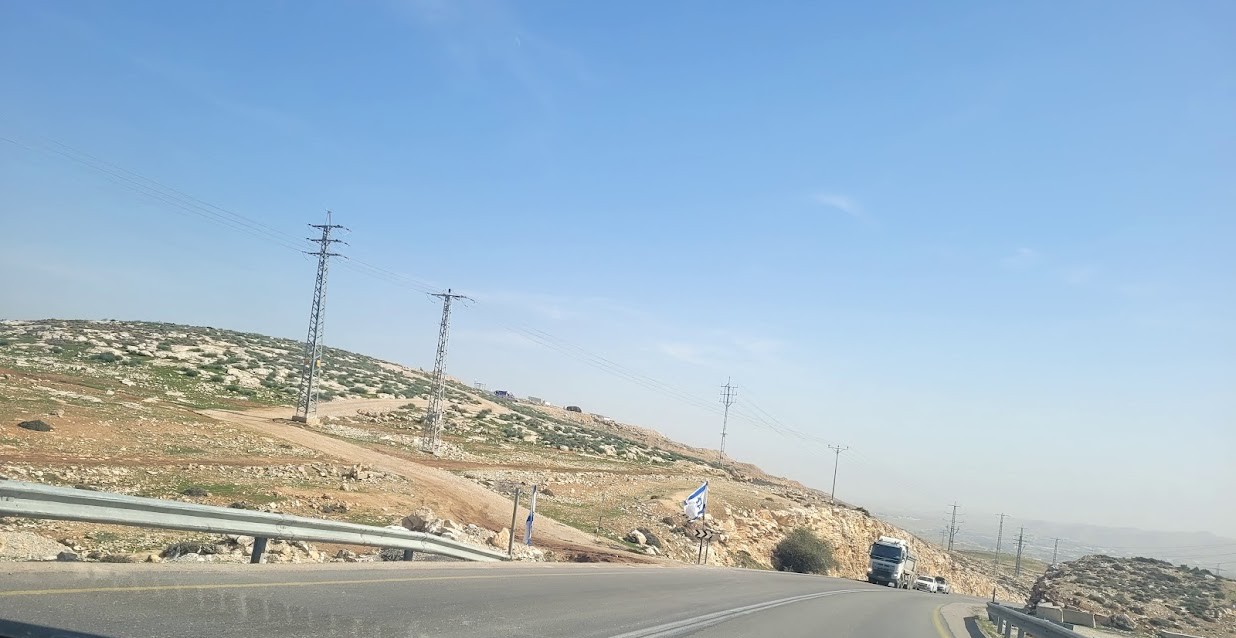 Anat TuegJan-25-2026Anata: A new outpost has been built south of the junction
-
Ras Abu Sbitan (Olive Terminal)
See all reports for this place-
A large checkpoint/crossing to the area of a-Tur, Abu Dis and the Old City; only for pedestrians. Located on Jerusalem’s municipal boundary.
One of the major crossings in Jerusalem’s central sector. It is located on the separation fence between the northern portion of the al-Ezariya neighborhood and the neighborhood of a-Tur and the rest of East Jerusalem. It is manned by Border Police soldiers and private security companies and operates 24 hours a day. Palestinians are forbidden to go through, other than permanent residents of East Jerusalem (holders of blue ID cards) and holders of work and commercial permits who are allowed through only on foot.
-
