
'Anata-Shu'afat, Jerusalem, Ras Abu Sbitan (Olive Terminal) - Second Friday of Ramadan
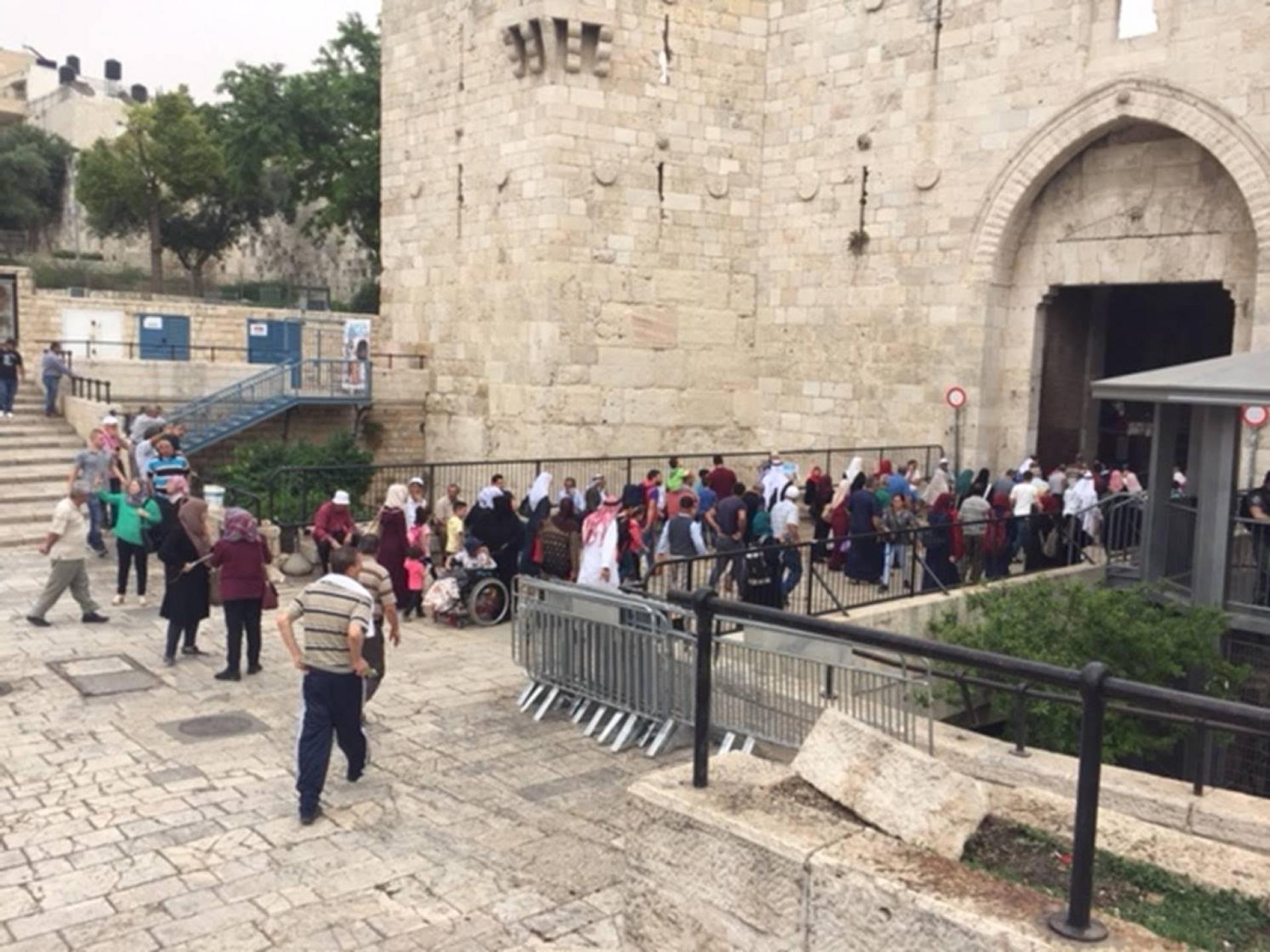
The day started off quietly but some things are meant to be. Chana and I first went to the Damascus gate where people were streaming in already by the 100s even though it was only 10.00. It was all very festive.
We went in the gate but there were such crowds and everything seemed to be quiet that we decided to go to Anata. There were no taxis in the area as the roads were closed but we found a taxi driver who took us to the checkpoint. There were not many people on foot and the buses seemed to be coming through with no difficult. People came off the buses, got on again. Drove a few metres where the bus stop and the driver’s ID is taken to be checked. It is not clear why this is not done while the passengers are checked. We also learned that the buses coming through Anata are those of people with East Jerusalem ID’s. People without have to go to Zeitim (olive) checkpoint. From where we were we did not see anyone being sent back. We left at 11.45 as a taxi came past which took us to the light train. 154 and 207 are the buses which go to the area.
And then the actual story of the day started. Being a bit confused as to where we were, we first took the train in the wrong direction. We were not sure where we were and there were none of the usual signs which one sees on the light train at any normal station. Which also says something about the attitude to the Palestinian users of the train.
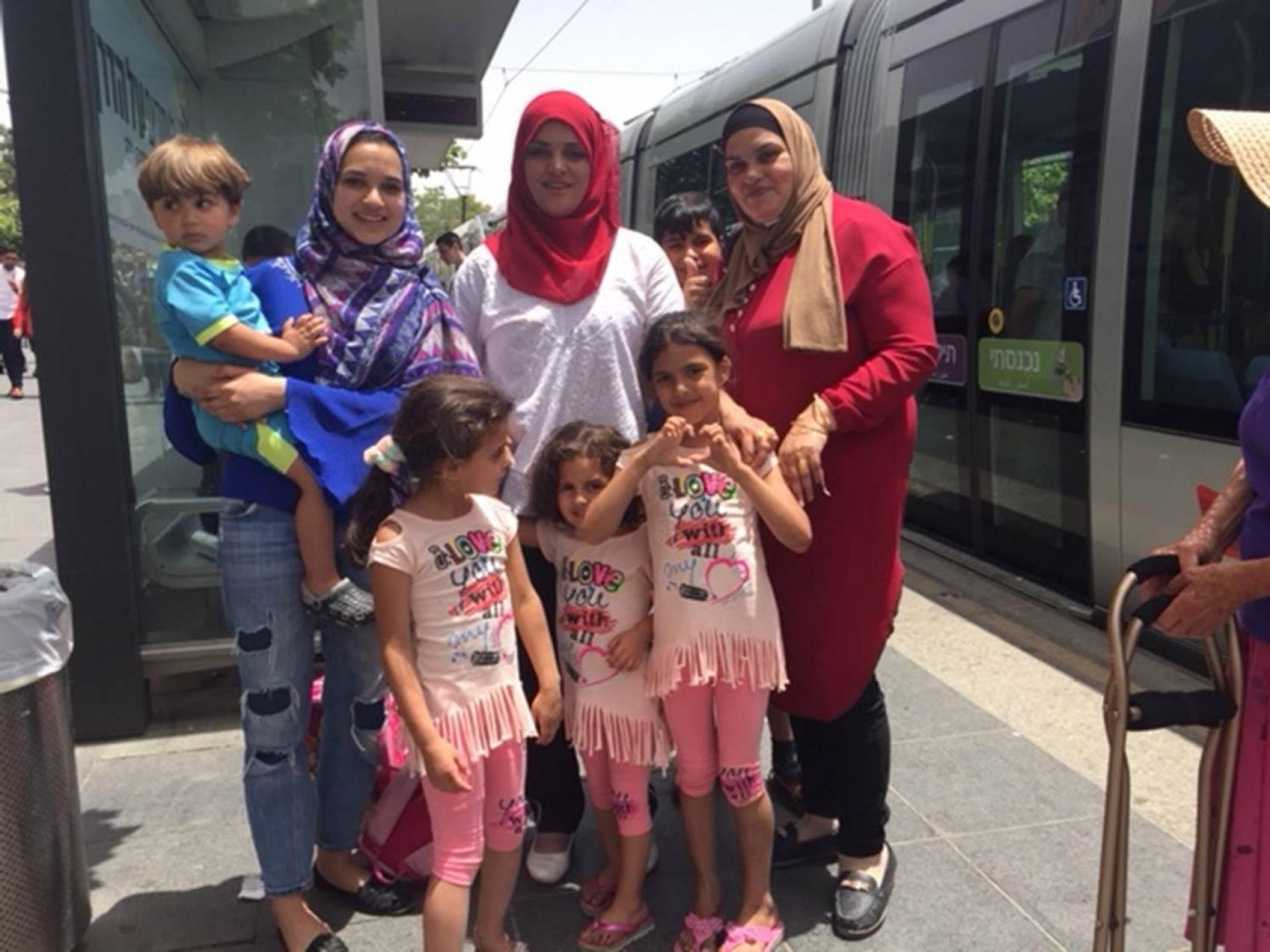
So by mistake we first took the train going in the wrong direction. And that is why I say that some things are meant to be. Wos is beschert. On the train with us when we eventually went in the right direction was a large Arab family who, in the course of the hour or so that followed, we learned had come from Nablus and were going to their family in Jaffa. They were not sitting all together.
As the train pulled out we heard someone banging on the door but the train did not stop and only after it had travelled to the city did a guard come along shouting in Hebrew asking if anyone had forgotten a little girl at Bab el Amud. It seemed as if no one had but as we drew into Mahane Yehuda the family went into a panic and started calling to one another and we realized that they were looking for a little girl. They knew no Hebrew and had not understood what the guard was saying. We were grateful for our smattering of Arabic. They rushed off the train and we went with them and we looked for a guard to help us but there was no one. We told them we would stay with them until they found the child and tried to phone the police. But while we were phoning the father got a call from someone to say he was with the little girl of seven and the father should come back to fetch her.
At this stage we did not want to leave them until we knew that all was well. Eventually he arrived with the little girl and we went on with them to Egged, thinking all is well that ends well. But as we were getting on to the light train again Chana saw that they were walking down the pavement in the wrong direction evidently looking for a bus to Tel Aviv. They had no clue of where or how.
To the end we accompanied them through Egged and it was no small task keeping them all together and in the right direction. We also helped with the communication with the ticket clerk and when we thanked him for his patience, he said, “Thank you for your Arabic.” We saw them safely on the bus and waited till it had departed.
Later I spoke to the father and they were all safely in Jaffa.
Checkpoint Shu'afat camp / Anata-Shu'afat (Jerusalem)
See all reports for this place-
The Shu’afat checkpoint is located in the northern part of East Jerusalem at the exit from the village of Anata and the Shu’afat refugee camp, which are located in the area annexed to Jerusalem in 1967. The refugee camp borders the Shu’afat neighborhood to the west, Pisgat Ze’ev to the north, the French Hill neighborhood to the south and the planned expansion of Ma’aleh Adumim to E-1 in the east. It was established in 1966 for 1948 refugees from the West Bank and was populated after the Six Day War by persons who had been expelled from the Jewish Quarter. Today its population comprises some 25,000 people holding blue ID cards and some 15,000 people with Palestinian ID cards. The camp lacks adequate infrastructure and services, and suffers from poverty, neglect and overcrowding. All its buildings are connected to the public electricity and water infrastructure, but not all are connected to the sewer system. The camp’s services are provided by UNRWA, except for those such as health clinics and transportation of pupils to schools in Jerusalem. In 2005, the Israeli High Court of Justice rejected a suit by the residents requesting that the route of the separation fence be drawn such that the camp would remain on the Israeli side, but conditioned its approval of the route on the establishment of a convenient and rapid crossing facility for the inhabitants of the neighborhood, most of whom are residents of Jerusalem.
A temporary checkpoint operated there until December, 2011. It was extremely congested during rush hours, and dangerous for pedestrians (especially children) because of inadequate safety provisions. The new checkpoint was inaugurated south of the old one, for public and private transportation and for pedestrians, intended solely for the residents of the camp – holders of blue ID cards, and those with Palestinian ID cards who possess appropriate permits. There are five vehicle inspection stations at the checkpoint, and two for pedestrians (one of which is currently closed) where scanners have been installed but are not yet operating. According to the army, representatives of government agencies will also be present to provide services to residents of the neighbourhood. The pedestrian lanes are very long, located far from the small parking lots, and accessible through only a single revolving gate.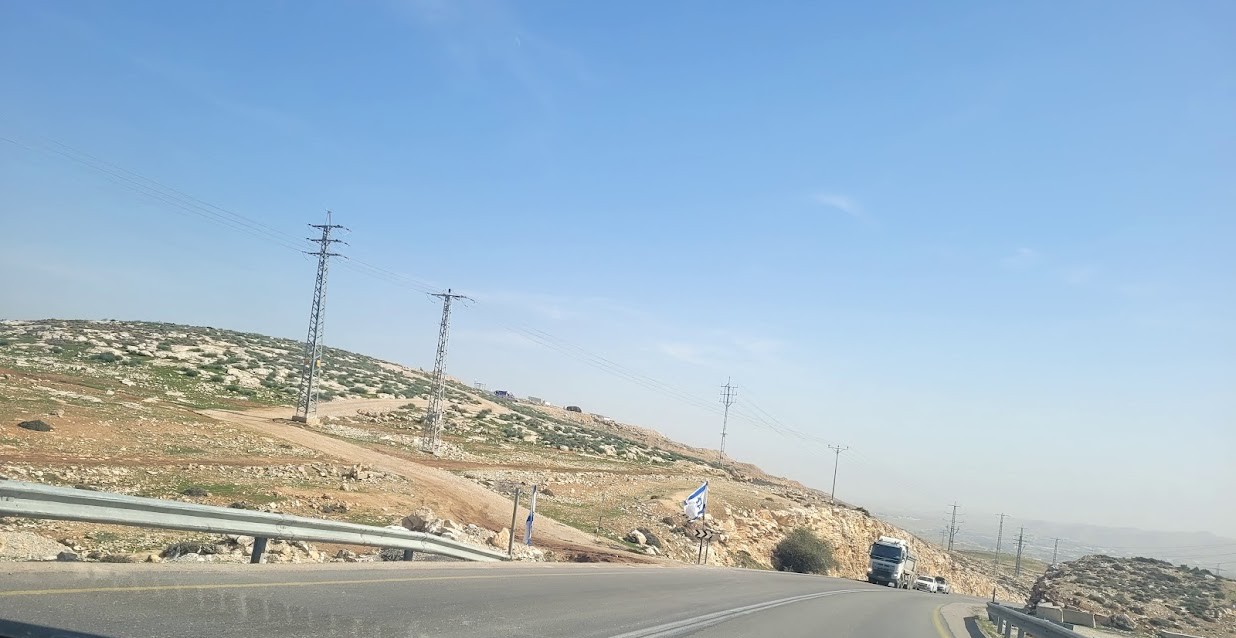 Anat TuegJan-25-2026Anata: A new outpost has been built south of the junction
-
Jerusalem
See all reports for this place-
The places in East Jerusalem which are visited routinely by MachsomWatch women are Silwan and Sheikh Jarrah. During the month of Ramadan, also the Old City and its environs are monitored.
-
Ras Abu Sbitan (Olive Terminal)
See all reports for this place-
A large checkpoint/crossing to the area of a-Tur, Abu Dis and the Old City; only for pedestrians. Located on Jerusalem’s municipal boundary.
One of the major crossings in Jerusalem’s central sector. It is located on the separation fence between the northern portion of the al-Ezariya neighborhood and the neighborhood of a-Tur and the rest of East Jerusalem. It is manned by Border Police soldiers and private security companies and operates 24 hours a day. Palestinians are forbidden to go through, other than permanent residents of East Jerusalem (holders of blue ID cards) and holders of work and commercial permits who are allowed through only on foot.
-
