
Back to reports search page

‘Anata-Shu’afat, Qalandiya

Observers: Hanna S. and Ronit D. (reporting), Hanna K. (translating)
Jan-13-2016
| Morning
A very crowded morning at the Qalandiya CP, with a surprise: An officer times the duration of time it takes to pass; at the Shua'fat CP there is a considerable improvement, after busses were allowed to pass with the passengers.
 
Qalandiya CP
We arrived at the Qalandiya CP at approx. 5:15. It is cold and dark. People group around bonfires to warm up. A many membered group prayer welcomed us near the passage in the direction of Qalandiya. As usual people make way for us and we pass. Inside we are welcomed by long queues which flow over beyond the shed. 5 checking posts were already active. But today there is a surprise: a young officer stands outside the aquarium with sheets in his hand. It turns out that he tries to time the duration it takes to pass. He has taken the ID cards from some people, and wrote down the numbers and the hour. He will then checks on the computer when they have passed. His problem is how to get to the end of the queue. He approached the people nearest to him, those who stand at the entrance to the enclosures. But the queues have already overflowed deep into the parking lot and the officer wanted to know how much time elapses from the moment a person arrives until he passes. He asked people to go and bring him ID cards of people standing at the end of the queue. The problem was that people were afraid to cooperate with him. Only later in the morning we saw somebody who agreed to help him. He went and brought him a few people from the end of the queue. In the meantime the few women who arrived were enabled to join the queue at the entrance to the enclosures and the queues were long, but the order was maintained and the speed of the progress was acceptable.
At 5:30 a policeman arrived and joined the soldier in the aquarium. A short time later another policeman arrived. Towards 6 o'clock people began waiting at the humanitarian gate. Just then the officer disappeared. Two guardsmen arrived and greeted the waiting people, but didn't open the gate. At about 6:15 the officer returned with P., the NCO from the DCO, whom we hadn't seen for a long time. The officer explained that he had gone to bring a key. Now P. opens the gate with the help of the guardsmen and the officer resumes writing down the ID numbers to check the timing. The queue becomes longer and then again shorter alternately.
We wnet to watch the sunrise and to warm ourselves over a glass of tea. The guy who runs the kiosk already knows how to prepare it for us. We asked him where Iman, who we hadn't seen for a long time, was.  He says he is Iman's brother, and is called Muhamad. Lately their father is ill and Iman takes care of him.
At 6:30, when the queues were already only in the shed, we joined the queue. It took us 25 minutes to pass. Outside the bonfires were already extinguished and we saw a municipality vehicle clearing the garbage.
 
Shua'fat CP
After a break for fueling and toilets at the gas station at the French Hill, where we saw that the blockage at the entrance to Issawiya wasn't manned but that the concrete barricades still blocked part of the road, we drove to the Shua'fat CP. We passed on foot. On the way inside we saw that busses, both student busses and public transportation ones, were coming out with their passengers. Inside we went to the student transportation zone. The place was teeming and bustling. Attendants direct the children to the busses which fill up and drive off, although we also saw a bus which loads the children in the middles of the traffic lane in a most dangerous manner. The student busses have a separate lane and they pass without being checked.
We met Jamil Sanduka, the energetic chairman of the residents committee of Ras Hamis. He tells us that with the help of Human Rights activists, among which is Hanna Brag and others. The passage of busses and their passages is again made possible. This greatly facilitates the situation. He says that about 5000 students travel every day on busses to their schools beyond the CP. We greet him for farewell and go to the pedestrian passage.
We were happy to see that the queue wasn't long, probably because of the fact that it was possible to pass by busses and it wasn't necessary to leave the busses and to pass on foot. The tempo of the passage was reasonable and within 10 minutes we were outside. At the exit from the building a cleaner was washing the steps, and greeted us Good Morning. We stopped to watch the passage of the vehicles. We wanted to see who the passage of the busses was conducted: were the passengers of the Public Transportation checked one by one, does the representative of the security forces get on the bus, etc. We managed to see the minibus stop, the door being opened and the women in the first seat holding their ID cards in their hands. But then the Border Policeman and the guard were alerted and demanded that we proceed. We made it clear that we wanted to observe, and that this was our right, but they insisted. As their dealings with us made them abandon their posts and thus the traffic was delayed, we decided not to argue, and moved on. All in all the situation seemed much better than in the past.


  • Checkpoint Shu'afat camp / Anata-Shu'afat (Jerusalem)

    See all reports for this place
    • The Shu’afat checkpoint is located in the northern part of East Jerusalem at the exit from the village of Anata and the Shu’afat refugee camp, which are located in the area annexed to Jerusalem in 1967. The refugee camp borders the Shu’afat neighborhood to the west, Pisgat Ze’ev to the north, the French Hill neighborhood to the south and the planned expansion of Ma’aleh Adumim to E-1 in the east.  It was established in 1966 for 1948 refugees from the West Bank and was populated after the Six Day War by persons who had been expelled from the Jewish Quarter.  Today its population comprises some 25,000 people holding blue ID cards and some 15,000 people with Palestinian ID cards.  The camp lacks adequate infrastructure and services, and suffers from poverty, neglect and overcrowding.  All its buildings are connected to the public electricity and water infrastructure, but not all are connected to the sewer system.  The camp’s services are provided by UNRWA, except for those such as health clinics and transportation of pupils to schools in Jerusalem.  In 2005, the Israeli High Court of Justice rejected a suit by the residents requesting that the route of the separation fence be drawn such that the camp would remain on the Israeli side, but conditioned its approval of the route on the establishment of a convenient and rapid crossing facility for the inhabitants of the neighborhood, most of whom are residents of Jerusalem.

      A temporary checkpoint operated there until December, 2011.  It was extremely congested during rush hours, and dangerous for pedestrians (especially children) because of inadequate safety provisions.  The new checkpoint was  inaugurated south of the old one, for public and private transportation and for pedestrians, intended solely for the residents of the camp – holders of blue ID cards, and those with Palestinian ID cards who possess appropriate permits.  There are five vehicle inspection stations at the checkpoint, and two for pedestrians (one of which is currently closed) where scanners have been installed but are not yet operating.  According to the army, representatives of government agencies will also be present to provide services to residents of the neighbourhood.  The pedestrian lanes are very long, located far from the small parking lots, and accessible through only a single revolving gate.
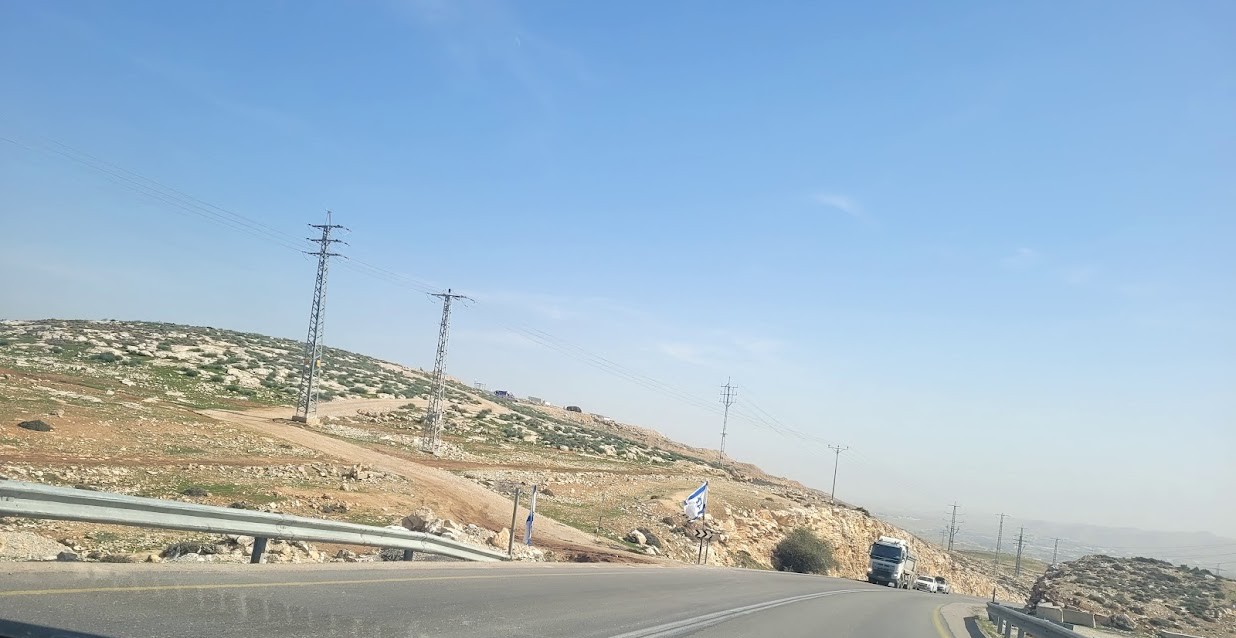
       

      ענאתא: מאחז חדש קם דרומה לצומת
      Anat Tueg
      Jan-25-2026
      Anata: A new outpost has been built south of the junction
  • Qalandiya Checkpoint / Atarot Pass (Jerusalem)

    See all reports for this place
    • Click here to watch a video from Qalandiya checkpoint up to mid 2019 Three kilometers south of Ramallah, in the heart of Palestinian population. Integrates into "Jerusalem Envelope" as part of Wall that separates between northern suburbs that were annexed to Jerusalem in 1967: Kafr Aqab, Semiramis and Qalandiya, and the villages of Ar-Ram and Bir Nabala, also north of Jerusalem, and the city itself. Some residents of Kafr Aqab, Semiramis and Qalandiya have Jerusalem ID cards. A terminal operated by Israel Police has functioned since early 2006. As of August 2006, northbound pedestrians are not checked. Southbound Palestinians must carry Jerusalem IDs; holders of Palestinian Authority IDs cannot pass without special permits. Vehicular traffic from Ramallah to other West Bank areas runs to the north of Qalandiya. In February 2019, the new facility of the checkpoint was inaugurated aiming to make it like a "border crossing". The bars and barbed wire fences were replaced with walls of perforated metal panels. The check is now performed at multiple stations for face recognition and the transfer of an e-card.  The rate of passage has improved and its density has generally decreased, but lack of manpower and malfunctions cause periods of stress. The development and paving of the roads has not yet been completed, the traffic of cars and pedestrians is dangerous, and t the entire vicinity of the checkpoint is filthy.  In 2020 a huge pedestrian bridge was built over the vehicle crossing with severe mobility restrictions (steep stairs, long and winding route). The pedestrian access from public transport to the checkpoint from the north (Ramallah direction) is unclear, and there have been cases of people, especially people with disabilities, who accidentally reached the vehicle crossing and were shot by the soldiers at the checkpoint. In the summer of 2021, work began on a new, sunken entrance road from Qalandiya that will lead directly to Road 443 towards Jerusalem and Tel Aviv. At the same time, the runways of the old Atarot airport were demolished and infrastructure was prepared for a large bus terminal. (updated October 2021)  
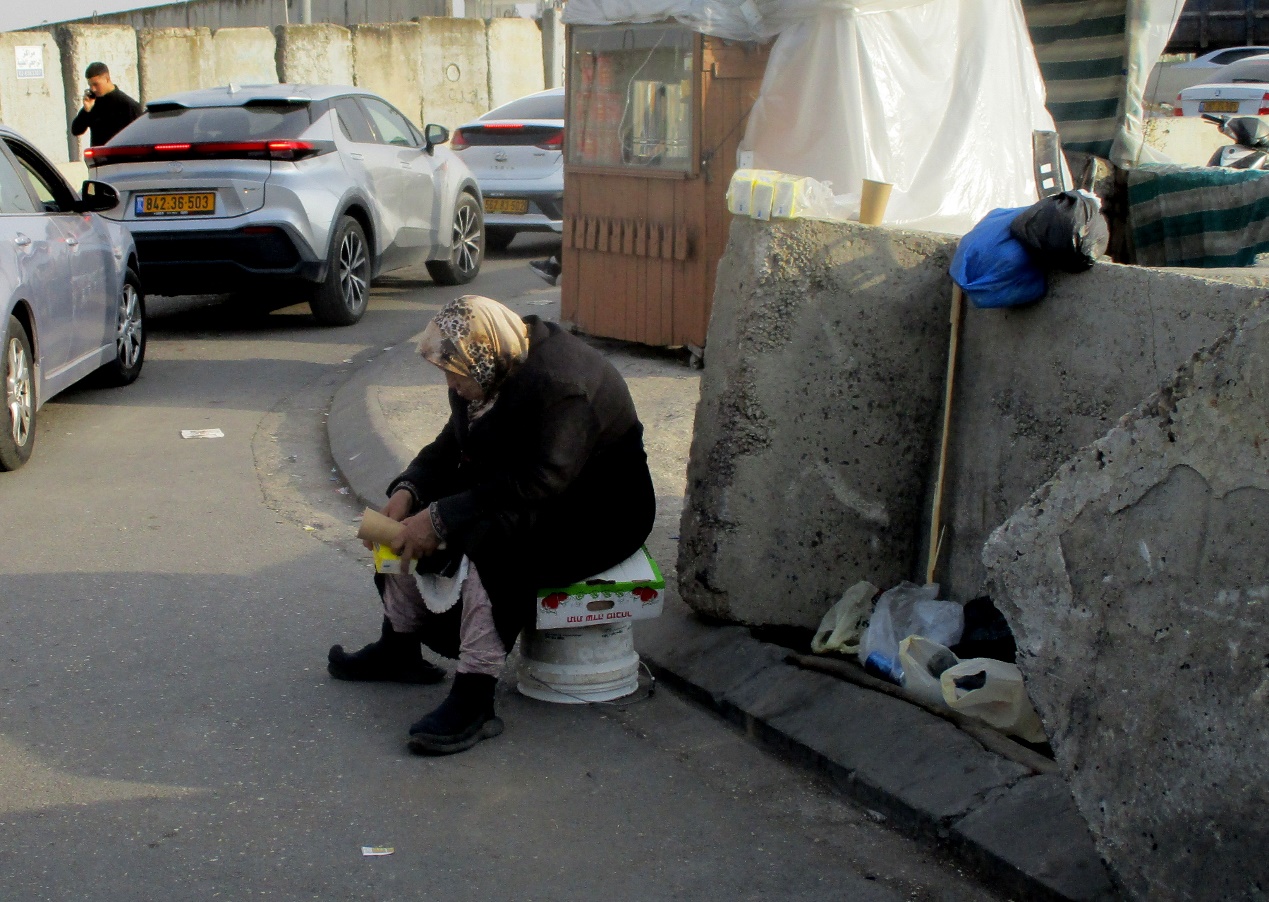
      קלנדיה. שרידי אדם או שרידי בגדים
      Tamar Fleishman
      May-31-2026
      Qalandiya. Human remains or clothing remains
Donate
