
‘Anata-Shuafat, Qalandiya, Mon 9.1.12, Afternoon
16:00: Today we decided to see what was happening at the "glorious" new CP that brutally amputates Anata from Jerusalem, leaving that city and its residents imprisoned behind walls of cement. On a winter afternoon, the pedestrian CP was almost deserted and only the vehicle CP showed signs of activity. Off to one side, in the long enfenced pathway leading to the CP, we could see a small steady stream of people returning to their homes.
As we entered the vehicle CP, one of the civilian security personnel approached to ask what we were up to and to chase us away. We asked him some questions about the CP that he was unable to answer, so he went off to call an officer. He came back with Elad who introduced himself as the CP Commander. He could not understand why he should have to explain the workings of the CP to ordinary citizens, but he did so anyway. He told us that parts of the area beyond the Wall were under the jurisdiction of the municipality of Jerusalem and that quite a number of residents bear Israeli I.D. cards. Natanya asked him about arrangements for children who go to school in Jerusalem. Elad proudly told us that on the other side of the CP there was a large square where buses picked up children to go to school every morning. Palestinian personnel were on duty every morning to see that children boarded the proper buses which then crossed through the CP in a dedicated lane. Soldiers did not board the buses to check out the children and this eliminates unnecessary contact and anxiety. (Could we suggest that the morning MW teams check this story out to see if it is true?) Elad insisted that we cross through the CP and see the square and the arrangements with our own eyes, so we did (and can confirm their existence). On our way back we passed through the pedestrian CP, traversing the cellar of the CP building. At the end of our route was a sign posted announcing this as a route for the handicapped. This was a bit surprising in view of the fact that the route ends at the foot of a flight of stairs (which could be daunting to someone confined to a wheelchair). In any event, both the officer (Elad) and the civilian security man were very polite and showed no hostility.
On our way out of the CP via the enfenced pathway we met and spoke with a Palestinian man who told us that he had once seen a soldier pushing an elderly woman (we probably served to remind him of the story) ungently out of the CP. When he intervened to ask the soldier to behave more politely he was arrested and beaten by a group of B.P. soldiers who then imprisoned him and held him for 2 days at their base.
17:00: We reached Qalandiya at dusk and found 2 passageways open with lines of about 20 people in each. But the lines were not moving and quickly grew to 30 or 40 people. We phoned both Headquarters and the Passageway Unit. Only very slowly did the soldiers on duty begin to process the papers of those on line
Checkpoint Shu'afat camp / Anata-Shu'afat (Jerusalem)
See all reports for this place-
The Shu’afat checkpoint is located in the northern part of East Jerusalem at the exit from the village of Anata and the Shu’afat refugee camp, which are located in the area annexed to Jerusalem in 1967. The refugee camp borders the Shu’afat neighborhood to the west, Pisgat Ze’ev to the north, the French Hill neighborhood to the south and the planned expansion of Ma’aleh Adumim to E-1 in the east. It was established in 1966 for 1948 refugees from the West Bank and was populated after the Six Day War by persons who had been expelled from the Jewish Quarter. Today its population comprises some 25,000 people holding blue ID cards and some 15,000 people with Palestinian ID cards. The camp lacks adequate infrastructure and services, and suffers from poverty, neglect and overcrowding. All its buildings are connected to the public electricity and water infrastructure, but not all are connected to the sewer system. The camp’s services are provided by UNRWA, except for those such as health clinics and transportation of pupils to schools in Jerusalem. In 2005, the Israeli High Court of Justice rejected a suit by the residents requesting that the route of the separation fence be drawn such that the camp would remain on the Israeli side, but conditioned its approval of the route on the establishment of a convenient and rapid crossing facility for the inhabitants of the neighborhood, most of whom are residents of Jerusalem.
A temporary checkpoint operated there until December, 2011. It was extremely congested during rush hours, and dangerous for pedestrians (especially children) because of inadequate safety provisions. The new checkpoint was inaugurated south of the old one, for public and private transportation and for pedestrians, intended solely for the residents of the camp – holders of blue ID cards, and those with Palestinian ID cards who possess appropriate permits. There are five vehicle inspection stations at the checkpoint, and two for pedestrians (one of which is currently closed) where scanners have been installed but are not yet operating. According to the army, representatives of government agencies will also be present to provide services to residents of the neighbourhood. The pedestrian lanes are very long, located far from the small parking lots, and accessible through only a single revolving gate.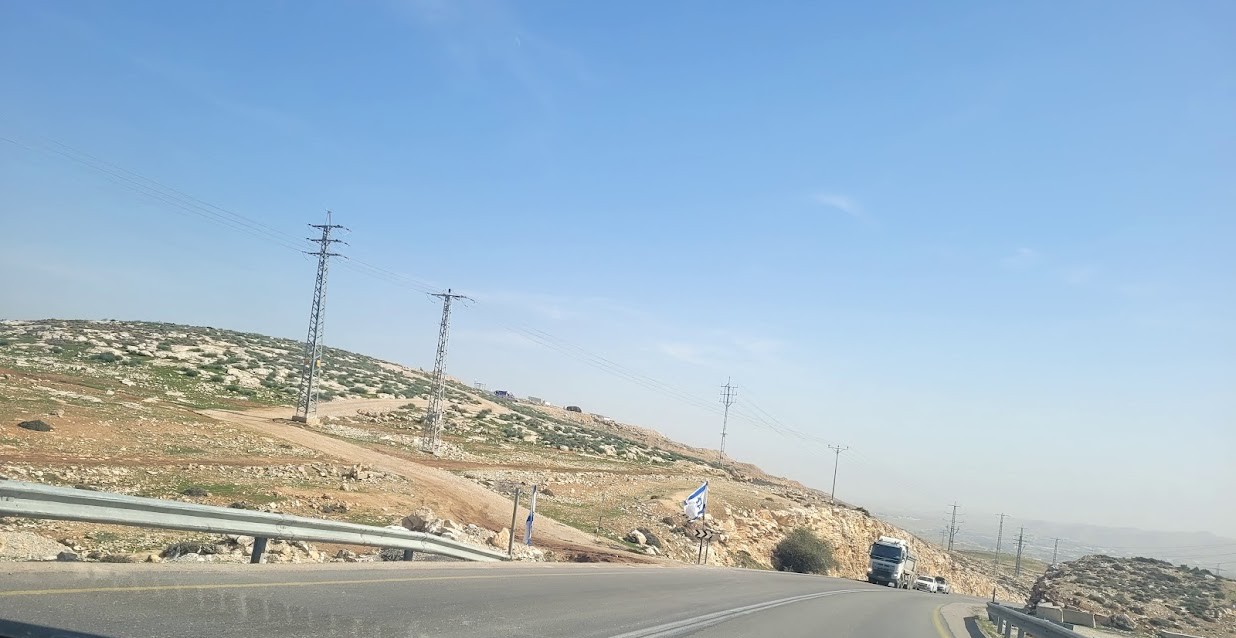 Anat TuegJan-25-2026Anata: A new outpost has been built south of the junction
-
Qalandiya Checkpoint / Atarot Pass (Jerusalem)
See all reports for this place-
Click here to watch a video from Qalandiya checkpoint up to mid 2019 Three kilometers south of Ramallah, in the heart of Palestinian population. Integrates into "Jerusalem Envelope" as part of Wall that separates between northern suburbs that were annexed to Jerusalem in 1967: Kafr Aqab, Semiramis and Qalandiya, and the villages of Ar-Ram and Bir Nabala, also north of Jerusalem, and the city itself. Some residents of Kafr Aqab, Semiramis and Qalandiya have Jerusalem ID cards. A terminal operated by Israel Police has functioned since early 2006. As of August 2006, northbound pedestrians are not checked. Southbound Palestinians must carry Jerusalem IDs; holders of Palestinian Authority IDs cannot pass without special permits. Vehicular traffic from Ramallah to other West Bank areas runs to the north of Qalandiya. In February 2019, the new facility of the checkpoint was inaugurated aiming to make it like a "border crossing". The bars and barbed wire fences were replaced with walls of perforated metal panels. The check is now performed at multiple stations for face recognition and the transfer of an e-card. The rate of passage has improved and its density has generally decreased, but lack of manpower and malfunctions cause periods of stress. The development and paving of the roads has not yet been completed, the traffic of cars and pedestrians is dangerous, and t the entire vicinity of the checkpoint is filthy. In 2020 a huge pedestrian bridge was built over the vehicle crossing with severe mobility restrictions (steep stairs, long and winding route). The pedestrian access from public transport to the checkpoint from the north (Ramallah direction) is unclear, and there have been cases of people, especially people with disabilities, who accidentally reached the vehicle crossing and were shot by the soldiers at the checkpoint. In the summer of 2021, work began on a new, sunken entrance road from Qalandiya that will lead directly to Road 443 towards Jerusalem and Tel Aviv. At the same time, the runways of the old Atarot airport were demolished and infrastructure was prepared for a large bus terminal. (updated October 2021)
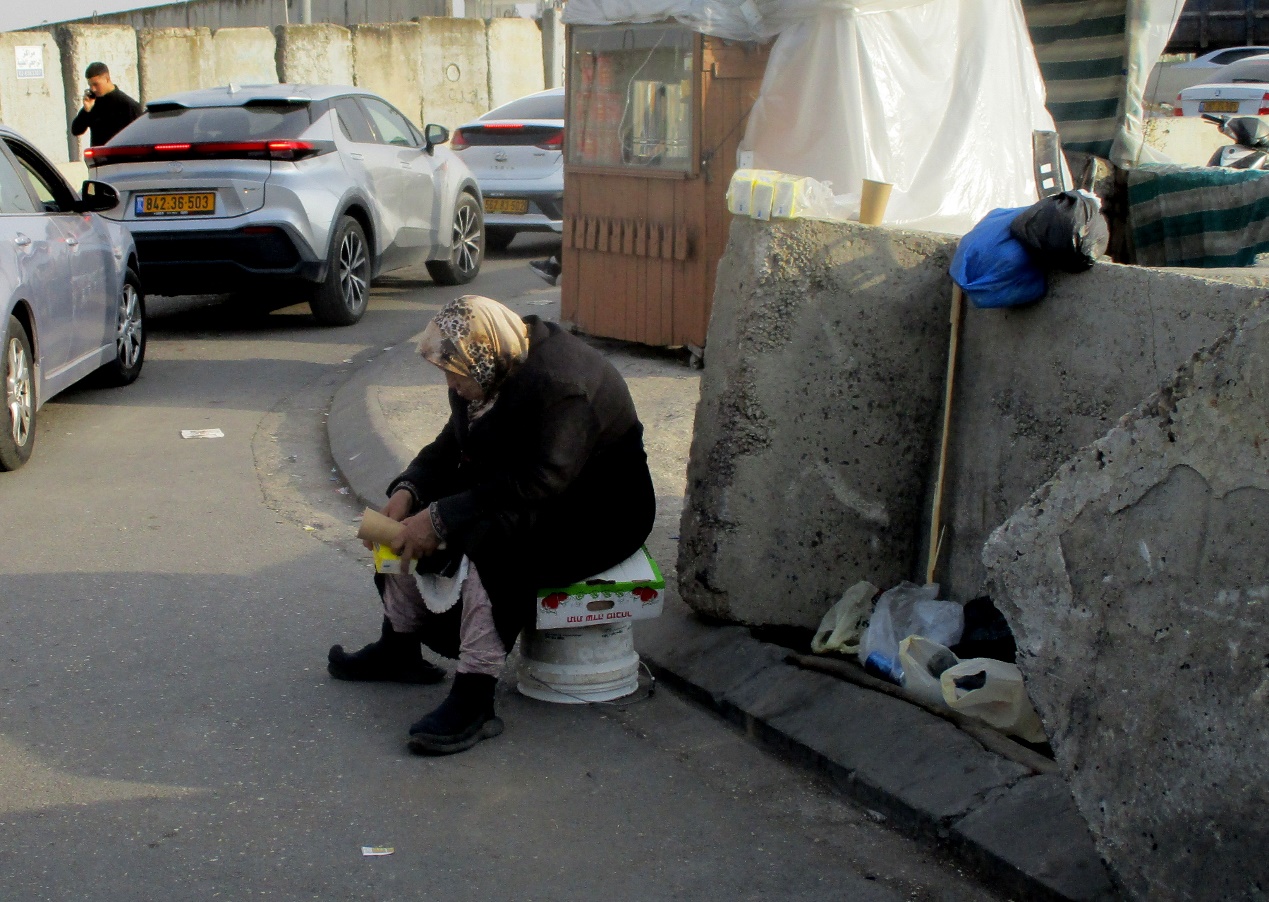 Tamar FleishmanOct-11-2026Qalandiya. Female Beggar
-
