
‘Anin, Barta’a-Reihan, Tayba-Rummana
6:05 Barta’a Checkpoint
Large numbers of young workers, and a small minority of older ones, are racing toward the lower parking area, on the Palestinian side of the checkpoint. They join the line to enter the terminal.
More and more workers are making their living in Israel and must pass through this checkpoint. Now and again the line stops moving (both lines seem “too” quiet) and in those intervals it rapidly grows longer. According to Iyad, the usher, at its peak the line was 250-300 people long. Iyad is approached by people with questions and requests, so he’s become an authority figure, much more than an usher. He tells us that last week there was a malfunction in the terminal and the line was stuck for an hour, causing hundreds of people to have to wait until 8am to get through.
We were happy to see our friend Walid again. Two weeks ago he got married and left his bachelor’s apartment in Barta’a for his home in Zabda. He travels back and forth through the checkpoint each morning and evening. “How is life, Walid?” “Praise God.”
There are many cars around the checkpoint, parked along the sides of the road, on the slope of the nearby hill, on the Palestinian Authority side, and on the side of the Occupation.
6:40 ‘Anin Checkpoint
The checkpoint is opened by reservist soldiers, more than 30 minutes late. At 07:15 people begin to move through the checkpoint in numbers greater than we’ve been used to seeing. They greet us warmly, wishing us a pleasant morning and asking how we are. For a moment it feels as though peace has already come. But then we’re reminded of why our presence here is important. The three women we’ve met two weeks ago approach us and ply us with questions (You don’t work? How do you live?).
The number of people passing through the checkpoint has grown but that fact that they are limited to just two days per week is an example of the way all Palestinians, not just the farmers, have been robbed of their right to enter and move through their lands, both in the Palestinian Authority territory and that under Israeli occupation.
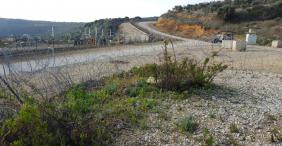
8:05 Taibe Romana Checkpoint
An agricultural checkpoint in the eastern foothills of Umm al-Fahm
Some 50 people are waiting on the Palestinian side. The Border Police are 5 minutes late opening the checkpoint. Today they take everyone’s identification, (perhaps?) check them, (perhaps?) verify them, and then call each person by name. One by one the Palestinians approach to get their documents back. Occupation games.
Here, too, we are greeted warmly and a few women pause to chat and satisfy their curiosity. The man who once said to us “I was born under occupation, I live under occupation and I’ll die under occupation,” passes by and says with a cynical smile: “well, the occupation is still here…”
We give an older woman and her two grown daughters a ride to the al-Midan neighborhood of Umm al-Fahm. We chatted during the 10-minute ride and though we didn’t understand everything, one thing was clear: there is someone to talk on the other side. Salamat.
'Anin checkpoint (214)
See all reports for this place-
'Anin checkpoint (214)
'Anin checkpoint is located on the Separation Fence east of the Israeli community Mei Ami and close to the village of Anin in the West Bank. It is opened twice a week, morning and afternoon, on days with shorter light time, for Anin farmers whose olive groves have been separated from the village by the fence it became difficult to cultivate their land. Transit permits are only issued to those who can produce ownership documents for their caged-in land, and sometimes only to the head of the family or his widow, eldest son, and children. Sometimes the inheritors lose their right to tend to the family’s land. The permits are eked out and are re-issued only with difficulty. 55-year-old persons may cross the checkpoint (into Israel) without special permits. During the olive harvest season (about one month around October) the checkpoint is open daily and more transit permits are issued. Names of persons eligible to cross are held in the soldiers’ computers. In July 2007, a sweeping instruction was issued, stating that whoever does not return to the village through this checkpoint in the afternoon will be stripped of his transit permit when he shows up there next time. Since 2019, the checkpoint has not been allways locked with the seam-line zone gate (1 of 3 gates), and the fence around it has been broken in several sites.
-
Barta’a-Reihan Checkpoint
See all reports for this place-
This checkpoint is located on the Separation Fence route, east of the Palestinian town of East Barta’a. The latter is the largest Palestinian community inside the seam-line zone (Barta’a Enclave) in the northern West Bank. Western Barta’a, inside Israel, is adjacent to it. The Checkpoint is open all week from 5 a.m. to 9 p.m. Since mid-May 2007, the checkpoint has been managed by a civilian security company subordinate to the Ministry of Defense. People permitted to cross through this checkpoint into and from the West Bank are residents of Palestinian communities inside the Barta’a Enclave as well as West Bank Palestinian residents holding transit permit. Jewish settlers from Hermesh and Mevo Dotan cross here without inspection. A large, modern terminal is active here with 8 windows for document inspection and biometric tests (eyes and fingerprints). Usually only one or two of the 8 windows are in operation. Goods, up to medium commercial size, may pass here from the West Bank into the Barta’a Enclave. A permanent registered group of drives who have been approved by the may pass with farm produce. When the administration of the checkpoint was turned over to a civilian security firm, the Ya’abad-Mevo Dotan Junction became a permanent checkpoint. . It is manned by soldiers who sit in the watchtower and come down at random to inspect vehicles and passengers (February 2020).
-
Tayba-Rummana
See all reports for this place-
Tayba-Rummana is an agricultural checkpoint. It is located in the separation fence in front of the eastern slopes of the Israeli city of Umm al-Fahm. The Palestinian villages next to the checkpoint are Khirbet Tayba and Rummana. Dozens of dunams of olive groves were removed from their owners, the residents of these villages on the western side of the separation fence. The Palestinian villages next to the checkpoint are Khirbet Tayba and Rumna. Dozens of olives dunams were removed from these villages' residents and swallowed up in a narrow strip of space, on the western side of the separation fence. The checkpoint allows the plantation owners who have permits to pass. Twice a week, the checkpoint opens for fifteen minutes in the morning and evening. During the harvest season, it opens every day for fifteen minutes in the morning (around 0630) and fifteen minutes in the afternoon (around 1530). (February 2020).
-
