
‘Anin, Barta’a-Reihan, Tayba-Rummana
 06:00-06:40 Barta’a checkpoint
It was immediately apparent there was no one keeping order in the Palestinian parking lot (the “red side” of the checkpoint), given the crowding and the masses of people at the turnstiles. There’s no sign of A., who volunteers to keep order, nor of the five hired personnel who began working two weeks ago but didn’t come this week. A. now works in Nazareth and
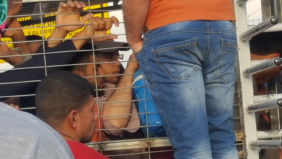
crosses through a different checkpoint. Crowding starts at 04:30, half an hour before the checkpoint opens, and continues until approximately 07:30 on a good day. People are angry and tired even before beginning their workday. What Israeli would have been willing to waste one or two hours each morning in an annoying, crowded, congested line? R., from the checkpoint management, politely and calmly rebuffs my attempt to find out what they’re doing to ease the line. What do you know, he tells me repeatedly. What I’ve seen and heard for fourteen years, I reply. He finds that hard to believe. At least both turnstiles are operating simultaneously for people entering the terminal. After stopping for 4-5 minutes they turn again and about 50 people come through, mostly young men, pushing and shoving; some were trapped within the turnstile when it stopped. Others, mostly older men, prefer to wait off to the side, at the price of being very late to work.
06:40 300-400 people were still waiting.
06:50-07:20 A’anin agricultural gate 214
The checkpoint opened on time but crossing goes slowly: The soldiers, who are acting as “fashion police,” didn’t allow ten people through because they thought they were too well-dressed for farm work. Let’s assume they’re not heading to the olive groves today, but why do they think a Palestinian farmer must be wearing dirty clothes?
An elderly resident of A’anin goes through without a permit, because of his age. His son’s permit was confiscated as part of the Shabak’s general, inexplicable clampdown. He knows about the wholesale clampdown but believes his son must be permitted, like him, to cross without documents.
Another resident wanted to cross this morning with his son. They let the father through. They told the son to return to the village. The father told the son to wait and he tried again later and this time got through.
The hunt continues for tractors born before 1995 which are thereby no longer entitled to cross to the seam zone. Remember: most of the agricultural lands belonging to A’anin are imprisoned in the seam zone. Now imagine this: Without a tractor, a farmer can’t cultivate his land. After a few years it will be considered to have been abandoned. Guess who’ll receive it as a gift from the state of Israel? In the following clip, Ahmad tells about his tractor that’s too old. This morning he was stopped and told to take it back to the village. He did, and came back on foot. His wife had already crossed and was waiting for him.
Ahmad, from A’anin: https://www.youtube.com/watch?v=CKQo2tZ03HI
08:00 Tayibe-Rummaneh agricultural gate 154
Today it opened exactly on time but not everyone went through. Four women and their small children were refused entry even though they had agricultural crossing permits. And not because they were too well dressed. They had the nerve to tell the truth, that they were going to visit relatives in Umm el Fahm, adjacent to the checkpoint. Often women and children are allowed to cross here even if they’re not going to the fields. It’s confusing. So – should they lie, or not?
'Anin checkpoint (214)
See all reports for this place-
'Anin checkpoint (214)
'Anin checkpoint is located on the Separation Fence east of the Israeli community Mei Ami and close to the village of Anin in the West Bank. It is opened twice a week, morning and afternoon, on days with shorter light time, for Anin farmers whose olive groves have been separated from the village by the fence it became difficult to cultivate their land. Transit permits are only issued to those who can produce ownership documents for their caged-in land, and sometimes only to the head of the family or his widow, eldest son, and children. Sometimes the inheritors lose their right to tend to the family’s land. The permits are eked out and are re-issued only with difficulty. 55-year-old persons may cross the checkpoint (into Israel) without special permits. During the olive harvest season (about one month around October) the checkpoint is open daily and more transit permits are issued. Names of persons eligible to cross are held in the soldiers’ computers. In July 2007, a sweeping instruction was issued, stating that whoever does not return to the village through this checkpoint in the afternoon will be stripped of his transit permit when he shows up there next time. Since 2019, the checkpoint has not been allways locked with the seam-line zone gate (1 of 3 gates), and the fence around it has been broken in several sites.
-
Barta’a-Reihan Checkpoint
See all reports for this place-
This checkpoint is located on the Separation Fence route, east of the Palestinian town of East Barta’a. The latter is the largest Palestinian community inside the seam-line zone (Barta’a Enclave) in the northern West Bank. Western Barta’a, inside Israel, is adjacent to it. The Checkpoint is open all week from 5 a.m. to 9 p.m. Since mid-May 2007, the checkpoint has been managed by a civilian security company subordinate to the Ministry of Defense. People permitted to cross through this checkpoint into and from the West Bank are residents of Palestinian communities inside the Barta’a Enclave as well as West Bank Palestinian residents holding transit permit. Jewish settlers from Hermesh and Mevo Dotan cross here without inspection. A large, modern terminal is active here with 8 windows for document inspection and biometric tests (eyes and fingerprints). Usually only one or two of the 8 windows are in operation. Goods, up to medium commercial size, may pass here from the West Bank into the Barta’a Enclave. A permanent registered group of drives who have been approved by the may pass with farm produce. When the administration of the checkpoint was turned over to a civilian security firm, the Ya’abad-Mevo Dotan Junction became a permanent checkpoint. . It is manned by soldiers who sit in the watchtower and come down at random to inspect vehicles and passengers (February 2020).
-
Tayba-Rummana
See all reports for this place-
Tayba-Rummana is an agricultural checkpoint. It is located in the separation fence in front of the eastern slopes of the Israeli city of Umm al-Fahm. The Palestinian villages next to the checkpoint are Khirbet Tayba and Rummana. Dozens of dunams of olive groves were removed from their owners, the residents of these villages on the western side of the separation fence. The Palestinian villages next to the checkpoint are Khirbet Tayba and Rumna. Dozens of olives dunams were removed from these villages' residents and swallowed up in a narrow strip of space, on the western side of the separation fence. The checkpoint allows the plantation owners who have permits to pass. Twice a week, the checkpoint opens for fifteen minutes in the morning and evening. During the harvest season, it opens every day for fifteen minutes in the morning (around 0630) and fifteen minutes in the afternoon (around 1530). (February 2020).
-
