
‘Anin, Barta’a-Reihan
04:50 Barta’a (Reihan) checkpoint
The very dark checkpoint is illuminated by artificial lighting. It’s a surreal sight: the workers (employed by a security company) run around, calling instructions to each other, each one goes to their station, last-minute preparations before opening.
Seven pickup trucks in the parking lot laden with agricultural produce from villages in the West Bank, intended primarily for Barta’a. The same number park on the road up to the vehicle checkpoint in the direction of the seam zone.
More than a hundred men and women crowd around the entrance to the checkpoint. Taxis continue arriving; more men and women get out, join the congested line. All wait for the gates to open.
05:00 The PA announces: Good morning; start coming 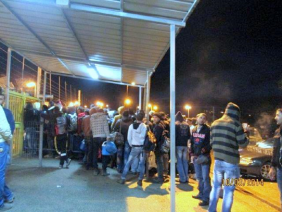 through. The checkpoint opens; the mass of human pulp flows toward the gate – about 150 people. The security guard at the entrance tries to control the line. He admits a group of people, tries to block the others and shut the gate but they press against it and don’t allow it to close. Each side pushes against the gate. Noise, shouts, curses, tension – it’s very unpleasant. A few dozen seamstresses are in the crowd. The line lengthens. A man in the improvised section beneath the canopy where people worship who’s detached from what’s going on prays fervently, then takes his lunch bag and quietly joins the line. More and more taxis arrive, unload their human cargo quickly, return for other people, again and again.
People “flow” in quickly (after coming through the yellow gate): they go through the revolving gate and immediately run to the entrance of the inspection area. At one point the security guard announces: “Bas banat! Women only.” A few dozen seamstresses enter, many fewer than I remember from previous times.
05:30 Now it’s much less congested. Those who came through first can be seen in the upper fenced corridor heading out of the terminal to their rides. Those emerging say it’s crowded and congested inside the terminal as well.
Rain begins. Those who came through the checkpoint wait for their co-workers or for their employers/transportation. Everyone  crowds together under the covered end of the fenced corridor which isn’t big enough to shelter all of them from the increasing gusts of rain.
06:00 ‘Anin agricultural checkpoint
The checkpoint is open, soldiers already there, opening the gate to the lower checkpoint (on the village side); the few people leaving walk up the road. I see an argument, accompanied by vigorous gestures, between the soldiers and one of the laborers who’s respectfully sent back to the village.
A tractor exits pulling a miserable, frightened donkey which isn’t cooperating. I ask the driver to untie him; he hands the rope to another man who’s coming through the checkpoint. The man says only 4-6 people are waiting to cross to the seam zone.
06:30 Those few who were waiting have gone through; the checkpoints close. In view of the stormy weather we decide to forgo travelling to the Tura checkpoint, which will open only in half an hour,
'Anin checkpoint (214)
See all reports for this place-
'Anin checkpoint (214)
'Anin checkpoint is located on the Separation Fence east of the Israeli community Mei Ami and close to the village of Anin in the West Bank. It is opened twice a week, morning and afternoon, on days with shorter light time, for Anin farmers whose olive groves have been separated from the village by the fence it became difficult to cultivate their land. Transit permits are only issued to those who can produce ownership documents for their caged-in land, and sometimes only to the head of the family or his widow, eldest son, and children. Sometimes the inheritors lose their right to tend to the family’s land. The permits are eked out and are re-issued only with difficulty. 55-year-old persons may cross the checkpoint (into Israel) without special permits. During the olive harvest season (about one month around October) the checkpoint is open daily and more transit permits are issued. Names of persons eligible to cross are held in the soldiers’ computers. In July 2007, a sweeping instruction was issued, stating that whoever does not return to the village through this checkpoint in the afternoon will be stripped of his transit permit when he shows up there next time. Since 2019, the checkpoint has not been allways locked with the seam-line zone gate (1 of 3 gates), and the fence around it has been broken in several sites.
-
Barta’a-Reihan Checkpoint
See all reports for this place-
This checkpoint is located on the Separation Fence route, east of the Palestinian town of East Barta’a. The latter is the largest Palestinian community inside the seam-line zone (Barta’a Enclave) in the northern West Bank. Western Barta’a, inside Israel, is adjacent to it. The Checkpoint is open all week from 5 a.m. to 9 p.m. Since mid-May 2007, the checkpoint has been managed by a civilian security company subordinate to the Ministry of Defense. People permitted to cross through this checkpoint into and from the West Bank are residents of Palestinian communities inside the Barta’a Enclave as well as West Bank Palestinian residents holding transit permit. Jewish settlers from Hermesh and Mevo Dotan cross here without inspection. A large, modern terminal is active here with 8 windows for document inspection and biometric tests (eyes and fingerprints). Usually only one or two of the 8 windows are in operation. Goods, up to medium commercial size, may pass here from the West Bank into the Barta’a Enclave. A permanent registered group of drives who have been approved by the may pass with farm produce. When the administration of the checkpoint was turned over to a civilian security firm, the Ya’abad-Mevo Dotan Junction became a permanent checkpoint. . It is manned by soldiers who sit in the watchtower and come down at random to inspect vehicles and passengers (February 2020).
-
