
‘Anin, Reihan, Shaked, Tayba-Rummana, Thu 2.12.10, Morning
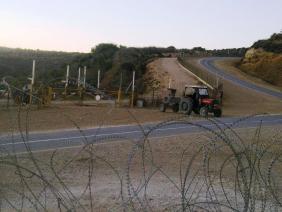 Translator: Charles K.
06:15 Tayba-Rummana checkpoint
On our way we passed the turn to the A’anin checkpoint, where those who already left A’anin for their lands in seam zone were gathered.
The Tayba-Rummana checkpoint gates are open. Border Police soldiers are there. One say they’re always there; if we’d seen soldiers, apparently the Border Police soldiers were called away to another mission.
Two tractors and three pedestrian go through. One of them says there will never be peace, because of Jerusalem. A Rummana resident says he has 15 dunums of olive trees in the seam zone; this is the first time he’s been granted an agricultural permit. He says residents of Rummana have a total of 200 dunums in the seam zone. Since they can’t take care of the groves on a continuing basis, cows enjoy the olives.
We enjoy a glorious sunrise.
06:30 The Border Police soldiers lock the checkpoint gates.
06:40 A’anin checkpoint
The checkpoint is still open. A man and wife are the last to go through. Children from the Bedouin village at the foot of the checkpoint on the seam zone side wait for their ride to school in Umm Reihan. Girls show us their textbooks for their Koran and English classes.
07:00 Shaked-Tura checkpoint
The checkpoint opens at 06:00 during the olive harvest, and by now the farmers have already gone through. Most now crossing are teachers and pupils. The sun that rose at the Tayba-Rummana checkpoint is blinding here.
An Umm Reihan resident says that he, his wife and children are registered as permanent residents of the seam zone, except for one son, aged 17, whose registered as a resident of A’anin. The reason might be that the son, like his other children, is a pupil at the school in A’anin. He says it’s better to go to school in A’anin, because the school there is connected to the electricity grid and they can use computers. The school in Umm Reihan, in the seam zone, is not connected to the electricity gird.
07:30 Reihan-Barta’a checkpoint
This time we observe the terminal entrance on the seam zone side. Those exiting say the terminal is full, and report that it takes people between 15 minute to an hour to go through.
In front of the vehicle checkpoint, on the seam zone side, seven loaded pickup truck wait for inspection. Passengers of a minibus get out to have their ID’s checked before continuing to the West Bank.
08:05 The charcoal manufactory is closed.
We visit the charcoal manufactory in the seam zone, opposite the southern entrance to East Barta’a. The manufactory is idle. We’re told that the army closed it because of complaints from the residents of Mitzpeh Ilan (a new locality, within the Green Line, on Route 611 leading from the Reihan-Barta’a checkpoint to Harish). He says the army closed all the charcoal manufactories in the Yabed (West Bank) area. While they may cause pollution, what right have we or the army to rob the exploited Palestinians of this livelihood as well?
'Anin checkpoint (214)
See all reports for this place-
'Anin checkpoint (214)
'Anin checkpoint is located on the Separation Fence east of the Israeli community Mei Ami and close to the village of Anin in the West Bank. It is opened twice a week, morning and afternoon, on days with shorter light time, for Anin farmers whose olive groves have been separated from the village by the fence it became difficult to cultivate their land. Transit permits are only issued to those who can produce ownership documents for their caged-in land, and sometimes only to the head of the family or his widow, eldest son, and children. Sometimes the inheritors lose their right to tend to the family’s land. The permits are eked out and are re-issued only with difficulty. 55-year-old persons may cross the checkpoint (into Israel) without special permits. During the olive harvest season (about one month around October) the checkpoint is open daily and more transit permits are issued. Names of persons eligible to cross are held in the soldiers’ computers. In July 2007, a sweeping instruction was issued, stating that whoever does not return to the village through this checkpoint in the afternoon will be stripped of his transit permit when he shows up there next time. Since 2019, the checkpoint has not been allways locked with the seam-line zone gate (1 of 3 gates), and the fence around it has been broken in several sites.
-
Barta’a-Reihan Checkpoint
See all reports for this place-
This checkpoint is located on the Separation Fence route, east of the Palestinian town of East Barta’a. The latter is the largest Palestinian community inside the seam-line zone (Barta’a Enclave) in the northern West Bank. Western Barta’a, inside Israel, is adjacent to it. The Checkpoint is open all week from 5 a.m. to 9 p.m. Since mid-May 2007, the checkpoint has been managed by a civilian security company subordinate to the Ministry of Defense. People permitted to cross through this checkpoint into and from the West Bank are residents of Palestinian communities inside the Barta’a Enclave as well as West Bank Palestinian residents holding transit permit. Jewish settlers from Hermesh and Mevo Dotan cross here without inspection. A large, modern terminal is active here with 8 windows for document inspection and biometric tests (eyes and fingerprints). Usually only one or two of the 8 windows are in operation. Goods, up to medium commercial size, may pass here from the West Bank into the Barta’a Enclave. A permanent registered group of drives who have been approved by the may pass with farm produce. When the administration of the checkpoint was turned over to a civilian security firm, the Ya’abad-Mevo Dotan Junction became a permanent checkpoint. . It is manned by soldiers who sit in the watchtower and come down at random to inspect vehicles and passengers (February 2020).
-
Tayba-Rummana
See all reports for this place-
Tayba-Rummana is an agricultural checkpoint. It is located in the separation fence in front of the eastern slopes of the Israeli city of Umm al-Fahm. The Palestinian villages next to the checkpoint are Khirbet Tayba and Rummana. Dozens of dunams of olive groves were removed from their owners, the residents of these villages on the western side of the separation fence. The Palestinian villages next to the checkpoint are Khirbet Tayba and Rumna. Dozens of olives dunams were removed from these villages' residents and swallowed up in a narrow strip of space, on the western side of the separation fence. The checkpoint allows the plantation owners who have permits to pass. Twice a week, the checkpoint opens for fifteen minutes in the morning and evening. During the harvest season, it opens every day for fifteen minutes in the morning (around 0630) and fifteen minutes in the afternoon (around 1530). (February 2020).
-
Tura-Shaked
See all reports for this place-
Tura-Shaked
This is a fabric of life* checkpoint through which pedestrians, cabs and private cars (since 2008) pass to and from the West Bank and the Seam-line Zone to and from the industrical zone near the settler-colony Shaked, schools and kindergartens, and Jenin university campuses. The checkpoint is located between Tura village inside the West Bank and the village of Dahar Al Malah inside the enclave of the Seam-line Zone. It is opened twice a day, between 7 a.m. and 10 a.m., and from 12 noon to 7 p.m. People crossing it (at times even kindergarten children) are inspected in a bungalow with a magnometer. Names of those allowed to cross it appear in a list held by the soldiers. Usually traffic here is scant.
- fabric of life roads and checkpoints, as defined by the Terminals Authority in the Ministry of Defense (fabric of life is a laundered name that does not actually describe any kind of humanitarian purpose) are intended for Palestinians only. These roads and checkpoints have been built on lands appropriated from their Palestinian owners, including tunnels, bypass roads, and tracks passing under bridges. Thus traffic can flow between the West Bank and its separated parts that are not in any kind of territorial contiguity with it. Mostly there are no permanent checkpoint on these roads but rather ‘flying’ checkpoints, check-posts or surprise barriers. At Toura, a small (less than one dunam) and sleepy checkpoint has been established, which has filled up with the years with nearly .every means of supervision and surveillance that the Israeli military occupation has produced. (February 2020)
 Mar-21-2022Anin Checkpoint: A magnificent breach in the center of the checkpoint
-
