
Ar-Ram, Qalandiya, יום ד’ 12.11.08, אחה”צ
Qalandiya checkpoint. For Marta, this was her first encounter
with a checkpoint. We decided to begin with a quote from her words at the end
of the shift
"Even though I am accustomed to difficult sights, I am a nurse
in an operating room I am in shock. The amounts of iron. Everything is so
fixed. Organized to perfection. Prepared well. It appears as if this place is
prepared for another 2000 years I looked at the people in their cages, on their
faces. I saw the expression of terrible humiliation and dehumanization; a
feeling of loss of hope — desperation. They don't care about what is
photographed or what is written. Afterall, we are not able to help them. The
lighting on the walls gives me the feeling of one big prison. I sensed
tremendous hidden violence. The woman soldier in the hut (near the cages) is
the age of my daughter. She was sitting and cracking sunflower seeds. Near her,
there was a big bottle of Cola, and she was signalling with her hand. From time
to time, she pressed a button. People passed. She closed the turnstile in
their faces and returns. The soldier looks at me and cannot understand why I am
looking at her.
And another thing. In my opinion, The position of the soldiers
in relation to the people is not professional"
We did not understand Marta, and she explained. "This is a
place that is supposed to give service to the population. The appearance, the
body language, the tone of speaking, the way the people are approached, the
manners, all should be appropriate. (Marta comes from Europe). The behavior of
the soldiers was very arrogant and there is a feeling that law does not apply in
this place".
16:20 Ar Ram. There were 21 vehicles in the line to Jerusalem.
The passage in the wall by which we used to travel to Qalandiya is closed and
the wall is complete. We passed via an iron gate that was open. A football
field was upscaled into a stadium with two original exits.
16:40 Qalandiya fromo the north.
In the closed areas of the plaza there were few people and only
lane 4 was open. In the area infront of it, there was a thick line. One
Palestinian said, we are like cattle. This is humiliating. We also
looked inside the cage in embarrassment.
16:50 The line in the left cage poured into the hut and there
was still just lane 4 operating.
17:07 The square for vehicles. Two lanes were open in the
direction of Jerusalem. There were 25 cars in the line. The waiting time was
at least 15 minutes. Throughout our entire shift, the traffic was heavy in all
directions.
A doctor from Ramallah who works in Jerusalem said to us: Change
the regulations. Medical crews must also go to Qalandiya. It takes me an hour
and a half to cross every morning. Request to ease up on the passage for people
with permits and who fulfill special functions. A demonstration is being
scheduled in the coming days and we were requested to come.
We saw today that it is possible to open just one lane in the
afternoon, and the world is not destroyed.
A-Ram
See all reports for this place-
two kilometers south of Qalandiya and 300 metres north of Neve Yaacov Junction, in Dahiyat el-Barid Quarter. Checkpoint has operated since 1991, in a Palestinian area annexed to Jerusalem in 1967. The checkpoint has been inactive since the middle of 2009.
The wall was built on the road that led to Jerusalem. Since then the situation in the town has deteriorated. Houses are abandoned and half finished, most of the businesses have closed. Severe neglect around the fence and on the streets. Those who could left. Updated January 2024
-
Qalandiya Checkpoint / Atarot Pass (Jerusalem)
See all reports for this place-
Click here to watch a video from Qalandiya checkpoint up to mid 2019 Three kilometers south of Ramallah, in the heart of Palestinian population. Integrates into "Jerusalem Envelope" as part of Wall that separates between northern suburbs that were annexed to Jerusalem in 1967: Kafr Aqab, Semiramis and Qalandiya, and the villages of Ar-Ram and Bir Nabala, also north of Jerusalem, and the city itself. Some residents of Kafr Aqab, Semiramis and Qalandiya have Jerusalem ID cards. A terminal operated by Israel Police has functioned since early 2006. As of August 2006, northbound pedestrians are not checked. Southbound Palestinians must carry Jerusalem IDs; holders of Palestinian Authority IDs cannot pass without special permits. Vehicular traffic from Ramallah to other West Bank areas runs to the north of Qalandiya. In February 2019, the new facility of the checkpoint was inaugurated aiming to make it like a "border crossing". The bars and barbed wire fences were replaced with walls of perforated metal panels. The check is now performed at multiple stations for face recognition and the transfer of an e-card. The rate of passage has improved and its density has generally decreased, but lack of manpower and malfunctions cause periods of stress. The development and paving of the roads has not yet been completed, the traffic of cars and pedestrians is dangerous, and t the entire vicinity of the checkpoint is filthy. In 2020 a huge pedestrian bridge was built over the vehicle crossing with severe mobility restrictions (steep stairs, long and winding route). The pedestrian access from public transport to the checkpoint from the north (Ramallah direction) is unclear, and there have been cases of people, especially people with disabilities, who accidentally reached the vehicle crossing and were shot by the soldiers at the checkpoint. In the summer of 2021, work began on a new, sunken entrance road from Qalandiya that will lead directly to Road 443 towards Jerusalem and Tel Aviv. At the same time, the runways of the old Atarot airport were demolished and infrastructure was prepared for a large bus terminal. (updated October 2021)
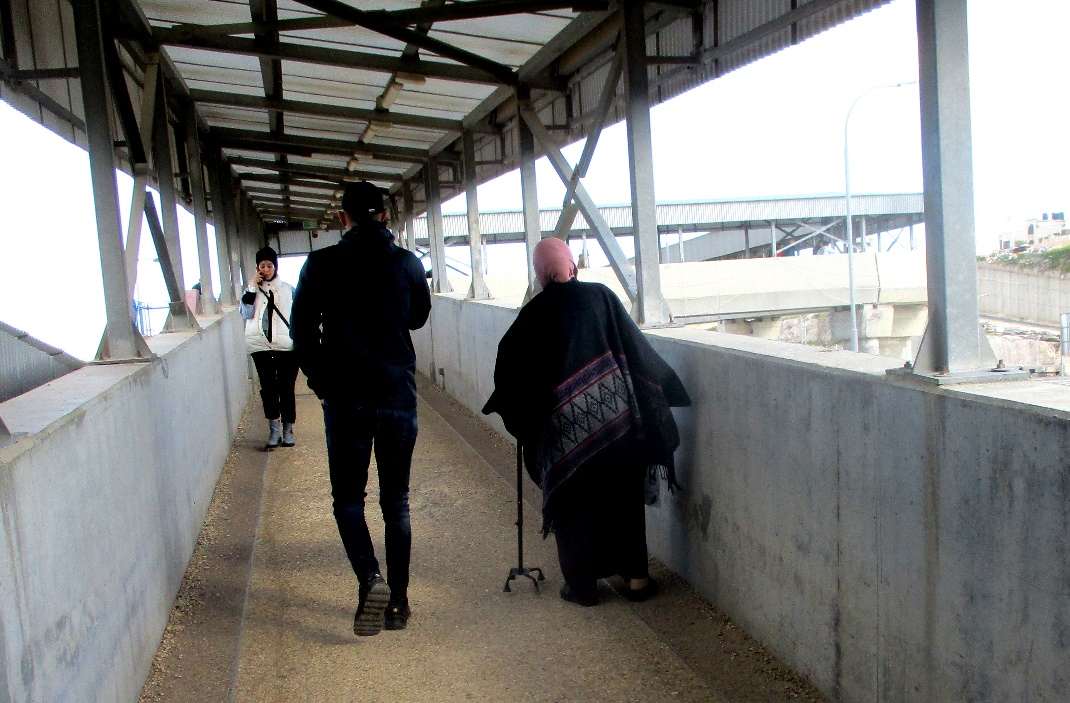 Tamar FleishmanJun-28-2026Qalandiya. The bridge leading from Jerusalem to the Qalandiya checkpoint
-