Ar-Ram, Qalandiya
I’ve already written about Ahmad from the Qalandiya refugee camp who was arrested a few years ago, accused of rock-throwing in the camp during Fatah Day demonstrations, and who I photographed eating a sandwich while being led away by the soldiers, and I came to the Ofer court to give his attorney the photos proving Ahmad was innocent, and then, perhaps because they knew I’d taken photographs, they changed the accusation to having thrown a Molotov cocktail a few months prior to his arrest, and claimed an officer had identified him by his shirt on which “Fox” was printed.
His attorney agreed to a plea bargain and Ahmad spent 16 months in prison.
So why am I again writing about him?
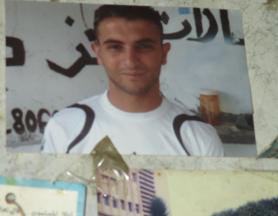
Because three days ago he was arrested again and he’s back at Ofer.
I wasn’t able to photograph Ahmad. Ahmad’s not here, he’s at Ofer.
He, who’d been a youth, is now a man. Last month he married, and in addition to his wife he supports his widowed mother; his father was murdered during the first intifada: “Soldiers shot him as he walked on the street, here in the camp.”
So I photographed the photograph I took of Ahmad after he was released from Ofer, which is posted on a panel on the wall of his place of work when he’s not at Ofer.
——
A number of patients were also at Qalandiya, who’d been released in the morning from hospitals on the West Bank and arrived at the checkpoint and entered the DCL offices to obtain permits to return home to Gaza, and after all had exited with the permits and continued on their way two, Maryam and Ahmad, remained without permits and without ID cards.
“Come back later,” they were told.
“I’ve been waiting here since this morning, I’m sick, I haven’t any strength left, I want to go home,” Maryam said, in tears.
And Ahmad? Ahmad was frightened. Afraid to return to the office and afraid not to return to the office. Ahmad was afraid lest… afraid to say what he was afraid of.
And when the DCL loudspeaker called Maryam’s name she wiped her tears, straightened her headscarf, stood erect and entered. She emerged a few minutes later with a smile on her face and a paper in her hand with which, with it alone, she’s allowed to return home, to Gaza.

And Ahmad? They called him also. He entered hesitantly and emerged without a smile on his face or a permit in his hand: “They said they’d contact me, maybe tomorrow, maybe another day.”
—–
A long column of armored vehicles brought an entourage of “Very Important People.”
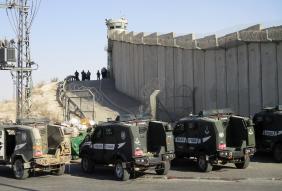
They parked in a line blocking the road, soldiers were stationed as human shields, and the people, some in uniform, some not, climbed to the top of hill beside the wall where they brainstormed. They were too far away for me to hear what they said, but I could see them waving their arms toward Palestinian territory.
The army’s way of dealing with the anger and fervor of the youth from A-Ram who throw stones at the main road and at military vehicles is with collective punishment: The entrance to A-Ram is blocked by concrete barriers,
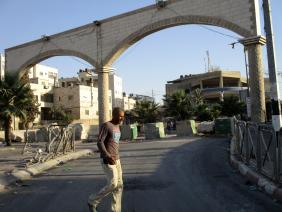
Soldiers stood in position opposite the blocked entry gate, armed and watchful.
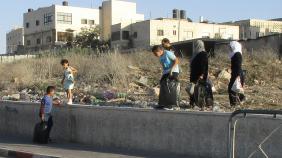
And A-Ram residents, who weren’t considered when the entrance was blocked, or perhaps someone had thought of them, must trudge through a barren field covered with rocks and thorns to reach the main road and avoid the stones and bullets.
A-Ram
See all reports for this place-
two kilometers south of Qalandiya and 300 metres north of Neve Yaacov Junction, in Dahiyat el-Barid Quarter. Checkpoint has operated since 1991, in a Palestinian area annexed to Jerusalem in 1967. The checkpoint has been inactive since the middle of 2009.
The wall was built on the road that led to Jerusalem. Since then the situation in the town has deteriorated. Houses are abandoned and half finished, most of the businesses have closed. Severe neglect around the fence and on the streets. Those who could left. Updated January 2024
-
Qalandiya Checkpoint / Atarot Pass (Jerusalem)
See all reports for this place-
Click here to watch a video from Qalandiya checkpoint up to mid 2019 Three kilometers south of Ramallah, in the heart of Palestinian population. Integrates into "Jerusalem Envelope" as part of Wall that separates between northern suburbs that were annexed to Jerusalem in 1967: Kafr Aqab, Semiramis and Qalandiya, and the villages of Ar-Ram and Bir Nabala, also north of Jerusalem, and the city itself. Some residents of Kafr Aqab, Semiramis and Qalandiya have Jerusalem ID cards. A terminal operated by Israel Police has functioned since early 2006. As of August 2006, northbound pedestrians are not checked. Southbound Palestinians must carry Jerusalem IDs; holders of Palestinian Authority IDs cannot pass without special permits. Vehicular traffic from Ramallah to other West Bank areas runs to the north of Qalandiya. In February 2019, the new facility of the checkpoint was inaugurated aiming to make it like a "border crossing". The bars and barbed wire fences were replaced with walls of perforated metal panels. The check is now performed at multiple stations for face recognition and the transfer of an e-card. The rate of passage has improved and its density has generally decreased, but lack of manpower and malfunctions cause periods of stress. The development and paving of the roads has not yet been completed, the traffic of cars and pedestrians is dangerous, and t the entire vicinity of the checkpoint is filthy. In 2020 a huge pedestrian bridge was built over the vehicle crossing with severe mobility restrictions (steep stairs, long and winding route). The pedestrian access from public transport to the checkpoint from the north (Ramallah direction) is unclear, and there have been cases of people, especially people with disabilities, who accidentally reached the vehicle crossing and were shot by the soldiers at the checkpoint. In the summer of 2021, work began on a new, sunken entrance road from Qalandiya that will lead directly to Road 443 towards Jerusalem and Tel Aviv. At the same time, the runways of the old Atarot airport were demolished and infrastructure was prepared for a large bus terminal. (updated October 2021)
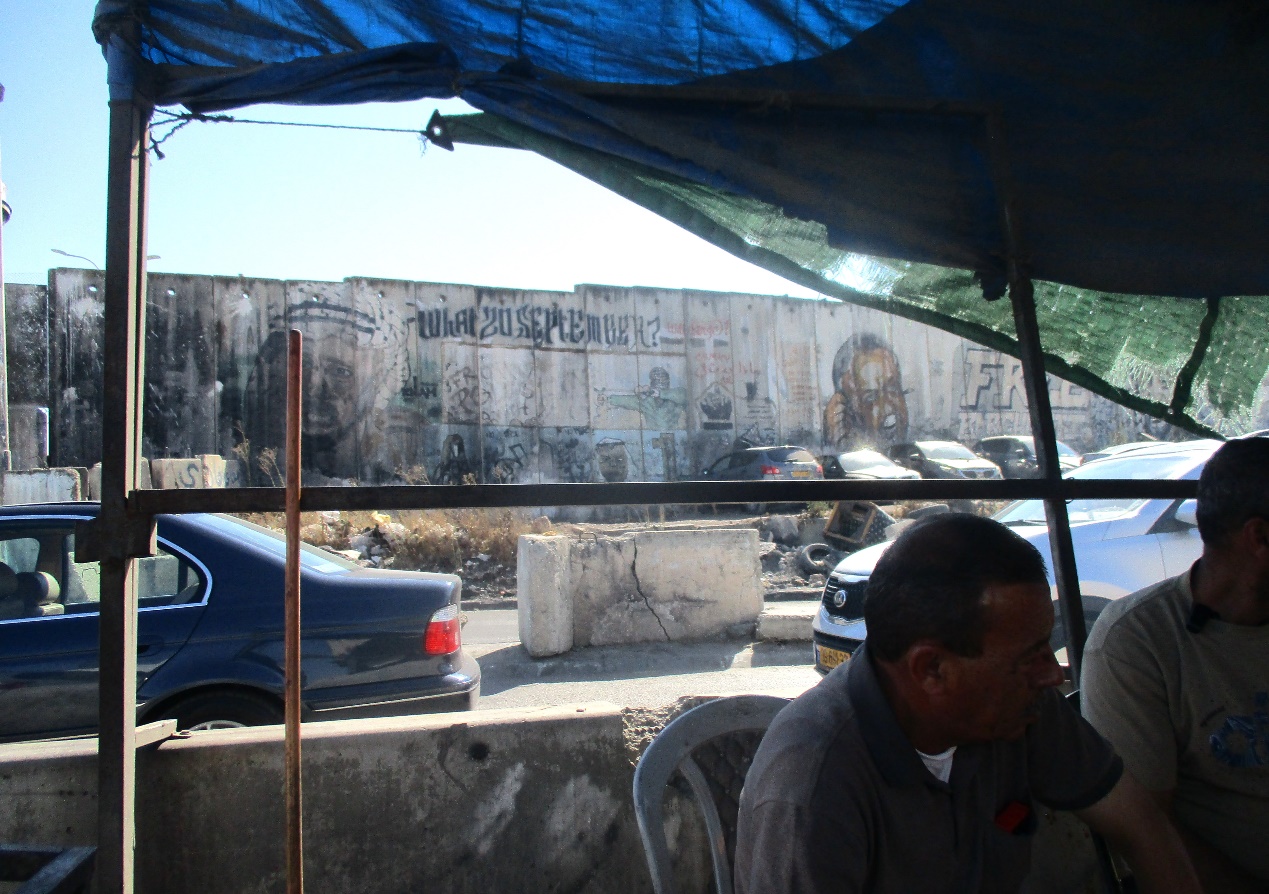 Tamar FleishmanJul-21-2026Qalandiya. Conversation in the shadow of the wall
-