
Ar-Ram, Qalandiya
Qalandiya and A-Ram
On the winding road leading to the soldiers’ posts stood a woman, her head dropped and her body leaning on the separating railing.
“Are you ill?” I asked and felt stupid, because her tearful eyes, the trembling body, yellowish complexion and broken sobs left no room for doubt.
“Cancer”, the woman said, and tapped her chest. “To hospital”.
We crossed arms and proceeded slowly, step by step.
At the sight of her face people in line hurried to make way, and a toddler who was pushed aside with his mother looked at the woman and began to cry.
Inside the inspection post, opposite the soldier, we had to release our arms in order to hold our IDs.
The woman took out a green ID and a doctor’s referral and a hospital document and a transit permit, and held them to the glass window with both hands. I held my own blue ID above her green one. The woman’s body still trembled, her head bent forward and her face – like her papers – was on the glass pane.
The soldier’s eyes moved from the documents to the computer screen and back to us and then to the screen again and then to the two IDs, her green and my blue. Then he looked at me, not at her, and said: “You can get through. She can’t.”
For once I, who never lack words, could only utter “What…” “You can get through. She’ can’t.” Did he think I didn’t hear him the first time? And he explained to me, not to her: “She’s blacklisted”.
Then I lost it.
I don’t know what I said. I only know I said a lot, and that we wouldn’t budge. There was nowhere to go.
And then,
I have no idea why and how and how soon this quasi-miracle happened. I only know that the soldier then said in a soft voice, as though his voice knows that we are one: “Okay, go on”. Again we held each other and began to walk like one body, slowly, step after step. After one or two steps I left her for a second, returned to the window, to the soldier, and apologized. Even though I didn’t know what I was apologizing for, I knew it was the right thing to do.
We still had a ways to go until the exit from the checkpoint compound, to the other side. A short-long way at the end of which, right there on the curb, she collapsed in a quiet sob, her head between her hands.
I called for help and the bus drivers at the gathering station took charge of the woman for the rest of the way.
I accompanied her with my gaze until she was seated next to the driver and I saw the thin hand raised in greeting and gradually disappearing.
***
Near the entrance to the vehicle checkpoint, during a coffee break, three pairs of legs rushed us over to catch Nicolas, a tourist from Argentina, who confidently stroke in behind the moving cars.
We grabbed him in the last meter before crossing the line of no return, the entrance to the killing ground – and pulled him back.
The fact that anyone crossing the no-return-line can be killed is one of those facts that “everyone knows”.
There, on the spot, no sign warns anyone. There are only armed men and rifles and from time to time – dead bodies.
A-Ram situation after the attack opposite police headquarters:
The air is full of teargas, the town smothered in smoke.
Bright smoke from the teargas grenades fired in by the army and dark smoke from burning tires rolled out by boys.
The youngsters of A-Ram broke out of the alleys, some of them with their faces covered, others bare, taking advantage of a few seconds between shootings to hurl stones at the soldiers who situated themselves on the hill and behind it.
“The shaheed” – so the Palestinians, “the terrorist” – so the Israelis – lives here, in A-Ram.
A-Ram
See all reports for this place-
two kilometers south of Qalandiya and 300 metres north of Neve Yaacov Junction, in Dahiyat el-Barid Quarter. Checkpoint has operated since 1991, in a Palestinian area annexed to Jerusalem in 1967. The checkpoint has been inactive since the middle of 2009.
The wall was built on the road that led to Jerusalem. Since then the situation in the town has deteriorated. Houses are abandoned and half finished, most of the businesses have closed. Severe neglect around the fence and on the streets. Those who could left. Updated January 2024
-
Qalandiya Checkpoint / Atarot Pass (Jerusalem)
See all reports for this place-
Click here to watch a video from Qalandiya checkpoint up to mid 2019 Three kilometers south of Ramallah, in the heart of Palestinian population. Integrates into "Jerusalem Envelope" as part of Wall that separates between northern suburbs that were annexed to Jerusalem in 1967: Kafr Aqab, Semiramis and Qalandiya, and the villages of Ar-Ram and Bir Nabala, also north of Jerusalem, and the city itself. Some residents of Kafr Aqab, Semiramis and Qalandiya have Jerusalem ID cards. A terminal operated by Israel Police has functioned since early 2006. As of August 2006, northbound pedestrians are not checked. Southbound Palestinians must carry Jerusalem IDs; holders of Palestinian Authority IDs cannot pass without special permits. Vehicular traffic from Ramallah to other West Bank areas runs to the north of Qalandiya. In February 2019, the new facility of the checkpoint was inaugurated aiming to make it like a "border crossing". The bars and barbed wire fences were replaced with walls of perforated metal panels. The check is now performed at multiple stations for face recognition and the transfer of an e-card. The rate of passage has improved and its density has generally decreased, but lack of manpower and malfunctions cause periods of stress. The development and paving of the roads has not yet been completed, the traffic of cars and pedestrians is dangerous, and t the entire vicinity of the checkpoint is filthy. In 2020 a huge pedestrian bridge was built over the vehicle crossing with severe mobility restrictions (steep stairs, long and winding route). The pedestrian access from public transport to the checkpoint from the north (Ramallah direction) is unclear, and there have been cases of people, especially people with disabilities, who accidentally reached the vehicle crossing and were shot by the soldiers at the checkpoint. In the summer of 2021, work began on a new, sunken entrance road from Qalandiya that will lead directly to Road 443 towards Jerusalem and Tel Aviv. At the same time, the runways of the old Atarot airport were demolished and infrastructure was prepared for a large bus terminal. (updated October 2021)
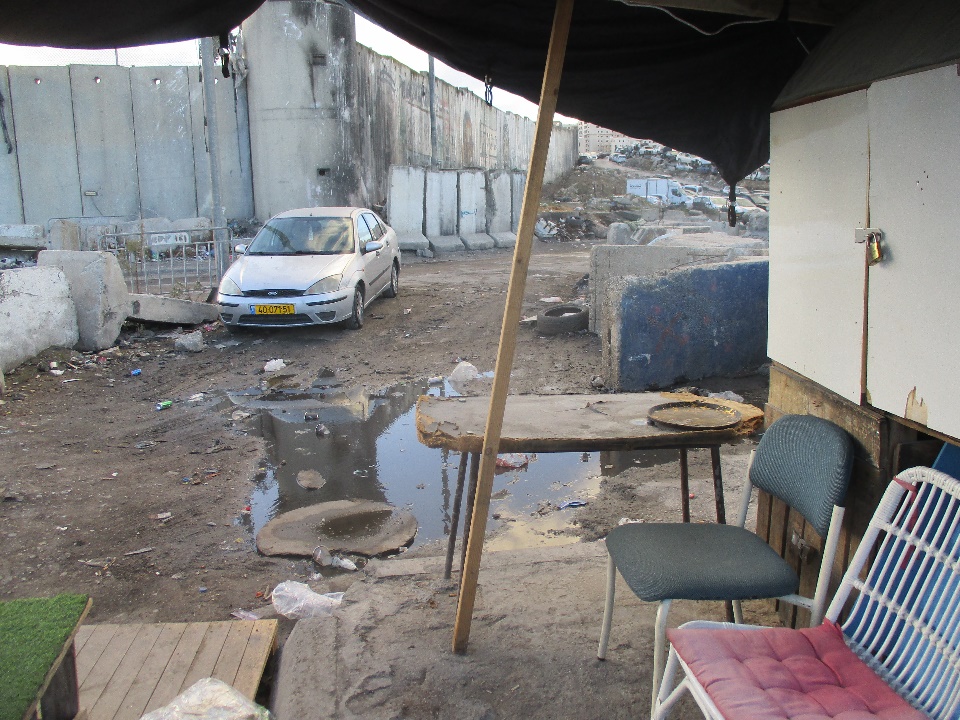 Tamar FleishmanNov-30-2025Qalandiya: Puddles and dirt after the rain
-