
Ar-Ram, Qalandiya, Mon 11.2.08, Afternoon
From 2:00 till 4:30 PM
A-Ram CP, Shuafat Refugee Camp, Anata, Qalandia
A short and frustrating shift.
After former reports from the A-Ram CP and the changes, which had occurred in its vicinity, We drove there. We met with an employee of a car dealer,located exactly opposite the CP and asked him for information. The man told us in excellent Hebrew that the road leading from a number of houses on a hill across from the CP to the road to Jerusalem was blocked off a few days ago with barbed wire coils. Until then people living there had been able to reach Jerusalem without any inspection and afterwards they had to get out via a narrow side-alley and pass the CP. The inhabitants of those buildings approached a lawyer whereupon the barbed wire was moved away. According to him there had been no problems for children to get to their schools. Two
boys who spoke English rather well affirmed his words. They had never been prevented from getting to school and their parents too have permission to cross before and after school. We went to the CP and the commander replied politely to all our questions. He told us that the CP would be abolished
within about three months when all openings in the northern part of the wall have been closed. In addition he told us that only the inhabitants of Dehiya-El-Bireh in possession of blue Id's are allowed to pass. Whoever else wanting to enter Jerusalem has to use the official CP's. All traffic passed uninterrupted while we were there.
We decided to drive to the entrance of the Shuafat camp. We parked on the sidewalk next to the power station where we had parked in the past. As we got out of the car a soldier called through a megaphone from the CP: "Move the car and go away". We didn't remain in enquire, but drove into Anata. The students had already left and there were no pedestrians in the cage. Many cars managed to wind their way over the potholes.
We drove to Qalandia and parked in one of the "parking lots" across from the entrance to the CP wanting to get into the CP and look. To our surprise we saw a new large sign at the entrance stating that this area falls under the Palestinian Authority and entry is strictly forbidden to Israelis. We tried to find out more and one of the civilian security guards amazed at our presence didn't know how long the sign had been up. Since we obey the law and had already been sent away from another CP, we left feeling frustrated.
A-Ram
See all reports for this place-
two kilometers south of Qalandiya and 300 metres north of Neve Yaacov Junction, in Dahiyat el-Barid Quarter. Checkpoint has operated since 1991, in a Palestinian area annexed to Jerusalem in 1967. The checkpoint has been inactive since the middle of 2009.
The wall was built on the road that led to Jerusalem. Since then the situation in the town has deteriorated. Houses are abandoned and half finished, most of the businesses have closed. Severe neglect around the fence and on the streets. Those who could left. Updated January 2024
-
Qalandiya Checkpoint / Atarot Pass (Jerusalem)
See all reports for this place-
Click here to watch a video from Qalandiya checkpoint up to mid 2019 Three kilometers south of Ramallah, in the heart of Palestinian population. Integrates into "Jerusalem Envelope" as part of Wall that separates between northern suburbs that were annexed to Jerusalem in 1967: Kafr Aqab, Semiramis and Qalandiya, and the villages of Ar-Ram and Bir Nabala, also north of Jerusalem, and the city itself. Some residents of Kafr Aqab, Semiramis and Qalandiya have Jerusalem ID cards. A terminal operated by Israel Police has functioned since early 2006. As of August 2006, northbound pedestrians are not checked. Southbound Palestinians must carry Jerusalem IDs; holders of Palestinian Authority IDs cannot pass without special permits. Vehicular traffic from Ramallah to other West Bank areas runs to the north of Qalandiya. In February 2019, the new facility of the checkpoint was inaugurated aiming to make it like a "border crossing". The bars and barbed wire fences were replaced with walls of perforated metal panels. The check is now performed at multiple stations for face recognition and the transfer of an e-card. The rate of passage has improved and its density has generally decreased, but lack of manpower and malfunctions cause periods of stress. The development and paving of the roads has not yet been completed, the traffic of cars and pedestrians is dangerous, and t the entire vicinity of the checkpoint is filthy. In 2020 a huge pedestrian bridge was built over the vehicle crossing with severe mobility restrictions (steep stairs, long and winding route). The pedestrian access from public transport to the checkpoint from the north (Ramallah direction) is unclear, and there have been cases of people, especially people with disabilities, who accidentally reached the vehicle crossing and were shot by the soldiers at the checkpoint. In the summer of 2021, work began on a new, sunken entrance road from Qalandiya that will lead directly to Road 443 towards Jerusalem and Tel Aviv. At the same time, the runways of the old Atarot airport were demolished and infrastructure was prepared for a large bus terminal. (updated October 2021)
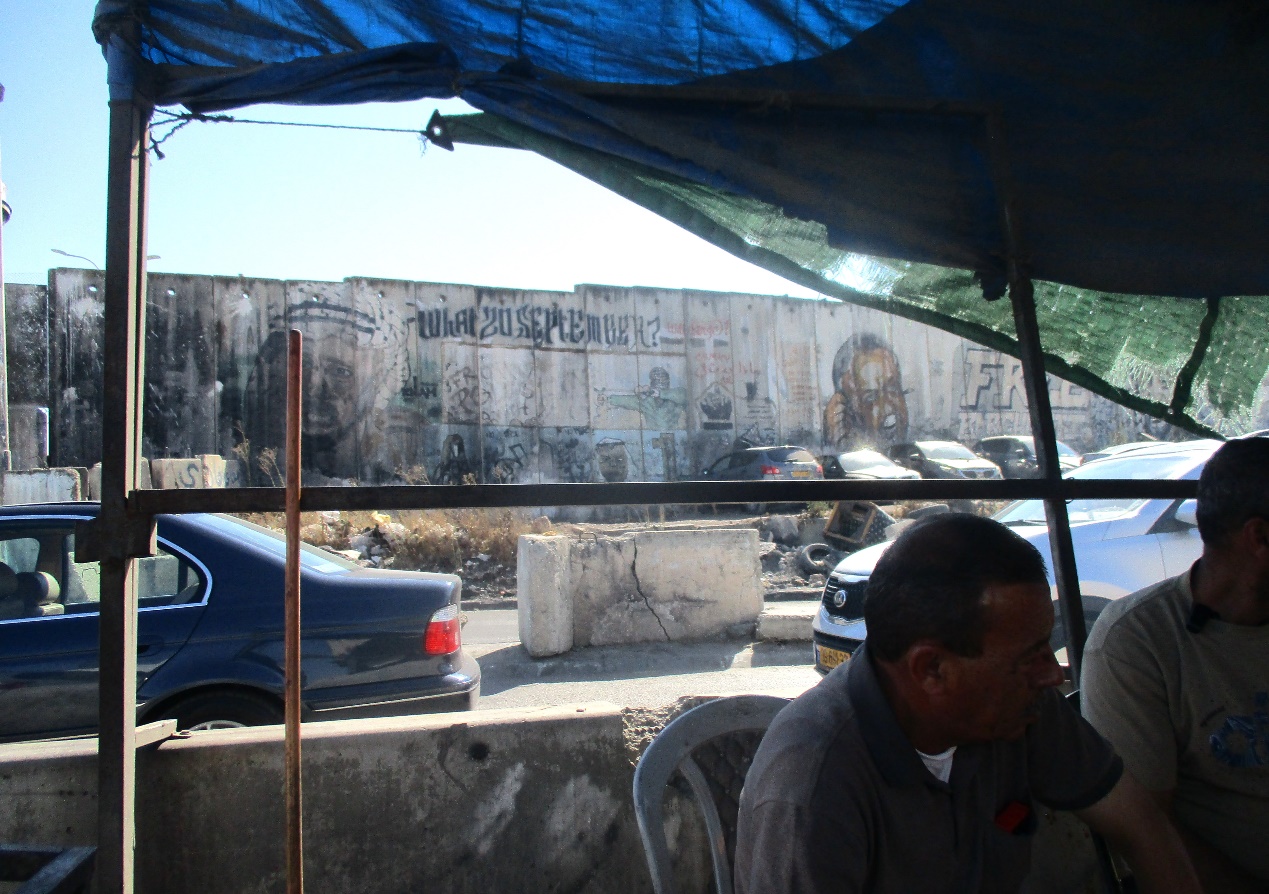 Tamar FleishmanJul-21-2026Qalandiya. Conversation in the shadow of the wall
-
