
Ar-Ram, Qalandiya, Wed 6.2.08, Morning
" When I woke up this morning, I saw that my home in the heart of Jerusalem, was surrounded by barbed wire".
A-Ram checkpoint was the first checkpoint covered by Machsom-Watch in Northern Jerusalem.
Its border to the south is with the settlement of Neve
Yaacov in Greater Jerusalem, to the west with annexed
Bet Hanina and Atarot, to
the north with Qalandya refugee camp and to the east
with Hizme and the settlements of Adam HaKafri. Neve Yaacov, a settlement with
mostly new immigrants from the 1990s, was built on A-Ram's land and today encroaches it from the south and from the east. A-Ram, with about 40,000 residents, is the
largest Palestinian city in North Jerusalem and
is the educational center for all the surrounding villages; it has
high-schools, inexistent in the smaller villages, and better schools than the
average village school.
In the past 2 years, a wall has been slowly built around A-Ram, which
leaves it with only one opening to the north, to Qalandya
checkpoint. It has become a very large enclave. A few residents with blue IDs
who live in the vicinity of A-Ram checkpoint, between the wall and the
checkpoint, are allowed to cross it to and from Jerusalem, but only if their name is
registered by the soldiers at the checkpoint and if they have an appropriate
number provided by the DCO. However, a
few buildings at the southern-most part of A-Ram neighborhood, those bordering
with Neve Yaacov, were
spared this fate because they are located beside the St. Anthony Coptic College
and the Rosary School,
powerful catholic church properties belonging to the Vatican. Although a written agreement was never signed
between the Vatican and Israel, it was agreed that these schools would remain
in Jerusalem, with direct access to and from Jerusalem, and no one,
particularly students and pupils, would have to cross checkpoints or deal with
soldiers on their way to and from school.
They have an access road to these buildings directly before the
checkpoint.
This also benefited the residents of the 5 buildings located at the
vicinity of the Vatican properties, who enjoyed the same treatment because they
were even closer to the Jerusalem
side.
But on the morning of the 5th.
of February, the residents of these buildings and the
Rosary nuns woke to a new reality: their homes had been cut off from the Jerusalem direct entrance
by barbed wire and, the next morning, they found that cement blocks had been
added to prevent vehicle crossing.
As if this would explain the change in policy, 'someone' told them that
the barbed wire was intended to give more security to the soldiers who guarded
a booth at the end of the road. When the
Palestinian residents attempted to find out how they would now reach work,
school, how they would go to relatives, go on with their daily life, they were
told: go to the DCO in Beit El, to Captain Shadi and get a number.
"All of a sudden, this is the language we hear… get a number, you
have a number, there is no number, you are on the list, your name is not
written, you are not on the list, you are
nobody". They tell us: "get
used to it, but how do you do that? How
can your children grow in these conditions?
I am a Jerusalemite, all my life I have lived in Jerusalem, I bought my
home in Jerusalem, pay city taxes, work in the city center, my children go to
school in Jerusalem, my wife also works in the city center, my parents live in
the Old City and my family lives in other East Jerusalem neighborhoods. Now no one will come to visit because they
have to come in through the A-Ram checkpoint, "if everything goes well and
the soldiers don’t decide there is one special circumstance that merits closing
the checkpoint, and to go back home they will have to travel north to Qalandya checkpoint and go through the humiliating checks
and then return south to get home."
In any case, there will be no visitors for the residents of these 5
buildings: they will not be able to get into the city of A-Ram in order to
reach Qalandya because it is surrounded by a wall and
all the openings are being sealed fast, and will not be able to cross A-Ram
checkpoint because they are not registered at the checkpoint as residents. So the A-Ram residents are destined to have
no visitors at all in their beautiful new homes.
We stand at the parking lot, next to the barbed wire: "Where will
our children play now? What kind of life
will this be? This is not conducive to a
healthy upbringing for a child. Who can
we turn to?" The soldiers see two
suspicious men talking near us. Two of
the soldiers approach the men. The
soldiers do not seem afraid at all, they do not have
their weapons at hand and walk at ease.
The suspicious bag contains tomatoes, onions and some potatoes. While the two male soldiers are checking the
vegetables, the female soldier remains alone by the barbed wire, also
smiling. Any claim of "fear for the
security of the soldiers" is not supported here by reality.
The residents show us mountains of garbage that the Jerusalem Municipality
doesn’t pick up, though they pay full taxes.
Surrounded by the garbage, the checkpoint, the barbed
wire and the cement blocks, the new campaign of the Jerusalem Municipality
that claims: "It is worthwhile to be Jerusalemite" (כדאי להיות ירושלמי) seems from here like a very bitter joke.
On our way back home we stop at the A-Ram checkpoint to observe the
slow movement of the long line of cars crossing southwards. The soldiers immediately approach and say:
"You have to stand 50 meters away from the checkpoint." We demand to
see a written order. There is none, yet.
A-Ram
See all reports for this place-
two kilometers south of Qalandiya and 300 metres north of Neve Yaacov Junction, in Dahiyat el-Barid Quarter. Checkpoint has operated since 1991, in a Palestinian area annexed to Jerusalem in 1967. The checkpoint has been inactive since the middle of 2009.
The wall was built on the road that led to Jerusalem. Since then the situation in the town has deteriorated. Houses are abandoned and half finished, most of the businesses have closed. Severe neglect around the fence and on the streets. Those who could left. Updated January 2024
-
Qalandiya Checkpoint / Atarot Pass (Jerusalem)
See all reports for this place-
Click here to watch a video from Qalandiya checkpoint up to mid 2019 Three kilometers south of Ramallah, in the heart of Palestinian population. Integrates into "Jerusalem Envelope" as part of Wall that separates between northern suburbs that were annexed to Jerusalem in 1967: Kafr Aqab, Semiramis and Qalandiya, and the villages of Ar-Ram and Bir Nabala, also north of Jerusalem, and the city itself. Some residents of Kafr Aqab, Semiramis and Qalandiya have Jerusalem ID cards. A terminal operated by Israel Police has functioned since early 2006. As of August 2006, northbound pedestrians are not checked. Southbound Palestinians must carry Jerusalem IDs; holders of Palestinian Authority IDs cannot pass without special permits. Vehicular traffic from Ramallah to other West Bank areas runs to the north of Qalandiya. In February 2019, the new facility of the checkpoint was inaugurated aiming to make it like a "border crossing". The bars and barbed wire fences were replaced with walls of perforated metal panels. The check is now performed at multiple stations for face recognition and the transfer of an e-card. The rate of passage has improved and its density has generally decreased, but lack of manpower and malfunctions cause periods of stress. The development and paving of the roads has not yet been completed, the traffic of cars and pedestrians is dangerous, and t the entire vicinity of the checkpoint is filthy. In 2020 a huge pedestrian bridge was built over the vehicle crossing with severe mobility restrictions (steep stairs, long and winding route). The pedestrian access from public transport to the checkpoint from the north (Ramallah direction) is unclear, and there have been cases of people, especially people with disabilities, who accidentally reached the vehicle crossing and were shot by the soldiers at the checkpoint. In the summer of 2021, work began on a new, sunken entrance road from Qalandiya that will lead directly to Road 443 towards Jerusalem and Tel Aviv. At the same time, the runways of the old Atarot airport were demolished and infrastructure was prepared for a large bus terminal. (updated October 2021)
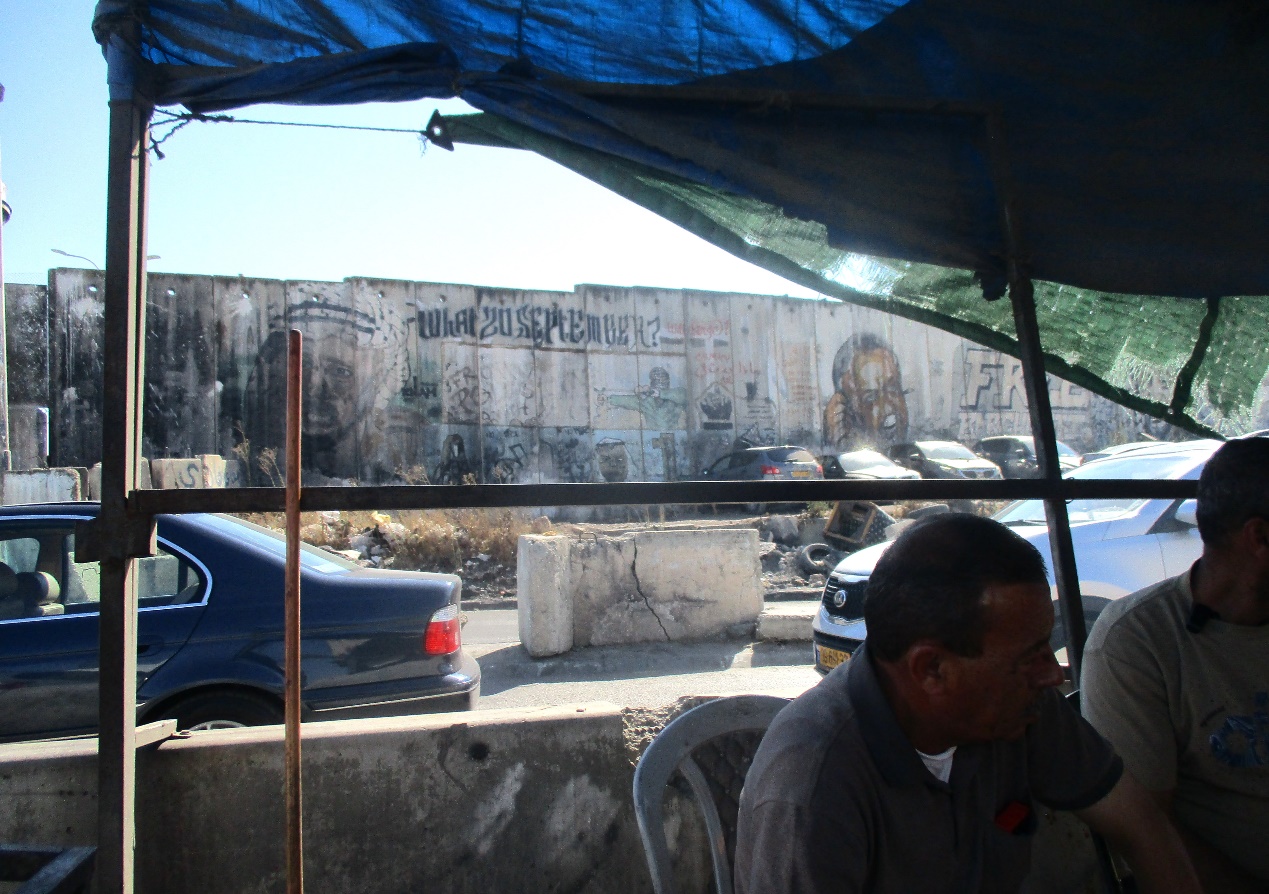 Tamar FleishmanJul-21-2026Qalandiya. Conversation in the shadow of the wall
-
