
Ariel checkpoing. Rosh Hashana eve
Palestinian lands trapped within the Ariel settlement.
Accompanying Kifl Harith farmers to their lands trapped within the Ariel settlement, invited by Engaged Dharma.
For a number of weeks Palestinians from Haris have been prevented from reaching their lands, access to which is through the Ariel settlement checkpoint.
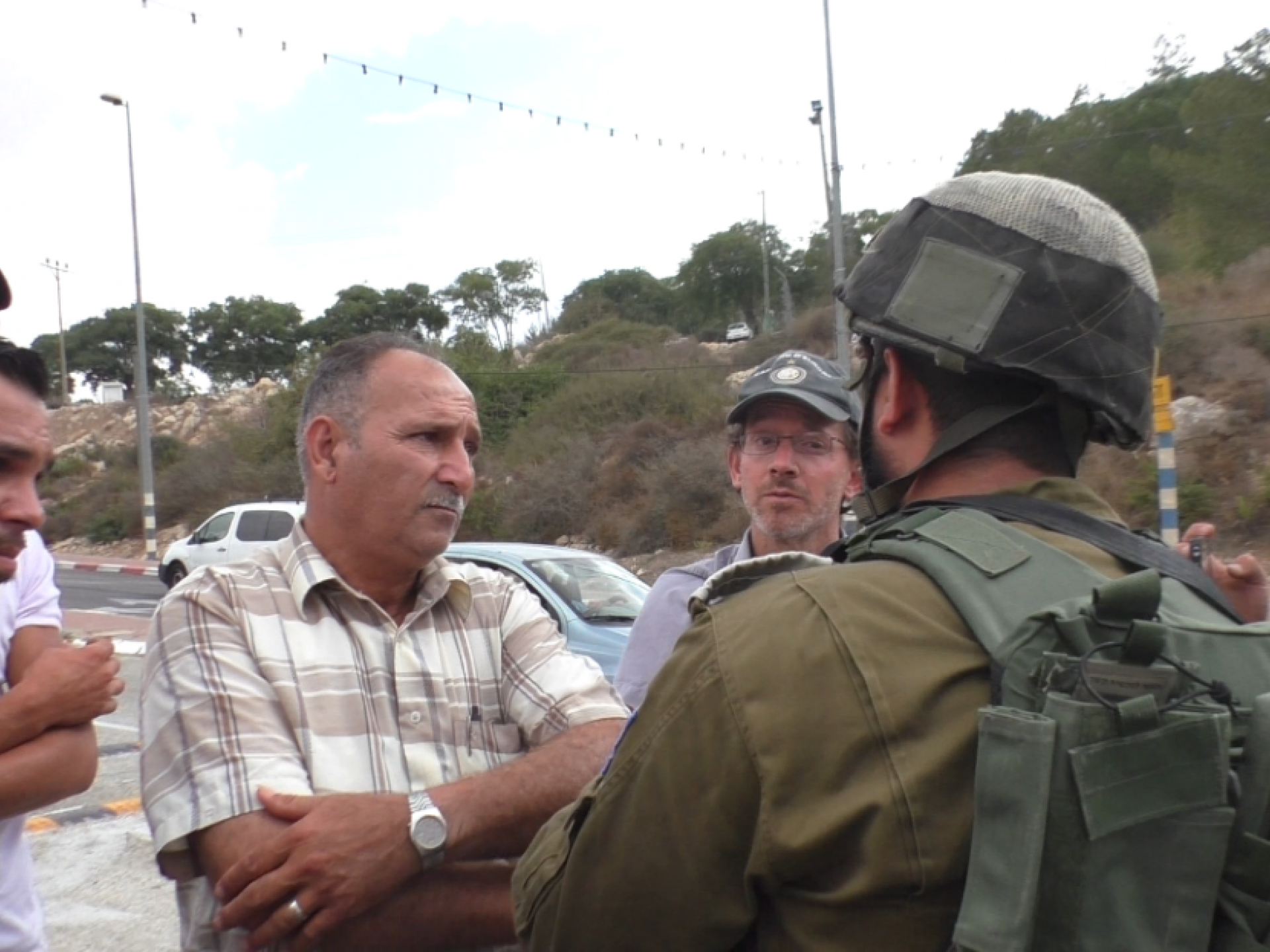
A discussion ensued between the uniformed personnel who physically blocked access with their bodies and the Palestinians and activists. For two hours we waited for an appropriate response to the farmers who owned the land. The officer notified us that, as Israelis, we’re able to go through the checkpoint and reach the lands. But the landowners are required, by a new order, for a permit which they have not yet been granted. Meanwhile, civilian vehicles went through the checkpoint and noticed the unusual gathering. Settlement youths arrived and mingled with us, taking advantage of the situation to draw attention to themselves, particularly from the cameras. Finally they were chased away, apparently by the army. While we waited, more and more soldiers and armed security personnel arrived. The presence of so many activists apparently had an effect and after about two hours a senior officer arrived and spoke with the farmers. Finally, after an exhausting discussion, it was agreed they could enter the area after the holidays but they’re required to present documents proving they own the land. When the officer was told that the security coordinator doesn’t allow them to enter, he replied: The security coordinator follows orders. We’ll follow-up to see whether the “orders” are followed.

Until three months ago, landowners from Hars and Kifl Harth had unlimited access to their lands adjoining the Ariel settlement, even though entry was through the settlement’s checkpoint. Colleagues who’d gone there reported that the lands were very well kept. After a new security coordinator was appointed farmers have been denied entry to the area.
Three weeks ago, Dharma Engaged undertook to join farmers heading for the cultivated land. As they approached the area a violent confrontation erupted during which Palestinians attempting to go through the checkpoint were injured. We learned of the incident from A., our friend in Hars, who’s very involved in community actions among the area’s villages. Last Sunday Dharma Engaged repeated its undertaking. We accepted A.’s invitation to join them. The plan was for a larger number of persons who were not Palestinians to accompany the farmers. The activists met next to Kifl Harth at 08:00, Rosh Hashana Eve, the last day of the year 5778. There were about 25 people from Dharma Engaaged, Combatants for Peace, internationals and Machsom Watch. This time the Civil Administration was notified in advance of the intention to reach the area. We drove until we approached the entrance to the settlement. The Palestinian family also arrived: the landowner, his sons and nephews whose father had died and who are his legal heirs. Soldiers and police awaited us. Military and police vehicles were parked next to the entrance to the fields.
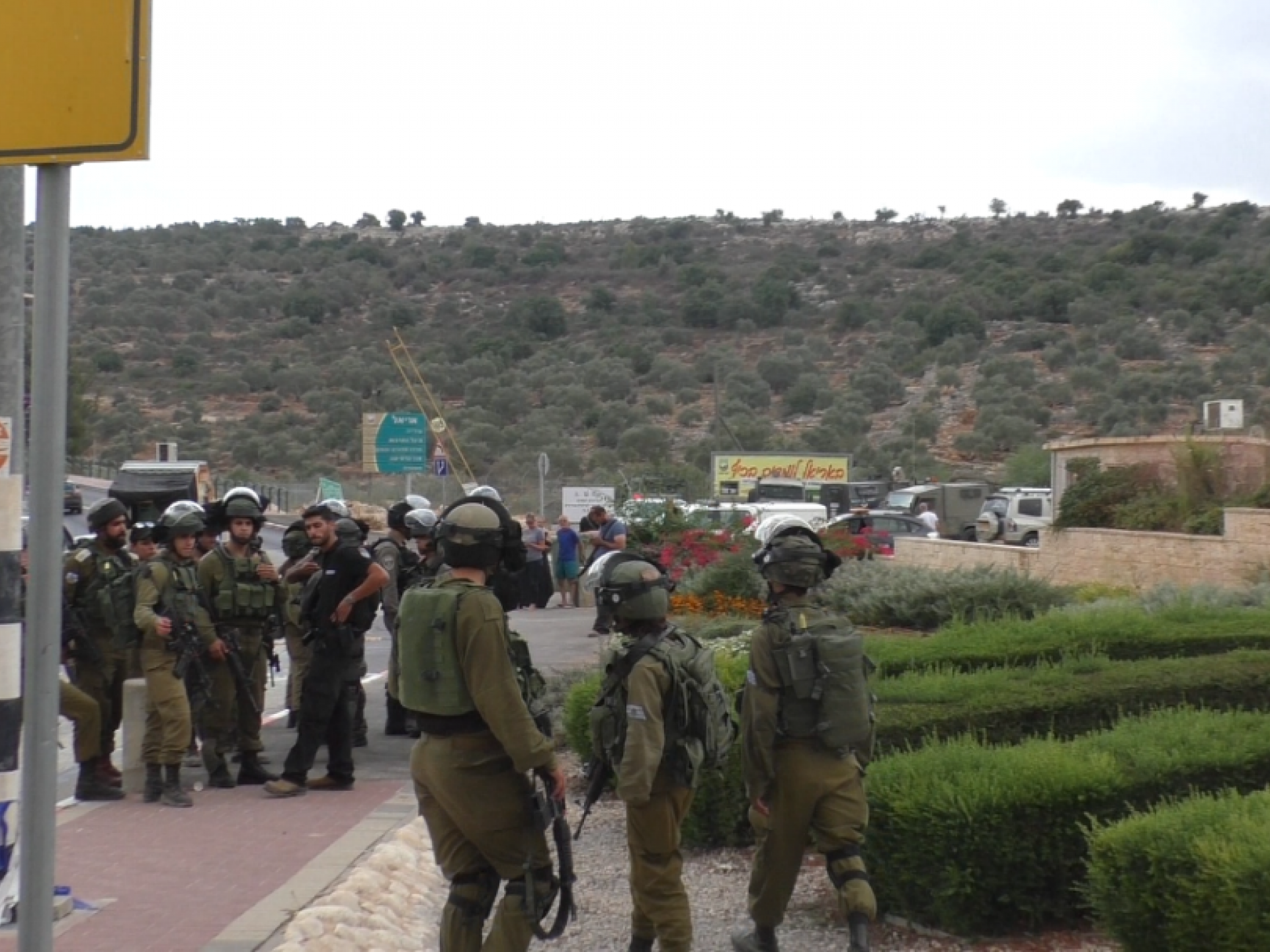
A discussion ensued between the uniformed personnel who physically blocked access with their bodies and the Palestinians and activists. For two hours we waited for an appropriate response to the farmers who owned the land. The officer notified us that, as Israelis, we’re able to go through the checkpoint and reach the lands. But the landowners are required, by a new order, for a permit which they have not yet been granted. Meanwhile, civilian vehicles went through the checkpoint and noticed the unusual gathering. Settlement youths arrived and mingled with us, taking advantage of the situation to draw attention to themselves, particularly from the cameras. Finally they were chased away, apparently by the army. While we waited, more and more soldiers and armed security personnel arrived. The presence of so many activists apparently had an effect and after about two hours a senior officer arrived and spoke with the farmers. Finally, after an exhausting discussion, it was agreed they could enter the area after the holidays but they’re required to present documents proving they own the land. When the officer was told that the security coordinator doesn’t allow them to enter, he replied: The security coordinator follows orders. We’ll follow-up to see whether the “orders” are followed.
Two maqams are located in Kifl Harth, sacred to all the monotheistic faiths and sites of mass pilgrimages under the army’s auspices. Our reports about them appear on the website.
Haris
See all reports for this place-
Haris
The village has 4,500 people and they have 5,000 dunams of land. The entrance to the village is blocked and opened arbitrarily, without informing the residents.The village has a seasonal checkpoint that blocks the road to the agricultural land and this checkpoint opens once a year! 2,500-3,000 dunams were stolen from the village in order to build the settlements of Revava and Netafim, which are located west of Haris.
The center of the village is Area B and around Area C. The population grows but the occupation does not permit new construction in Area C.
-
Kifl Harith
See all reports for this place-
Kifl Harith
This is a Palestinian located north-west of the settler-colony town of Ariel, 18 kilometers south of the city of Nablus. It numbers 3, 206 inhabitants, as of 2007. 42% of the village lands lie in Area B, and 58% in Area C. In 1978, some hundreds of dunams of the village’s farmland was sequestered in order to found the settler-colony of Ariel – in total 5,184 dunams from the Palestinian communities of Salfit, Iscaqa, Marda, and Kifl Harith. Dozens of square kilometers were also confiscated for paving road no. 5 as well as road 505 and their buffer zones, and the Israeli electricity company’s power station. Over the years the village has suffered harassment by sometimes-armed settler-colonists, even casualties. In 1968 the army’s rabbinate ruled the maqam site Nabi Yanoun (sanctified grave of the Prophet Yanoun) is in fact the tomb of Joshua, Son of Nun. Another structure in the village, named Nabi Tul Kifl by the Palestinians, has been identified by the Israeli authorities as to the tomb of Caleb, Son of Yefuneh. These sites are located in the heart of the village, near the mosque, and at times of Jewish religious festivities and pilgrimages, the center of the village is illuminated by projectors and thousands of Jews arrive, protected by hundreds of Israeli soldiers. During such a period, a night curfew is imposed on the village and the villagers are forced to stay shut inside their homes.
-
