
At Tarkumiya it is even worse than Qalandiya

A Red Crescent ambulance was already parked at the designated spot and waited for its Palestinian counterpart.
They waited for a woman cancer-patient arriving from Ramallah, to bring her to the Augusta Victoria Hospital in East Jerusalem, the paramedic told us. I’ve known him for years.
We used the wait to talk about procedures of ambulance crossing at different checkpoints.
The worst is Tarqumieh – even if I’m sent there, I try to find someone else to replace me and not go, said my conversant, and explained that it’s because there, at the Tarqumieh Checkpoint, there’s a special conveyor belt where stretchers are placed with dead bodies, for a metal-detector inspection. This is done to Gazans who did not survive their treatment in the Hebron hospital and are sent to be buried at home, in the Gaza Strip.
Since that conversation I’ve been thinking about the person accompanying the ill and quietly, resignedly mourns this humiliating sight.
At Tarqumiya it’s the worst, he repeated. Even worse than Qalandiya (this notorious checkpoint).
As his words were still echoing, the ambulance arrived from Ramallah bearing a woman connected to an oxygen tank.
She has cancer of the chest, said the medical team.
The woman was accompanied by her adolescent daughter and son.
All the permits are okay, the medical team said, but the security inspection turned out not okay – the daughter has the necessary permit, but the son who relied on the work permit he holds, was not issued a permit to accompany his ill mother. He could be caught at the hospital and arrested as an illegal alien, and things could even get sticky for those who inspected the papers here at Qalandiya, said one of the guards.
The back-to-back procedure was halted, the ill woman remained unmoving on the stretcher, her children remained seated next to her in the Ramallah ambulance, the Jerusalem medical team and myself huddled together and about the logic behind letting someone work in Jerusalem when he is not allowed to help his mom in her illness. Embarrassment, phone calls followed, until the armed guard ruffled his feathers and announced that he had solved the problem, the son too has the proper permit.
The woman and her children went on to the other ambulance and drove off to Augusta Victoria, and I remained with the burden of information about the Tarqumieh proceedings.
**
At the Qalandiya refugee camp front the air was filled with teargas fumes, seemingly unexplained, but within minutes the meaning arose with the appearance of five children armed with stones and empty glass bottles that were thrown at the vehicular checkpoint gates. The provocation of the children – who averaged no more than 13 years of age – resulted in two armed guards coming out of the checkpoint, and at their sight the young combatants dispersed among the bushes on the hill. The armed guards returned to their own compound, the children returned, came downhill, renewed their stone assortment and repeated their actions.
Qalandiya Checkpoint / Atarot Pass (Jerusalem)
See all reports for this place-
Click here to watch a video from Qalandiya checkpoint up to mid 2019 Three kilometers south of Ramallah, in the heart of Palestinian population. Integrates into "Jerusalem Envelope" as part of Wall that separates between northern suburbs that were annexed to Jerusalem in 1967: Kafr Aqab, Semiramis and Qalandiya, and the villages of Ar-Ram and Bir Nabala, also north of Jerusalem, and the city itself. Some residents of Kafr Aqab, Semiramis and Qalandiya have Jerusalem ID cards. A terminal operated by Israel Police has functioned since early 2006. As of August 2006, northbound pedestrians are not checked. Southbound Palestinians must carry Jerusalem IDs; holders of Palestinian Authority IDs cannot pass without special permits. Vehicular traffic from Ramallah to other West Bank areas runs to the north of Qalandiya. In February 2019, the new facility of the checkpoint was inaugurated aiming to make it like a "border crossing". The bars and barbed wire fences were replaced with walls of perforated metal panels. The check is now performed at multiple stations for face recognition and the transfer of an e-card. The rate of passage has improved and its density has generally decreased, but lack of manpower and malfunctions cause periods of stress. The development and paving of the roads has not yet been completed, the traffic of cars and pedestrians is dangerous, and t the entire vicinity of the checkpoint is filthy. In 2020 a huge pedestrian bridge was built over the vehicle crossing with severe mobility restrictions (steep stairs, long and winding route). The pedestrian access from public transport to the checkpoint from the north (Ramallah direction) is unclear, and there have been cases of people, especially people with disabilities, who accidentally reached the vehicle crossing and were shot by the soldiers at the checkpoint. In the summer of 2021, work began on a new, sunken entrance road from Qalandiya that will lead directly to Road 443 towards Jerusalem and Tel Aviv. At the same time, the runways of the old Atarot airport were demolished and infrastructure was prepared for a large bus terminal. (updated October 2021)
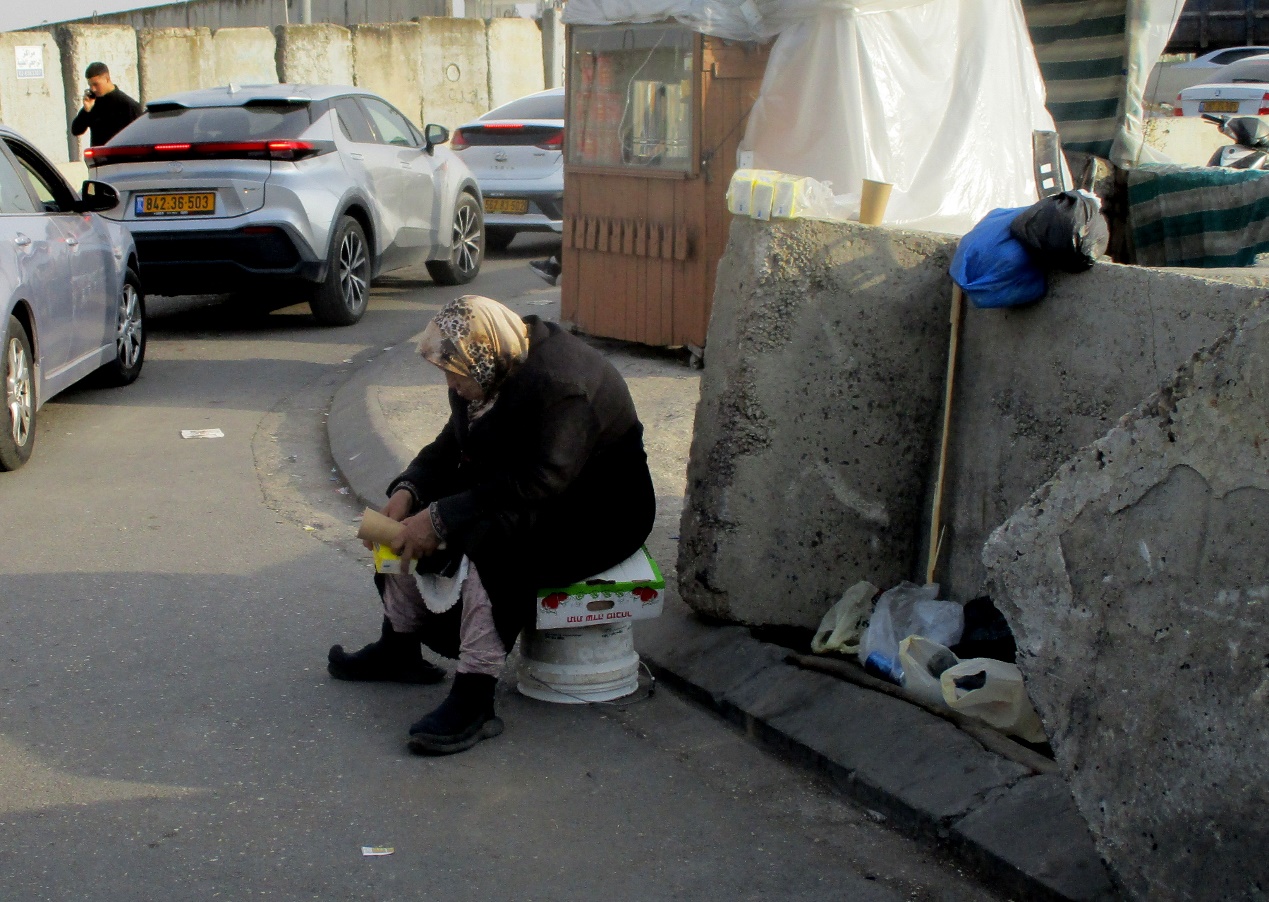 Tamar FleishmanOct-11-2026Qalandiya. Female Beggar
-
