
‘Atarot, Hizma, Qalandiya, Mon 18.1.10, Afternoon
15:20: Atarot: The line of cars was very small.
15:30: Qalandiya: From the northern parking lot we watched the new "improved" traffic barrier (that was built in conjunction with the new passageway installation) in action at the entrance to the CP. We saw that its components include a traffic light, a barrier arm that can be swung up and 4 or 5 large aluminum cylinders that emerge from (or sink back into) the roadway to block the entrance. The female soldier in the booth controlling the barrier (which has been moved to an area between the traffic lanes and surrounded by a fence), turned on the green light, raised the barrier arm and lowered the aluminum cylinders and a wave of vehicles rushed forward. The soldier, who couldn't control the flow, resorted to shouting into the PA system and finally halted the flow with vehicles standing on the cylinders and below the raised arm, neutralizing the system so that she couldn't operate it. The scene was pretty ridiculous.
15:35: Inside the pedestrian CP, two of the three cages in the northern shed and three internal passageways were full of people waiting. It was our impression that the lines were making only very slow progress. The weather was stormy and cold and some of our telephone numbers were not operating. The soldier who answered our phone call to the Humanitarian hotline told us that they were not going to respond to requests for help for the next three days. The headquarters phone was working only intermittently.
When we entered the CP we saw a couple waiting in Passageway 5, the entrance to the DCO offices. The man held a blue ID and his wife a Palestinian one. They said that they had been in the DCO to receive a permit for the woman. They had been given a promise that it would be issued and told to wait outside. They said that they had been at Qalandiya since 1 PM. As the DCO didn't answer the phone, we called headquarters and asked to be connected to the DCO representative. The DCO rep told the couple that the permit was being prepared and that they were to wait in the northern shed.
We got on line in passageway 4. To pass the time we phoned the DCO once again at 4:05 PM. This time a soldier answer the phone and we told her about the couple who were waiting. The soldier asked for and received the woman's ID number, checked and returned to say that the permit (for one week only) had been issued and transferred to the Palestinian DCO office in A-Ram, so that the couple had to go to A-Ram to receive it. But the A-Ram DCO was already closed at this time, and the weather was rapidly deteriorating. If we hadn't "accidentally" reached the DCO, the couple might still be waiting there in vain. We ran to give them the message.
Then we returned and got on line once again in the northern shed at 4:15 PM. After waiting in the shed and then in the internal passageway, we finally emerged on the Jerusalem side of the CP at 4:50 PM after a wait of 35 minutes. Our initial impression was confirmed – the passageways were operating very slowly.
16:50: When we got to the Jerusalem side we saw a truck parked in the bus station area. The driver told us that the soldiers were not letting him through because he had a pile of empty cartons in the truck. We phoned headquarters and they took details of the truck and promised to help. We wished the driver good luck and fled back inside the CP to get out of the rain.
17:15: We left Qalandiya to return to Jerusalem. When we drove past Lil/Jabba, we saw the soldier on duty aiming his weapon off into the darkness in a threatening manner. There were no vehicles at the CP and no pedestrians. What was he doing, playing? That's how tragedies occur.
There were no lines at Hizmeh either.
'Atarot
See all reports for this place-
Atarot
Atarot was a workers' settlement destroyed during the War of Independence, where the Arab village of Qalandiya now stands, in the southwestern part of Atarot Airport, built by the British Mandate. After 1967, the Atarot industrial zone was established nearby, and until the completion of the wall from the Qalandiya checkpoint to Road 443, a checkpoint was in place. A new Jewish neighborhood is currently planned for the old airport area.
-
Hizma
See all reports for this place-
Hizma
A checkpoint at the north-eastern entrance to the Jerusalem area which was annexed in 1967, at Pisgat Zeev. The passage is allowed to bearers of blue IDs only. Open 24 hours a day.
-
Qalandiya Checkpoint / Atarot Pass (Jerusalem)
See all reports for this place-
Click here to watch a video from Qalandiya checkpoint up to mid 2019 Three kilometers south of Ramallah, in the heart of Palestinian population. Integrates into "Jerusalem Envelope" as part of Wall that separates between northern suburbs that were annexed to Jerusalem in 1967: Kafr Aqab, Semiramis and Qalandiya, and the villages of Ar-Ram and Bir Nabala, also north of Jerusalem, and the city itself. Some residents of Kafr Aqab, Semiramis and Qalandiya have Jerusalem ID cards. A terminal operated by Israel Police has functioned since early 2006. As of August 2006, northbound pedestrians are not checked. Southbound Palestinians must carry Jerusalem IDs; holders of Palestinian Authority IDs cannot pass without special permits. Vehicular traffic from Ramallah to other West Bank areas runs to the north of Qalandiya. In February 2019, the new facility of the checkpoint was inaugurated aiming to make it like a "border crossing". The bars and barbed wire fences were replaced with walls of perforated metal panels. The check is now performed at multiple stations for face recognition and the transfer of an e-card. The rate of passage has improved and its density has generally decreased, but lack of manpower and malfunctions cause periods of stress. The development and paving of the roads has not yet been completed, the traffic of cars and pedestrians is dangerous, and t the entire vicinity of the checkpoint is filthy. In 2020 a huge pedestrian bridge was built over the vehicle crossing with severe mobility restrictions (steep stairs, long and winding route). The pedestrian access from public transport to the checkpoint from the north (Ramallah direction) is unclear, and there have been cases of people, especially people with disabilities, who accidentally reached the vehicle crossing and were shot by the soldiers at the checkpoint. In the summer of 2021, work began on a new, sunken entrance road from Qalandiya that will lead directly to Road 443 towards Jerusalem and Tel Aviv. At the same time, the runways of the old Atarot airport were demolished and infrastructure was prepared for a large bus terminal. (updated October 2021)
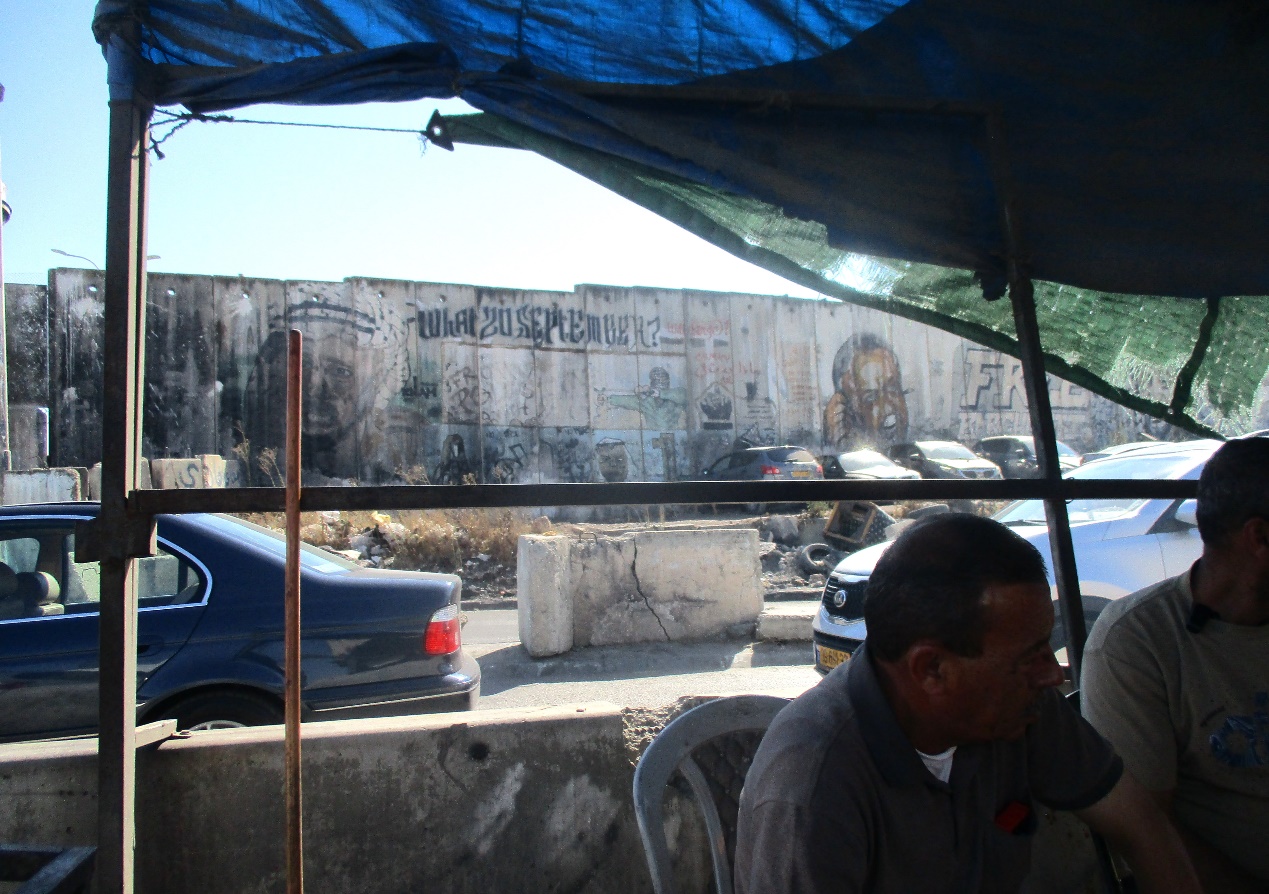 Tamar FleishmanJul-21-2026Qalandiya. Conversation in the shadow of the wall
-
