
Atarot, Qalandiya, Mon 14.7.08, Afternoon

Har Shmuel, ‘Life Fabric’ Road, Giv’on Hakhadasha, Givat Zeev CP, Bitunia and Qalandiya
Since we had a guest and also because Ruth of our shift had never been with us to the first few places, we did some sightseeing first. There were neither workers nor employers near the concrete slabs obstructing the road to Bidu, at the entrance to the new settlement of Mount Samuel, across from Nebi Samuel where spacious villas are being constructed. There is now a double row of concrete slabs, the new one about fifty yards closer to the main road (443). From there we drove to the hidden dug-in ‘life texture’ road where our photographer Ruth got some good shots to illustrate how REAL apartheid works.


Then we visited the site of the fenced in house on the top of West Giv’on – one has to see it to believe that there actually exists a wicked mind who ordered the construction of the cage around the Palestinian house which unfortunately happened to be ‘in the way’ of the settlers. At the Givat Zeev CP which serves only construction workers in this region we saw workers who were returned by their employers and crossed back into the territories without any checking making us wonder again why people have to be checked when they exit Jerusalem via the Rachel passage (CP300). We had a peek at the newly renovated entrance to the Ofer Prison with its fancy flag on the roof and didn’t even leave the car at the Bitunia CP since it was totally empty.
On the way to Qalandia the line for the CP at the entrance to the Atarot Industrial Zone started at the turn-off before the major CP of Road 443. We counted about fifty waiting cars, mostly big trucks and walked over to the two BP-men who manned the temporary CP that is turning slowly but surely into a permanent one. We were told that because this is the time people finish working, there is more traffic, but that during the day it is slack. Needless to say all cars had Israeli number plates, but most of the drivers were Palestinians. The trucks drove into the Industrial Zone from where the workers either took a bus (so there must be a bus serving the school too (??); we will inquire) or their own cars to go home. The private cars proceeded to the Qalandia CP. We timed a wait of 20 minutes (and this is a few minutes BEFORE reaching the official Qalandia CP).
We parked near the traffic light (which was as usual on red) but the large ‘humanitarian (?)’ metal door opened and an army jeep exited – the traffic light remained on red. We passed on foot through the CP which now has a new sign stating that the road ‘leads’ to area A, which is forbidden to Israelis.

This means that we can apparently drive until Semiramis and explore the ‘life-texture’-road from beyond Bir Naballa (we will find out). From the Southern side we could not see the crowds on the Northern side and had assumed that since it is late afternoon there wouldn’t be too many people. A mistake. The crowds are kept beyond the far fences and from within the CP one doesn’t see them. A novelty, which has been in operation only recently are the two ‘sleeves’; very narrow caged passages where only one person can sqwueeze through at the time be fore reaching the turnstiles.

The queue didn’t move and it turned out that one of the girl soldiers had left for a break half an hour earlier. As soon as we asked, a second post was operated and things started moving. But then apparently one of the soldiers thought that the wait had been too short and closed her post, which however was very soon reopened when it turned out that the other post had become too crowded. We noted that all people in line were in possession of blue Id’s. Those with Palestinian Id’s and work or humanitarian permits probably only pass in the morning. Nevertheless this didn’t prevent the girl soldiers from shouting at the crowds to move back, to approach one by one or threatening not to let anyone through unless a man agreed to put his mobile phone on the conveyor belt. The man lives in Issawiya and is a volunteer at Yad Sarah; he had talked to us while we were waiting in line. The wait had been half an hour.
The line of cars waiting at the impromptu Atarot CP had not yet shortened. We were stopped at the 443 Road CP after turning from the Atarot Industrial Zone; the soldier who stopped us, wondered what Israelis had been doing there and thought we might have taken a Palestinian with us.
'Atarot
See all reports for this place-
Atarot
Atarot was a workers' settlement destroyed during the War of Independence, where the Arab village of Qalandiya now stands, in the southwestern part of Atarot Airport, built by the British Mandate. After 1967, the Atarot industrial zone was established nearby, and until the completion of the wall from the Qalandiya checkpoint to Road 443, a checkpoint was in place. A new Jewish neighborhood is currently planned for the old airport area.
-
Qalandiya Checkpoint / Atarot Pass (Jerusalem)
See all reports for this place-
Click here to watch a video from Qalandiya checkpoint up to mid 2019 Three kilometers south of Ramallah, in the heart of Palestinian population. Integrates into "Jerusalem Envelope" as part of Wall that separates between northern suburbs that were annexed to Jerusalem in 1967: Kafr Aqab, Semiramis and Qalandiya, and the villages of Ar-Ram and Bir Nabala, also north of Jerusalem, and the city itself. Some residents of Kafr Aqab, Semiramis and Qalandiya have Jerusalem ID cards. A terminal operated by Israel Police has functioned since early 2006. As of August 2006, northbound pedestrians are not checked. Southbound Palestinians must carry Jerusalem IDs; holders of Palestinian Authority IDs cannot pass without special permits. Vehicular traffic from Ramallah to other West Bank areas runs to the north of Qalandiya. In February 2019, the new facility of the checkpoint was inaugurated aiming to make it like a "border crossing". The bars and barbed wire fences were replaced with walls of perforated metal panels. The check is now performed at multiple stations for face recognition and the transfer of an e-card. The rate of passage has improved and its density has generally decreased, but lack of manpower and malfunctions cause periods of stress. The development and paving of the roads has not yet been completed, the traffic of cars and pedestrians is dangerous, and t the entire vicinity of the checkpoint is filthy. In 2020 a huge pedestrian bridge was built over the vehicle crossing with severe mobility restrictions (steep stairs, long and winding route). The pedestrian access from public transport to the checkpoint from the north (Ramallah direction) is unclear, and there have been cases of people, especially people with disabilities, who accidentally reached the vehicle crossing and were shot by the soldiers at the checkpoint. In the summer of 2021, work began on a new, sunken entrance road from Qalandiya that will lead directly to Road 443 towards Jerusalem and Tel Aviv. At the same time, the runways of the old Atarot airport were demolished and infrastructure was prepared for a large bus terminal. (updated October 2021)
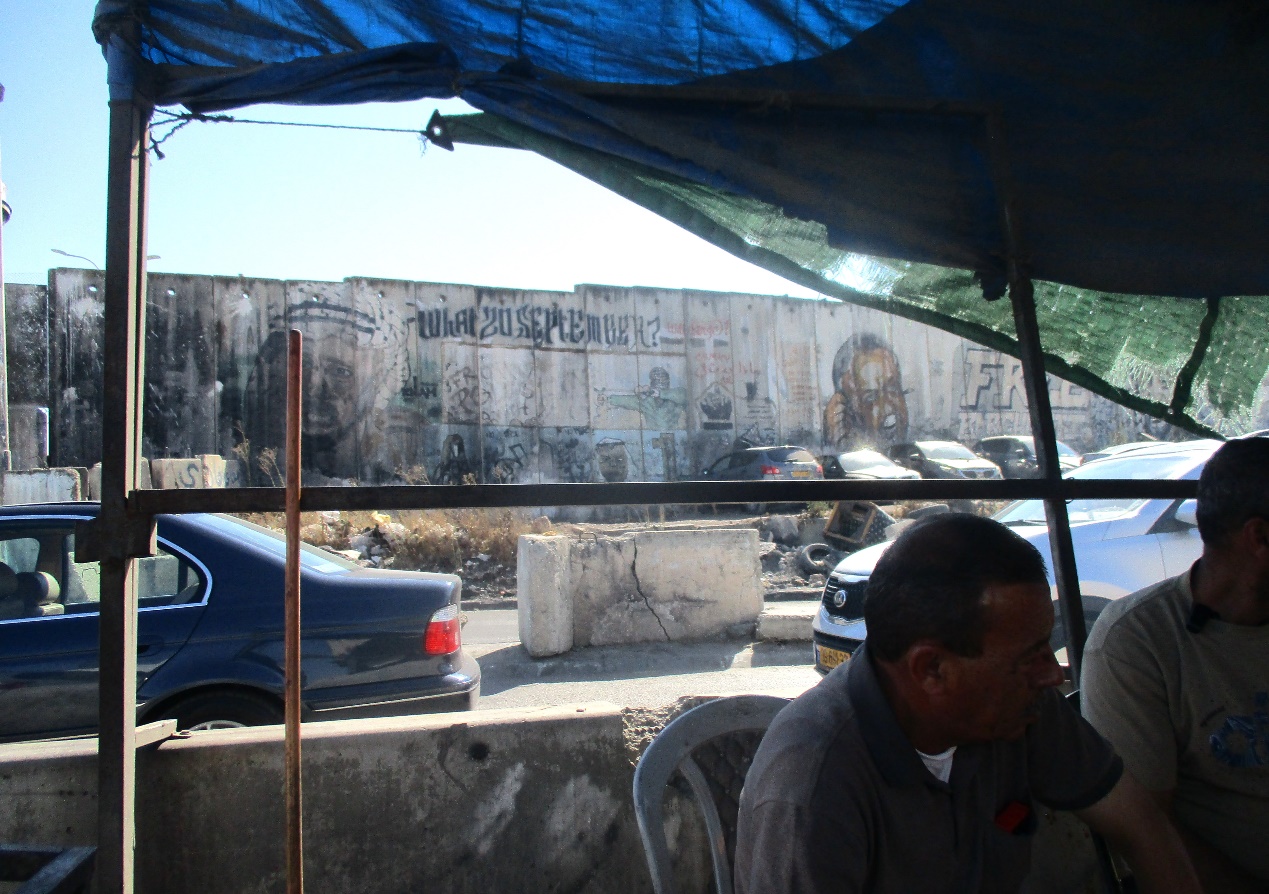 Tamar FleishmanJul-21-2026Qalandiya. Conversation in the shadow of the wall
-
