
‘Atarot, Qalandiya, Sun 15.2.09, Afternoon
15:30- Atarot Checkpoint
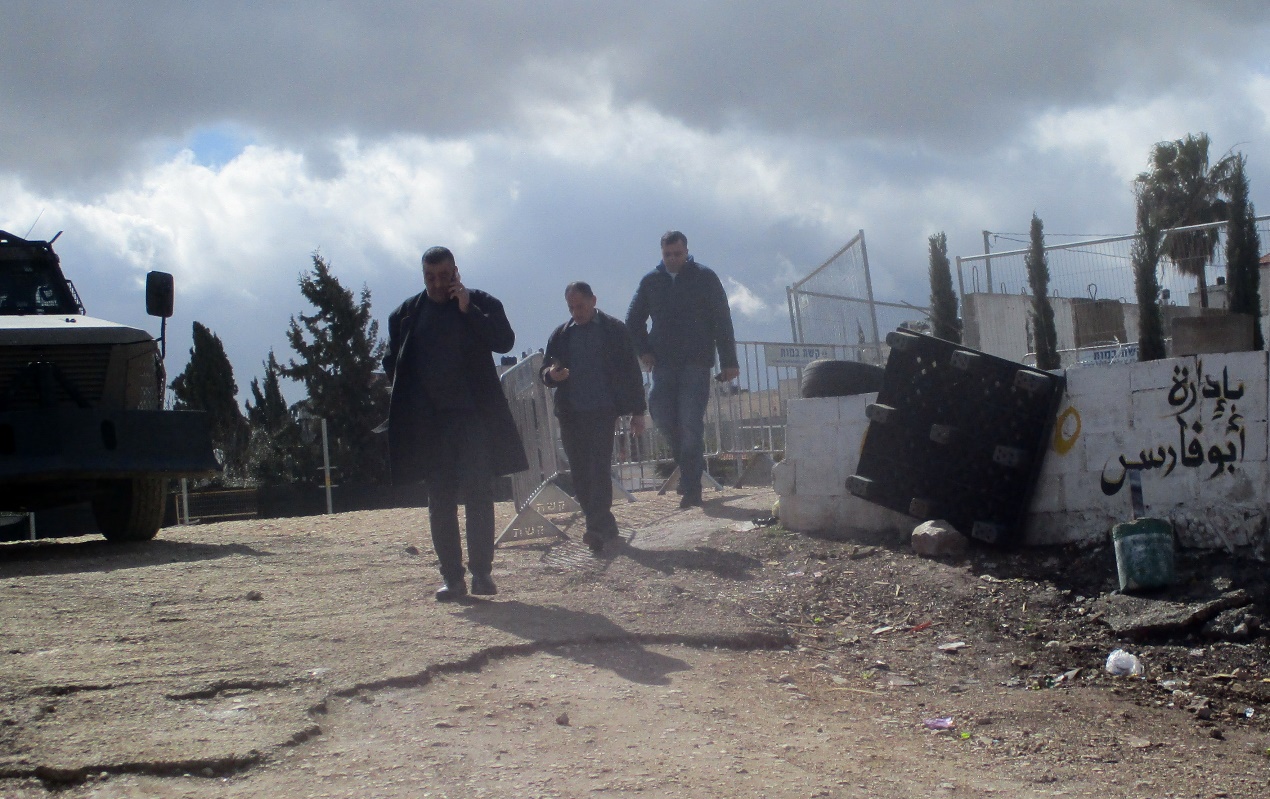
Three BP soldiers were positioned at the checkpoint: Two were frowning and the third (an acquaintance) was smiling and friendly. In side the checkpoint were meet two detainees who were seated separately, and on the side of the road was an Israeli cab. One was a Jewish cab driver and the other was his Palestinian passenger, he didn't have a permit and he probably thought that taking a ride in the car of an Israeli Jew (with a Kipa) would be enough to pass. In spite of that he was spotted by the police.
The one of the frowning BP policemen came towards Roni who was trying to speak to the Palestinian, and said: "He is under arrest and you have nothing to say to him!"
Roni replied that she actually did have things to talk to him about and added: "You have a rifle and can force your will on me".
After about 10 minutes a police vehicle (blue police) arrived and took away the two detainees. They drove towards the gate leading to the industrial zone of Atarot.
The BP policemen explained that the Palestinian will be taken for interrogation at the GSS and/or the police station, both are place in the same building at the local military base.
The Palestinian was unlucky during the last couple of meter that he managed to make after a day of work somewhere, for a less then minimum wage no doubt, and he was taken in by men hunters.
How much will this distance between Atarot and Qalandia checkpoints, which were the last 1,200 forbidden meters of his way (we checked), cost him? Not just in the form of money but also in his freedom
Qalandiya checkpoint: 
New on the wall:
Two new insctiptions:
1. "I always feel that somebody`s watchin` me"
2. On the write side of the Mahatma is written: "Victory will bring love someday and this wall won't stand in our way", the letters H K a signed above.
3. In the picture of the man holding keys and two other figures are standing on each side of him, the dress of the woman with the olive branch had been filled with bricks which give the feeling that her dress is now an apartment complex.
16:00
During the whole time we were there the inspection and passage were very slow.
We were trapped in the human cage for over 10 minutes together with tens of Palestinians until the turnstiles had opened and we managed to enter.
The two turnstiles at the sides weren't working and only the middle one was active.
The sovereign had built a terminal/passage. But the he can't be bothered with the maintenance: The facilities look as though they are about to collapse and decay.
We met A. and had a chat with him about the political situation of the region: "Haniya and Liberman". He said that at the bottom line: "they are one and the same, our Hamas and your right wing; they are made from the same substance".
A. told us of his difficulties with the Israeli bureaucracy, about the days he wastes walking about different offices trying to get permits, about getting the same answers over and over again: "come back tomorrow", about his daily routine that was put on hold, about the fact that his living with his family is conditional, but he really doesn't know what the conditions are and when might this situation change.
He also said that he is worried that his nine year old son might be traumatized, he has been suffering from reoccurring nightmares of his father never returning from work, of him being arrested, of him disappearing. The child often wakes up frightened looking for his father.
A. also told us that he was summoned to the GSS a while ago. He sat there before a young officer that was able to tell him every instance from his life, down to his daily routines. The officer (that how A. called him, he didn't say "Captain" and he didn't call him by his name), after going through his day to day schedule, said: "We know you don't like the Hamas and that you don't pray and don't go to the mosques".
-"That's bad?" asked A.
-"Don't you have any friends?"
-"I do, why?"
-"So why don't we see you at the coffee places during the day?"
A. said that during work hours he usually works, and he spends his free time with his friends.
The officer added: "We always see you getting together with Jews, why don't you spend any time with Arabs?"
This bizarre conversation went on for a while. The officer seemed to know a lot about A. trade and told A. that he was studying the same subject. He then asked A. whether he would be willing to help him with his studying: "We can be buddies", "No", A. replied, "We can't be buddies, you belong to the other side".
The officer suggested that A. join the parallel Palestinian organization and then they could work in front of one another…
Roni and I felt privileged that A. shared with us the most intimate details of his life and hardships. The moments in which we are invited to take part in such personal places of one of the thousands of people who pass by us with no names, faces or stories are rare moments in our shifts through out the years. These moments of trust that enables a person to unfold before us is hardships, which we too go on bearing with him, scarcely happen.
'Atarot
See all reports for this place-
Atarot
Atarot was a workers' settlement destroyed during the War of Independence, where the Arab village of Qalandiya now stands, in the southwestern part of Atarot Airport, built by the British Mandate. After 1967, the Atarot industrial zone was established nearby, and until the completion of the wall from the Qalandiya checkpoint to Road 443, a checkpoint was in place. A new Jewish neighborhood is currently planned for the old airport area.
-
Qalandiya Checkpoint / Atarot Pass (Jerusalem)
See all reports for this place-
Click here to watch a video from Qalandiya checkpoint up to mid 2019 Three kilometers south of Ramallah, in the heart of Palestinian population. Integrates into "Jerusalem Envelope" as part of Wall that separates between northern suburbs that were annexed to Jerusalem in 1967: Kafr Aqab, Semiramis and Qalandiya, and the villages of Ar-Ram and Bir Nabala, also north of Jerusalem, and the city itself. Some residents of Kafr Aqab, Semiramis and Qalandiya have Jerusalem ID cards. A terminal operated by Israel Police has functioned since early 2006. As of August 2006, northbound pedestrians are not checked. Southbound Palestinians must carry Jerusalem IDs; holders of Palestinian Authority IDs cannot pass without special permits. Vehicular traffic from Ramallah to other West Bank areas runs to the north of Qalandiya. In February 2019, the new facility of the checkpoint was inaugurated aiming to make it like a "border crossing". The bars and barbed wire fences were replaced with walls of perforated metal panels. The check is now performed at multiple stations for face recognition and the transfer of an e-card. The rate of passage has improved and its density has generally decreased, but lack of manpower and malfunctions cause periods of stress. The development and paving of the roads has not yet been completed, the traffic of cars and pedestrians is dangerous, and t the entire vicinity of the checkpoint is filthy. In 2020 a huge pedestrian bridge was built over the vehicle crossing with severe mobility restrictions (steep stairs, long and winding route). The pedestrian access from public transport to the checkpoint from the north (Ramallah direction) is unclear, and there have been cases of people, especially people with disabilities, who accidentally reached the vehicle crossing and were shot by the soldiers at the checkpoint. In the summer of 2021, work began on a new, sunken entrance road from Qalandiya that will lead directly to Road 443 towards Jerusalem and Tel Aviv. At the same time, the runways of the old Atarot airport were demolished and infrastructure was prepared for a large bus terminal. (updated October 2021)
 Tamar FleishmanFeb-27-2026Qalandiya: On the way to prayer
-