
‘Atarot, Qalandiya, Tue 16.3.10, Afternoon
From 2:00 till 5:00 PM
Beit Iksa, Givat Zeev, Bitunia, Atarot and Qalandia
A curfew and riots all over the city. We wondered where to go in order to avoid getting our car ruined.
The turn into Beit Iksa from the Ramot CP has become even more awkward. There were quite a few soldiers but we were not stopped. There was only one car parked at the beginning of the road. The condition of the road has become even worse since the last torrential rains and the potholes are very deep. We took a Palestinian from Hizme who had come to look in vain for work in Beit Iksa and passed the CP without anyone paying attention. There were only two cars passing smoothly. There is a large yellow sign telling Israelis that they are not allowed to have their cars fixed in B. Iksa. There are also large new green billboards welcoming us to Beit Iksa. Our hitchhiker showed us the way to the under pass-road which we had missed last time and told us he had been interviewed by Tami and Aya for machsanmilim. He had been in jail for many years and had completed his university studies there. At the end of the ride he begged us for money (and more money), spoiling the good impression he had made.
On the way back we were stopped at the B. Iksa CP, but only just to be greeted and again there were no other cars.
The G. Zeev CP was empty too, it was clear that no one got in or out due to the curfew.
However, in Bitunia, which is now called the Ofer Passage and there is a new fence before the CP, there was a long line of trucks transporting goods into the West Bank. A typical phenomenon, the (Israeli) economy is allowed to go on also when the Palestinians are not allowed to work.
The Atarot CP was manned by two soldiers and a policewoman. She looked attentively into each car. The Industrial area is being renovated, but so far only the roads, most of the old industrial buildings are still in total disrepair.
We have never seen Qalandia so empty and we were a little scared to park our car. There were dozens of police vans parked in the bus parking lot and the buses waited on the main road. There is construction going on towards the West and the VIP passage is still not in use. We turned into what was once the ‘humanitarian' passage into the Qalandia village, now entirely closed off by barbed wire coils. The little caravan has been moved further north and two border policemen told us they were only stationed there because of the riots – there was nothing to do for them. A security van waited for the cars of the Aviation Industry workers to exit and accompanied them on their way to safety (presumably till the highway), at the Atarot CP the line of cars had grown significantly and moved extremely slowly.
'Atarot
See all reports for this place-
Atarot
Atarot was a workers' settlement destroyed during the War of Independence, where the Arab village of Qalandiya now stands, in the southwestern part of Atarot Airport, built by the British Mandate. After 1967, the Atarot industrial zone was established nearby, and until the completion of the wall from the Qalandiya checkpoint to Road 443, a checkpoint was in place. A new Jewish neighborhood is currently planned for the old airport area.
-
Qalandiya Checkpoint / Atarot Pass (Jerusalem)
See all reports for this place-
Click here to watch a video from Qalandiya checkpoint up to mid 2019 Three kilometers south of Ramallah, in the heart of Palestinian population. Integrates into "Jerusalem Envelope" as part of Wall that separates between northern suburbs that were annexed to Jerusalem in 1967: Kafr Aqab, Semiramis and Qalandiya, and the villages of Ar-Ram and Bir Nabala, also north of Jerusalem, and the city itself. Some residents of Kafr Aqab, Semiramis and Qalandiya have Jerusalem ID cards. A terminal operated by Israel Police has functioned since early 2006. As of August 2006, northbound pedestrians are not checked. Southbound Palestinians must carry Jerusalem IDs; holders of Palestinian Authority IDs cannot pass without special permits. Vehicular traffic from Ramallah to other West Bank areas runs to the north of Qalandiya. In February 2019, the new facility of the checkpoint was inaugurated aiming to make it like a "border crossing". The bars and barbed wire fences were replaced with walls of perforated metal panels. The check is now performed at multiple stations for face recognition and the transfer of an e-card. The rate of passage has improved and its density has generally decreased, but lack of manpower and malfunctions cause periods of stress. The development and paving of the roads has not yet been completed, the traffic of cars and pedestrians is dangerous, and t the entire vicinity of the checkpoint is filthy. In 2020 a huge pedestrian bridge was built over the vehicle crossing with severe mobility restrictions (steep stairs, long and winding route). The pedestrian access from public transport to the checkpoint from the north (Ramallah direction) is unclear, and there have been cases of people, especially people with disabilities, who accidentally reached the vehicle crossing and were shot by the soldiers at the checkpoint. In the summer of 2021, work began on a new, sunken entrance road from Qalandiya that will lead directly to Road 443 towards Jerusalem and Tel Aviv. At the same time, the runways of the old Atarot airport were demolished and infrastructure was prepared for a large bus terminal. (updated October 2021)
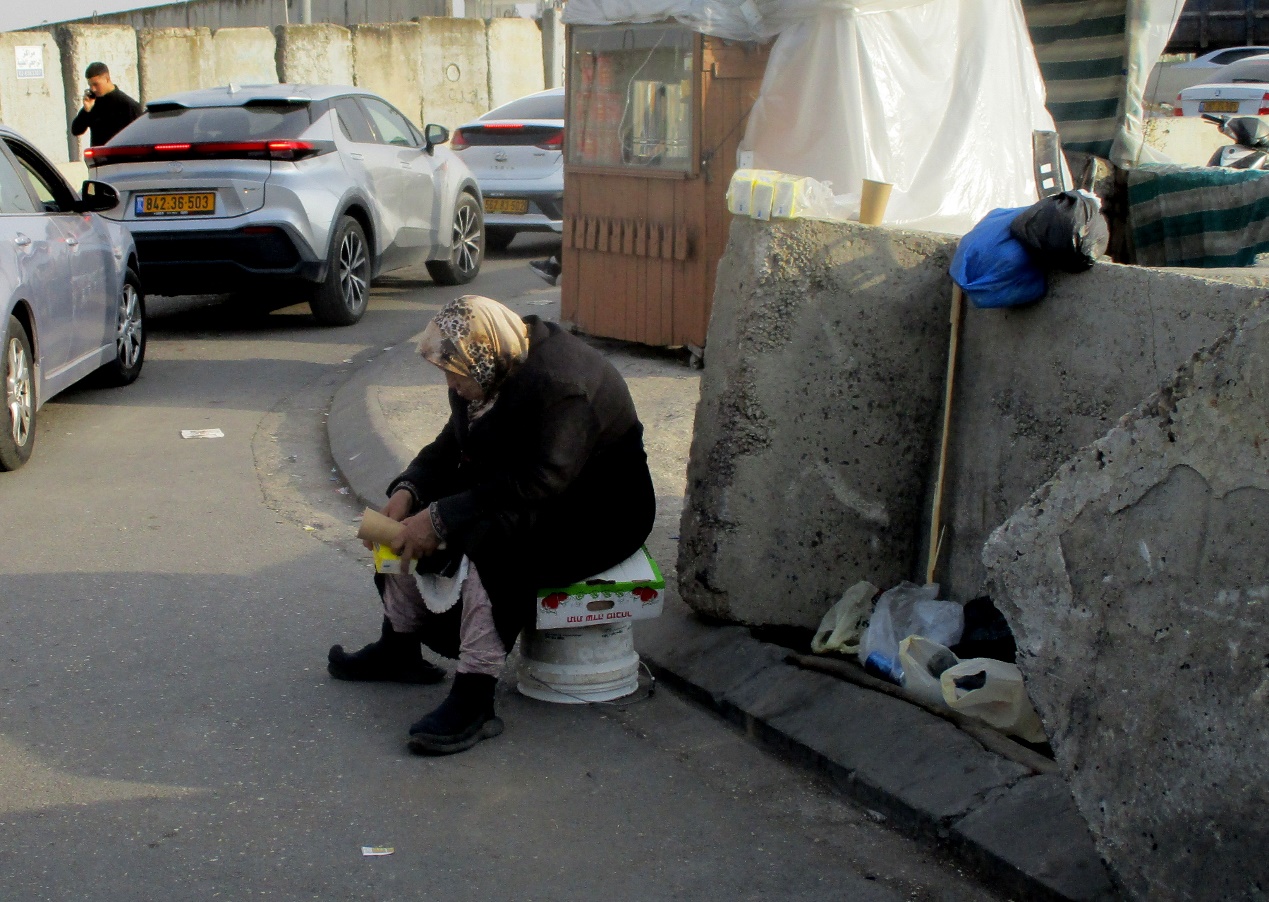 Tamar FleishmanOct-11-2026Qalandiya. Female Beggar
-
