
‘Awarta, Huwwara, Irtah (Sha’ar Efrayim), Thu 11.2.10, Afternoon

Natanya translating.
"If We Are Not Seen – We Do Not See". The Rabbi Asherman at the meeting at Awarta today.
We went out on our usual route to Huwwara. On the way we stopped at two villages and were exposed to their problems. The feeling which we got was that each Palestinian whom we met and heard his story had enclosed within himself layers of bodily wounds, wounds which included his health, his properly and his natural resources. The injustices of the occupation are detailed in stories of their lives.
The personal meeting gave us new, interesting and emotional contacts.
12.30 Four women in Dalia's car. We go past the checkpoint of Irtach/Sha'ar Ephraim. We decide to enter Kifal Haris (at the circle opposite Ariel) where we knew no one.
Today the checkpoint/ the iron gate is open and there are no soldiers to be seen.
We stop in the beginning at the entrance to a carpenter's shop in the village and begin speaking to Mahmoud G. who owns the shop and who was standing at the entrance. A conversation ensued.
He said that four youths had been arrested lately. He showed us the abusive slogans which had been written on the iron door of his house, on the bullets holes which the army had shot "just so" at his house. He showed us his big toe which had been amputated and since then he has problems with his foot. This happened while there was a commotion in the village and when he tried to flee from the army and was hurt.
We asked to meet the head of the village and he made the connection between us. We got to the top of the village where the village council is. The municipality. Here we met Abed Rachum Buzia who is the director of the council. In a conversation with us he spoke about the commotions in the village which took place on the 20.4.2009 when thousands of settlers ( he said 8000) went up to the graves which are supposed to be the grav of Caleb Ben Yefuna and Yehushua which is in the Moslem cemetery. They broke down tombstones, pipes, lighting installations, cars and windows of houses. 3-4 times a year the settlers go up to these graves . He showed us the thousands of people on his cell phone. M-P-Head, the head of the council went to complain at the Ariel police station but since then nothing has been done and there has been no compensation or repairs. Afterwards he spoke to the 4 who had been arrested and no one knew where they were. He promised to give us their names and ID numbers. Maybe we can find out where they are being kept.
A worrying note. When we returned from the municipality close to the school at 12.30 when the school day was ending 10s of pupils came out, came close to the car and started throwing stones at us. Dalia drove bravely and quickly and we managed to disappear from their sight. The children do not know that we are peaceful Jewish women. We learned not to enter the village at the times when they come out all together on their way home.
Ecological damage in an olive grove. Mr. Buzia told us of the rubbish which has been deposited lately in the agricultural area. One of their specialists says that it is cancerous waste. We went to the olive grove of the village of Haris so see the mounds of rubbish. 3 mounds of industrial waste has been thrown into the grove. Zvia said that these are the remains of chemical industrial procedure, iron oxide & sulfur which seem to her to be dangerous. She phoned a specialist of the organization of "Man, nature and law" to check out the nature of this waste material. (We photographed this by video and still)
Today there are no rolling checkpoints which come and go arbitrarily on the way to Haris.
A young man comes to us who has a utility for washing cars next to the road. He got an order to demolish it "because it is too close to the road" and also confiscated his expensive equipment.
"On suspicion that it was a criminal business." Why? Just so.
Our feeling is that the trend is to demolish every possible way of making a living.
He is now in consultation with the administration and showed us the papers.
Huwwara.
This time we help Basama make a living. She is a widow with 8 children. Boma Inbar helped her to open a shop of second hand clothing. Zvia got hold of bags of clothes with the help of a friend from kibbutz Kabri. When we arrived a group of women arrived at the shop and made us sit down to drink with them and speak. This is the first time that we sit in a circle of women (not only the men as is usual) and there was a lot of laughter.
Awarta.
We arrived after we had made an appointment with Moueid – a religious & history student at the university of A-Nagach in Nablus. He speaks Hebrew well. We got to his house which stands next to the graveyard which had been desecrated 3 weeks ago by settlers and ultra-orthodox Jews. As mentioned previously his house had also been taken over by the soldiers so as to "guard those praying." His money and phones were nearly stolen. We "matched" him up with "Yesh Din" and he will help us to make a claim against the army. His family received us with Maramia tea from the garden on a sunny day.
While we were sitting there with the family a group of "Rabbis for Human Rights" arrived with Rabbi Asherman and Zecharia and Hani, the mayor. The conclusion of Rabbi Asherman from his untiring Activities on the West Bank is that we must be seen in the villages. As much as we can. "If we are not seen….we do not see."
We concluded with Moueid who will help us to contact the representatives of other villages in the area of Huwwara. Beita Fuka and Beita Tachta and maybe other villages in the area.
Those that we can get to fairly easily, With these connections we can raise and publish the happenings which infringe on the rights of the villages and the violence of the occupation. Events which the eye does not see while on the patrols of machsomwatch all along the road.
The photos are of the refuse at Kifal Haris and some of the caves at Awarta.
Photos of the meeting with the women at Awarta. Video only and therefore not given here.
'Awarta
See all reports for this place-
Awarta, an internal checkpoint in the heart of the West Bank, is located east of the Hawara checkpoint, at the junction of Roads 555 (which was forbidden for Palestinian traffic in this area) and the entrance road to Nablus. It was one of the four checkpoints that surrounded Nablus until 2009. We used to watch it at Huwwara shifts because it was the only one where goods could be transferred to and from Nablus, using the back-to-back method. It was operated by the army, from 06:00 to 20:00. Until 2009.
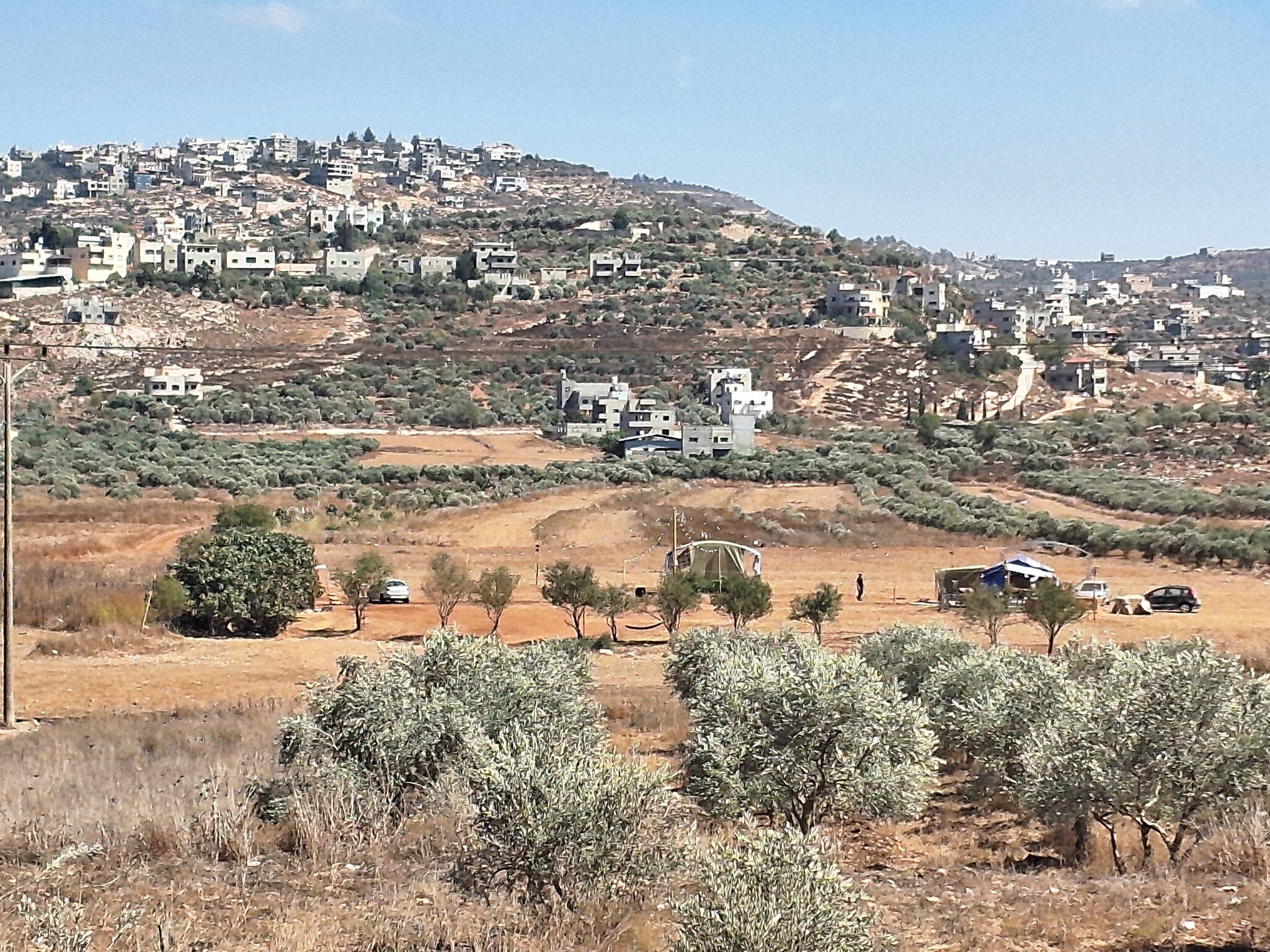 Ronit Dahan-RamatiSep-10-2026Awarta. Outpost below the town
-
Huwwara
See all reports for this place-
The Huwwara checkpoint is an internal checkpoint south of the city of Nablus, at the intersection of Roads 60 and 5077 (between the settlements of Bracha and Itamar). This checkpoint was one of the four permanent checkpoints that closed on Nablus (Beit Furik and Awarta checkpoints to the east and the Beit Iba checkpoint to the west). It was a pedestrian-only barrier. As MachsomWatch volunteers, we watched therre since 2001 two shifts a day - morning and noon, the thousands of Palestinians leaving Nablus and waiting for hours in queues to reach anywhere else in the West Bank, from the other side of the checkpoint the destination could only be reached by public transport. In early June 2009, as part of the easing of Palestinian traffic in the West Bank, the checkpoint was opened to vehicular traffic. The passage was free, with occasional military presence in the guard tower. Also, there were vehicle inspections from time to time. Since the massacre on 7.10.2023, the checkpoint has been closed to Palestinians.
On February 26, 2023, about 400 settlers attacked the town's residents for 5 hours and set fire to property, such as houses and cars. Disturbances occurred in response to a shooting of two Jewish residents of Har Bracha by a Palestinian Terrorist. The soldiers stationed in the town did not prevent the arson and rescued Palestinian families from their homes only after they were set on fire. No one was punished and Finance Minister Smotrich stated that "the State of Israel should wipe out Hawara." Left and center organizations organized solidarity demonstrations and support actions for the residents of Hawara.Hawara continued to be in the headlines in all the months that followed: more pogroms by the settlers, attacks by Palestinians and a massive presence of the army in the town. It amounted to a de facto curfew of commerce and life in the center of the city. On October 5, 2023, MK Zvi established a Sukkah in the center of Hawara and hundreds of settlers backed the army blocked the main road and held prayers in the heart of the town all night and the next day. On Saturday, October 7, 23 The "Swords of Iron" war began with an attack by Hamas on settlements surrounding Gaza in the face of a poor presence of the IDF. Much criticism has been made of the withdrawal of military forces from the area surrounding Gaza and their placement in the West Bank, and in the Hawara and Samaria region in particular, as a shield for the settlers who were taking over and rioting.
On November 12, 2023, the first section of the Hawara bypass road intended for Israeli traffic only was opened. In this way, the settlers can bypass the road that goes through the center of Hawara, which is the main artery for traffic from the Nablus area to Ramallah and the south of the West Bank. For the construction of the road, the Civil Administration expropriated 406 dunams of private land belonging to Palestinians from the nearby villages. The settlers are not satisfied with this at the moment, and demand to also travel through Hawara itself in order to demonstrate presence and control.(updated November 2023)
.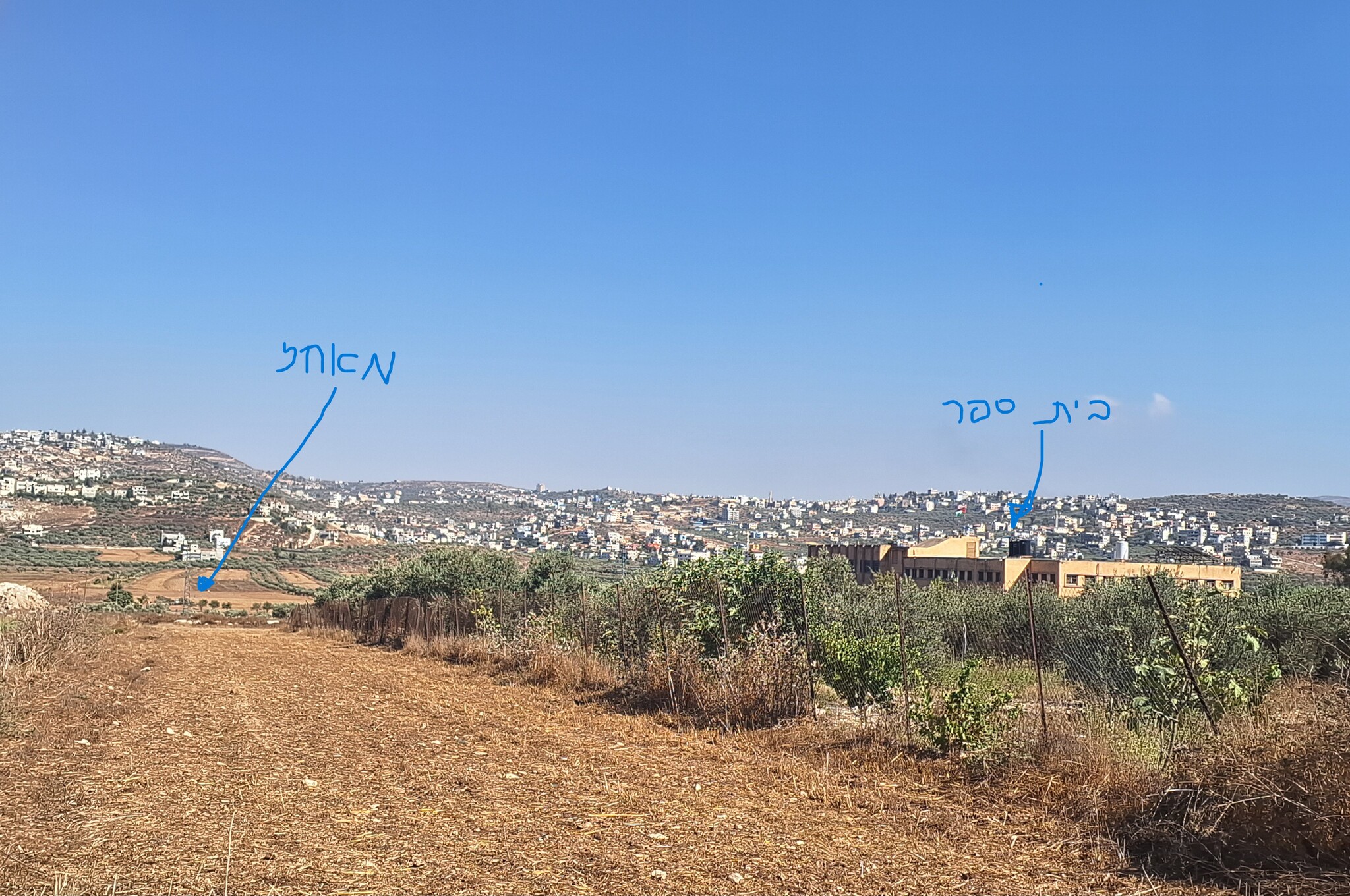 Ronit Dahan-RamatiAug-24-2026Huwara: The school on the outskirts of town and an outpost hidden among the trees
-
Irtah (Sha'ar Efrayim)
See all reports for this place-
The checkpoint is for Palestinians only. It is the main barrier to the passage of workers from the northern West Bank to Israel. Workers with a permit to work in Israel and also for trade (with appropriate permissions), medicine, and visiting prisoners. One can cross the checkpoint only on foot. The checkpoint is located north of Road 557 and south of Tulkarm. Operated by a civil security company, opening hours: between 4:00 and 19:00 on weekdays. As members of Machsom Watch, we began our shifts to this location in 2007. We arrived before it opened at 4 in the morning and report since, on the harsh conditions and the long and crowded queues of workers. The workers who pass by continue their journey by transportation to work throughout Israel. In the first period of its activity, about 3,000 and then 5,000 people passed through this checkpoint every day. Due to the small number of checking points and arbitrary delays for long periods of time in the "rooms", workers feared losing their transportation. Hence workers leave their homes at 2:30 at night to be among the first. Today, 15,000 pass and the transition is faster. Workers are still leaving their homes very early to get past the checkpoint at 7 p.m. In an adjacent compound, there is a terminal for the transfer of goods on a commercial scale, using the back-to-back method.
-
