
‘Azzun ‘Atma, Eliyahu Crossing, Falamiya, Habla, Kufr Jammal, Sun 2.6.13, Morning
Three “café kids” walked around at the Azzun Atme checkpoint, selling a cup of coffee for one shekel to the passer-by’s. This way they help supporting their family: Muad, 12 years old, who speaks excellent Hebrew (that he learned at the checkpoints), along with his two siblings, a girl about 10 years old and boy about 8 years old. I had to think of Israeli kids, still sleeping sweetly in their homes at this time (6 in the morning).
Judi, our guest, was appalled to witness life between the checkpoints, while on the other hand she could not help being impressed by the beauty of the area.
6:15 Azzun Atme Checkpoint
We made an exception from our regular Mondays, to see if there is a change in the checkpoint routine on a Sunday.
Outside the checkpoint many people were waiting for the transports of their employers, more than on a Monday at this hour.
It is unclear whether this results out of the efficiency of the soldiers at the checkpoint, or rather because on Sunday also people with a weekly permit arrive and maybe the passage just started earlier. At the queue itself, there was about the same amount of people as on Mondays. The carousel works, and so the queue proceeds at a reasonable pace. The checkpoint soldiers are calm, perhaps because the carousel works well, perhaps because they are “veterans” themselves (two weeks have passed since they were posted here).
Personal belongings are being left, until they get through the metal detector, along a low and narrow concrete wall. There is no orderly desk or basket for the belongings, as elsewhere. Of course, we have noticed things falling out and rolling on the floor.
We drank Muad’s coffee while observing the checkpoint.
7:25 Hable Checkpoint
People passed through the gap in the fence. The indigence here is apparently stronger than the fear to be caught. At the checkpoint, only a few people wait in the queue.
At 7:30 the school transports arrived – a boys bus and a girls bus. Both half empty. The boys bus was controlled. Probably there was someone over 16 years old, as they checked ID’s. The girls bus was controlled too – doors left open – it is rather unclear why the soldiers care about what is being brought into the west bank.
Both buses passed quickly through the checkpoint.
7:40 Eliyahu Gate
A few people wait at the pedestrians’ queue.
8:15 Falamiye
Quiet and peaceful, everything is green now, plenty of bird singings.
A truck loaded with pipes is not allowed to pass through. The driver explains that he does not have a steady permit and that the equipment on the truck is intended for building a greenhouse. The soldiers tell him he would be allowed to pass if they would receive a permit from the Liaison & Coordination Administration on the phone. The truck owner explains that it is not possible to obtain a permit in advance, and so he must wait an hour or two each time, until the permit is given on the phone.
Why is it not possible to arrange for him such a permit in advance?
As usual, the logic of the military is not clear; it is rather part of the general and routine policy of distressing the population.
We then visited a grocery store owner at Jimal village. His 20 year old son used to have a permit to work in agriculture at the seamline zone. As he said, while being checked by the soldiers last time, he had a laugh with them, and they took away his permit and told him to return the next day. Since then, for two weeks, he comes every day and hears the same answer. We appealed to the Liaison & Coordination Administration and the matter is now under examination.
'Azzun 'Atma
See all reports for this place-
'Azzun 'Atma
A Palestinian village of about 1,800 residents. The settlement of Sha'arei Tikva was established on its land adjacent to it, and the settlement of Oranit was established on its agricultural lands. By 2013, the separation fence had passed through the village and a checkpoint staffed by the army allowed the residents to cross from side to side. After building a massive wall surrounding the village and some of its agricultural lands, the residents went daily for five years to their lands that remained in the Seam Zone through the Oranit agricultural checkpoint (4). Since 2018 it has only opened during the olive harvest and the farmers have to pass daily at the Beit Amin / Abu Salman checkpoint (1447), about 3 kilometers north.From a report from March 24, 2021: "The farmers from Beit Amin and Azon Atma are happy that since February 21 the Oranit checkpoint .is going to be open 3 times a day, The farmers are really developing the place."
Report from July 14, 2024: "Ornit checkpoint is closed . The Beit Amin/Abu Salman agricultural checkpoint is closed (there is no contact with the military to check if it opens rarely), the Ezbat Jaloud checkpoint was opened once a day before the war.
Updated for July 2024
 Apr-11-2019Azoun: The main entrance to village blocked now for several weeks
-
Eliyahu CP (109) / Crossing
See all reports for this place-
Eliyahu CP (109) / Crossing This checkpoint, also known as the Fruit Crossing, is one of the main checkpoints between Israel and the West Bank. It is located on Route 55 between Alfei Menashe and the turn to Qalqilya and Zufin, more than 4 km east of the Green Line, in the separation fence, which separates Qalqilya from its lands to the south, thus leaving Alfei Menashe West of the fence - the Seam Zone. This checkpoint, a few kilometers across the Green Line, is intended for "Israeli settlement in the West Bank and the population of the Seam Zone." It is managed by a civil company. Palestinians with a special permit for their lands in the seam area are also allowed to pass through it, on foot, and sometimes by car.
-
Falamiya
See all reports for this placeHabla
See all reports for this place-
Habla CP (1393)
The Habla checkpoint (1393) was established on the lands of the residents of Qalqilya, on the short road that
connected it for centuries to the nearby town of Habla. The separation barrier intersects this road twice and cut off the residents of Qalqilya from their lands in the seam zone.(between the fence and the green line).
There is a passage under Road 55 that connects Qalqilya to the sabotage This agricultural barrier is used by the farmers and nursery owners established along Road 55 from the Green Line and on both sides of the kurkar road leading to the checkpoint.
This agricultural checkpoint serves the residents of Arab a-Ramadin al-Janoubi (detached from the West Bank), who pass through it to the West Bank and back to their homes. The opening hours (3 times a day) of this agricultural checkpoint are longer than usual, about an hour (recently shortened to 45 minutes), and are coordinated with the transportation hours of a-Ramadin children studying in the occupied in the West Bank.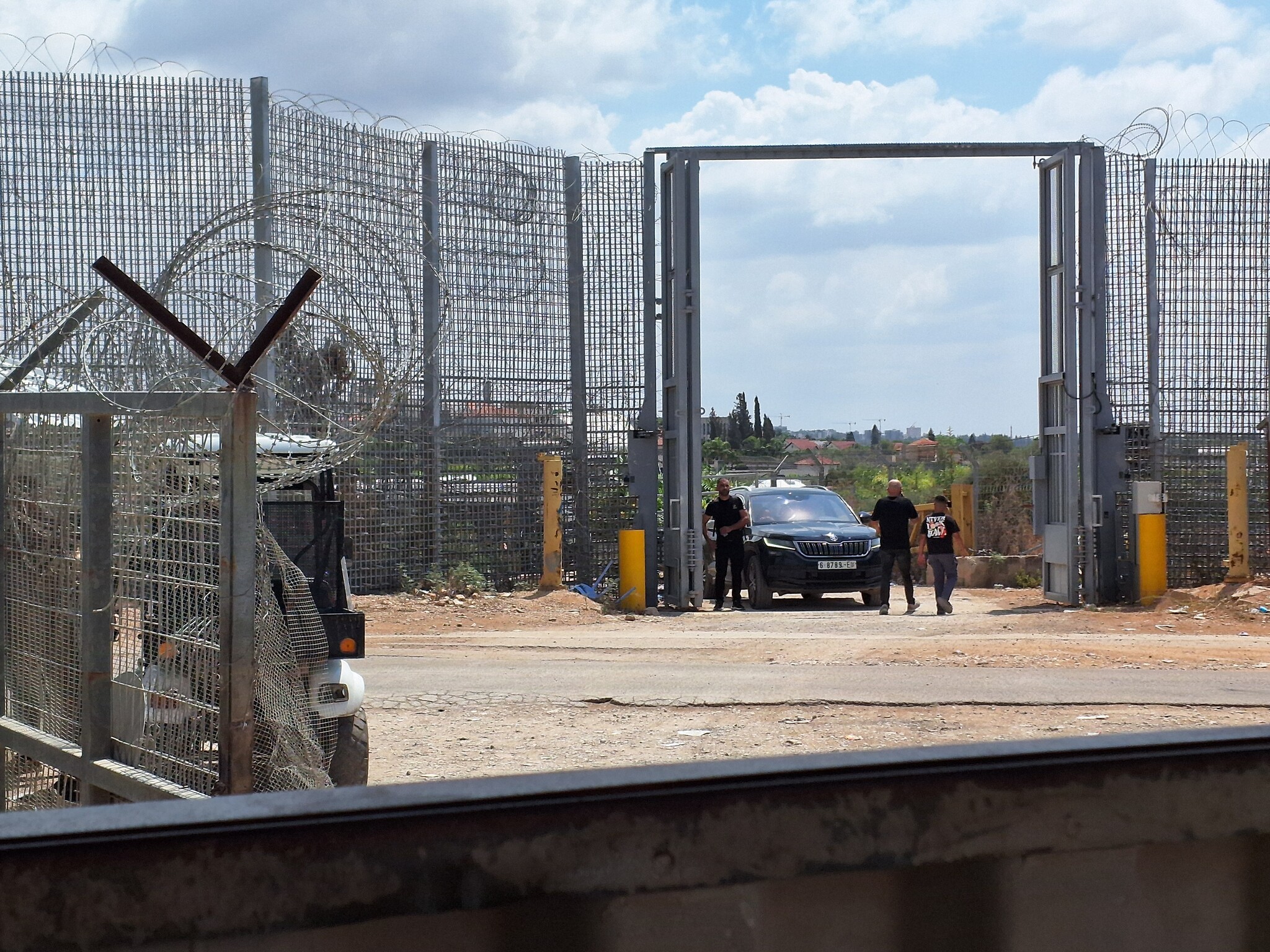 Ronit Dahan-RamatiAug-31-2026Habla. The gate is open
-
Kufr Jammal
See all reports for this place-
Kufr Jammal This village, rising about 200 meters over sea level, is located about 14 kilometers south of Tul Karm town and about 17 kilometers from the Mediterranean Sea. The families living there since the mid-18th century number about 3,000 persons at present. The village has lost thousands of dunams of its northern and western lands due to the construction of the Separation Barrier, leaving the lands themselves behind the barrier. After the Israeli Supreme Court ruling in 2011, the barrier was moved to the west and many farmlands were returned to their owners. It is a quiet village, its relations with the nearby settler-colony of Sal’it are favorable, and many of the villagers work in the colony’s industrial plants. Farmers cross the agricultural checkpoint close to this settler-colony in order to tend their fields unhampered. However, there are numerous acts of harassment and disorder taking place when the village farmers cross the other agricultural checkpoints: gates do not open at hours suitable to the farmers’ needs, and for a short period of time only; the Civil Administration usually prevents all kinds of crops except olives; tractors and other farm equipment are forbidden entry; only a single permit is issued per family, and occasionally such permits are confiscated and their re-issue is delayed – the common excuse is usually “security reasons”. How do the villagers make their living? Holders of work permits inside Israel travel at 3 a.m. to Eyal Checkpoint near Qalqiliya town in order to make it on time to their workplace at Sal’it (close to their village) and elsewhere. Owners of vegetable patches who hold permits are allowed to reach their fields beyond the Separation Barrier through the distant Falamiya Checkpoint. Importantly, fields returned to the village show amazing improvement intending, irrigation and farming variety – and instead of the neglected olive tree groves that were accessible only to holders of transit permits through agricultural checkpoints usually closed, farming has now flourished. (updated Jan 2021)
-
