
‘Azzun ‘Atma, Eliyahu Crossing, Falamiya, Habla, Mon 13.8.12, Morning
06:00 We drove toward the Tamar gate from the entrance to Oranit (The Tamar gate is the southern agricultural gate of 'Azzun 'Atma; it adjoins the road parallel to it on the south side. That road is closed at both ends by gates, one of which is open when the Tamar gate is open. The farmers leave through the Tamar gate and can freely access their groves or reach the main road leading to the settlements to get to work. In our last report we noted that we’d heard an additional fence had been erected south of the road, which is now hemmed in between two fences; access from it to the groves is via an additional gate in the new fence which also involves a tale (that has already been told). We wanted to try to see what’s happening. And in fact, the road from the direction of Oranit is blocked by a gate which is closed.
06:10 'Azzun 'Atma, south. A few people wait outside. Two inspection stations operate normally. Fewer people on line as well – maybe 50 waiting to cross; about 20 went through in ten minutes. Laborers with belongings leave them before the gate and after their documents have been inspected return to go through the gate and collect their things. Today, unlike the usual arrangement, a soldier opens and closes the gate which isn’t usually locked – the gate is locked and each time an MP must get the key from the checkpoint commander, open the gate, close it and return the key to the commander. Pretty funny. It reminds me of the keys held by the housekeeper in the home of a British aristocrat, who would give them temporarily to one of the servants to remove something from a cupboard and immediately take them back.
06:20 We returned toward the Tamar gate on the other side of the road. The soldiers arrived at 06:30, opened the gate, closed it leaving a small opening (without locking it), to make it clear to us that we weren’t allowed to enter. Soon those crossing to the main road on their way to work began flowing in. From where we stood we couldn’t see the gates, nor were we able to find somewhere else to stand which allowed us to view them, nor the new gate erected next to the well, so we couldn’t learn anything beyond the facts that those crossing told us about, but they didn’t know whether it was open or whether it opened only at specific times. Now the gate is open from 06:30 to 07:00.
07:00 Habla – The soldiers begin opening the gates.
07:07 The first people coming through entered for inspection. A night watchman from the plant nurseries arrives. His permit is valid only for Gate 109 (Eliyahu), but he lives in Habla. He wanted to take a shortcut rather than wait until he can get a ride to 109; he’s very old. The soldiers didn’t permit him to cross, despite his appeals. He’s already been to the DCO; they told him they can alter the permit only when it expires – in mid-September – but it’s now Ramadan, and it’s hard for him? Who cares. There are rules; that’s that.
07:30 Eliyahu gate – 109 – The occupation routine. A Palestinian who’d gone through the checkpoint and took a shortcut to the parking lot to catch a ride to work was reprimanded and made to take the longer route designated for Palestinians. He’s forbidden to walk on the Jews’ path. A few cars being inspected, as usual; few laborers go through.
08:15 Falamya – Quiet. An elderly woman arrives on the security road from the fields. She’s already returning from her land, to which she came early in the morning. Now she must walk all the way to Beit Jamal, because of the fence, and it’s impossible to walk directly home from her field. The distance must be at least 3-4 kilometers in each direction. A car arrives from the fields and enters after a brief inspection.
'Azzun 'Atma
See all reports for this place-
'Azzun 'Atma
A Palestinian village of about 1,800 residents. The settlement of Sha'arei Tikva was established on its land adjacent to it, and the settlement of Oranit was established on its agricultural lands. By 2013, the separation fence had passed through the village and a checkpoint staffed by the army allowed the residents to cross from side to side. After building a massive wall surrounding the village and some of its agricultural lands, the residents went daily for five years to their lands that remained in the Seam Zone through the Oranit agricultural checkpoint (4). Since 2018 it has only opened during the olive harvest and the farmers have to pass daily at the Beit Amin / Abu Salman checkpoint (1447), about 3 kilometers north.From a report from March 24, 2021: "The farmers from Beit Amin and Azon Atma are happy that since February 21 the Oranit checkpoint .is going to be open 3 times a day, The farmers are really developing the place."
Report from July 14, 2024: "Ornit checkpoint is closed . The Beit Amin/Abu Salman agricultural checkpoint is closed (there is no contact with the military to check if it opens rarely), the Ezbat Jaloud checkpoint was opened once a day before the war.
Updated for July 2024
 Apr-11-2019Azoun: The main entrance to village blocked now for several weeks
-
Eliyahu CP (109) / Crossing
See all reports for this place-
Eliyahu CP (109) / Crossing This checkpoint, also known as the Fruit Crossing, is one of the main checkpoints between Israel and the West Bank. It is located on Route 55 between Alfei Menashe and the turn to Qalqilya and Zufin, more than 4 km east of the Green Line, in the separation fence, which separates Qalqilya from its lands to the south, thus leaving Alfei Menashe West of the fence - the Seam Zone. This checkpoint, a few kilometers across the Green Line, is intended for "Israeli settlement in the West Bank and the population of the Seam Zone." It is managed by a civil company. Palestinians with a special permit for their lands in the seam area are also allowed to pass through it, on foot, and sometimes by car.
-
Falamiya
See all reports for this placeHabla
See all reports for this place-
Habla CP (1393)
The Habla checkpoint (1393) was established on the lands of the residents of Qalqilya, on the short road that
connected it for centuries to the nearby town of Habla. The separation barrier intersects this road twice and cut off the residents of Qalqilya from their lands in the seam zone.(between the fence and the green line).
There is a passage under Road 55 that connects Qalqilya to the sabotage This agricultural barrier is used by the farmers and nursery owners established along Road 55 from the Green Line and on both sides of the kurkar road leading to the checkpoint.
This agricultural checkpoint serves the residents of Arab a-Ramadin al-Janoubi (detached from the West Bank), who pass through it to the West Bank and back to their homes. The opening hours (3 times a day) of this agricultural checkpoint are longer than usual, about an hour (recently shortened to 45 minutes), and are coordinated with the transportation hours of a-Ramadin children studying in the occupied in the West Bank.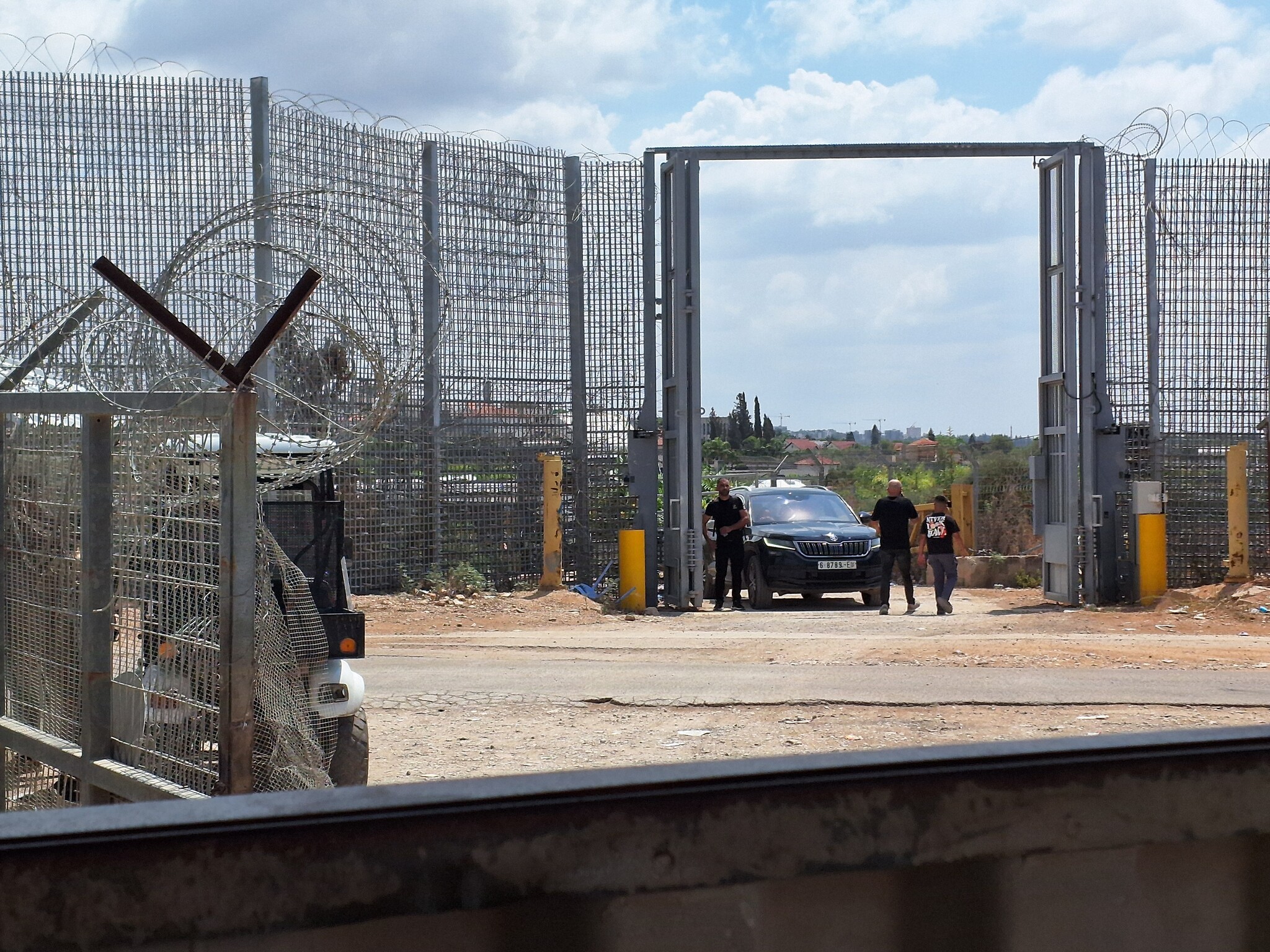 Ronit Dahan-RamatiAug-31-2026Habla. The gate is open
-
