
‘Azzun ‘Atma, Eliyahu Crossing, Falamiya, Habla, Mon 27.2.12, Morning
.
06:30 'Azzun 'Atma
It’s cold, 10 degrees Celsius, not many people outside waiting; they’ve lit small fires around which they’re warming themselves.
The line appears shorter than usual at this hour, but perhaps they’re just standing very close together because when we are able to count them later there were about 70 people on line. Many of those coming out complain that, although the inspection itself seems to go quickly, there are only two inspection booths and from time to time things slow down, the revolving gate doesn’t open. We timed one man – it took him half an hour from the time he arrived. But earlier, when there were more people on line, it must have taken longer. And, if you consider that many people come from far away, like Nablus or even Bethlehem, it’s really terrible. Hours are wasted getting to and from work, on a minimum wage. When I think about having to wait an hour on line twice a day I feel sick; I’d go mad.
Slightly before 07:00 the MP put a table outside the building to open an additional inspection station, not computerized, which, of course, allowed people to go through more quickly, which was good. Too bad they didn’t do that at 05:00. There’s a danger of registration errors, and so what will happen when the person tries to return in the evening? They’ll say he didn’t leave in the morning? So how did he enter the previous evening? But that’s better than waiting longer on line.
07:00 The first schoolgirls come through, and now there’s a steady trickle of pupils crossing without any problem; the gates to the cars are opened for them.
07:25 – Habla. The gate is open. You could scream at how long it takes to get through. The pupils already crossed. A car going to Habla from the plant nursery takes five minutes to cross. At one point the crossing procedure is delayed for 12 minutes in the inspection building. People come out angry – they say they were detained because someone entered with a cigarette, and when the MP yelled at him to leave he didn’t understand ; she called him a donkey, but didn’t explain why. Finally he understood, put out the cigarette and people were allowed to cross, but only after the inspector intentionally worked slowly. If she’d bothered to make clear what the problem was instead of yelling at him to leave, everything would have been taken care of quickly. We telephoned the DCO, but didn’t stay to see what happened because we had to meet a detainee who’d give us documents for his lawyer.
A soldier asks whether we’re waiting to cross to Habla. They’re reservists; they don’t know we’re not allowed to cross in that direction. It would have been interesting to do so. At 08:00 there were still at least 30 people waiting to go to work who should have crossed long before.
08:05 Eliyahu gate. Some cars are being inspected; about 20 people waiting at the pedestrian entrance.
08:30 Falamya. Two tractors with spraying equipment cross toward the fields; one continues along the security road. An additional tractor from Jayyus arrives, because if they don’t cross when their gate opens briefly they’re forced to make a long detour via Falamya.
'Azzun 'Atma
See all reports for this place-
'Azzun 'Atma
A Palestinian village of about 1,800 residents. The settlement of Sha'arei Tikva was established on its land adjacent to it, and the settlement of Oranit was established on its agricultural lands. By 2013, the separation fence had passed through the village and a checkpoint staffed by the army allowed the residents to cross from side to side. After building a massive wall surrounding the village and some of its agricultural lands, the residents went daily for five years to their lands that remained in the Seam Zone through the Oranit agricultural checkpoint (4). Since 2018 it has only opened during the olive harvest and the farmers have to pass daily at the Beit Amin / Abu Salman checkpoint (1447), about 3 kilometers north.From a report from March 24, 2021: "The farmers from Beit Amin and Azon Atma are happy that since February 21 the Oranit checkpoint .is going to be open 3 times a day, The farmers are really developing the place."
Report from July 14, 2024: "Ornit checkpoint is closed . The Beit Amin/Abu Salman agricultural checkpoint is closed (there is no contact with the military to check if it opens rarely), the Ezbat Jaloud checkpoint was opened once a day before the war.
Updated for July 2024
 Apr-11-2019Azoun: The main entrance to village blocked now for several weeks
-
Eliyahu CP (109) / Crossing
See all reports for this place-
Eliyahu CP (109) / Crossing This checkpoint, also known as the Fruit Crossing, is one of the main checkpoints between Israel and the West Bank. It is located on Route 55 between Alfei Menashe and the turn to Qalqilya and Zufin, more than 4 km east of the Green Line, in the separation fence, which separates Qalqilya from its lands to the south, thus leaving Alfei Menashe West of the fence - the Seam Zone. This checkpoint, a few kilometers across the Green Line, is intended for "Israeli settlement in the West Bank and the population of the Seam Zone." It is managed by a civil company. Palestinians with a special permit for their lands in the seam area are also allowed to pass through it, on foot, and sometimes by car.
-
Falamiya
See all reports for this placeHabla
See all reports for this place-
Habla CP (1393)
The Habla checkpoint (1393) was established on the lands of the residents of Qalqilya, on the short road that
connected it for centuries to the nearby town of Habla. The separation barrier intersects this road twice and cut off the residents of Qalqilya from their lands in the seam zone.(between the fence and the green line).
There is a passage under Road 55 that connects Qalqilya to the sabotage This agricultural barrier is used by the farmers and nursery owners established along Road 55 from the Green Line and on both sides of the kurkar road leading to the checkpoint.
This agricultural checkpoint serves the residents of Arab a-Ramadin al-Janoubi (detached from the West Bank), who pass through it to the West Bank and back to their homes. The opening hours (3 times a day) of this agricultural checkpoint are longer than usual, about an hour (recently shortened to 45 minutes), and are coordinated with the transportation hours of a-Ramadin children studying in the occupied in the West Bank.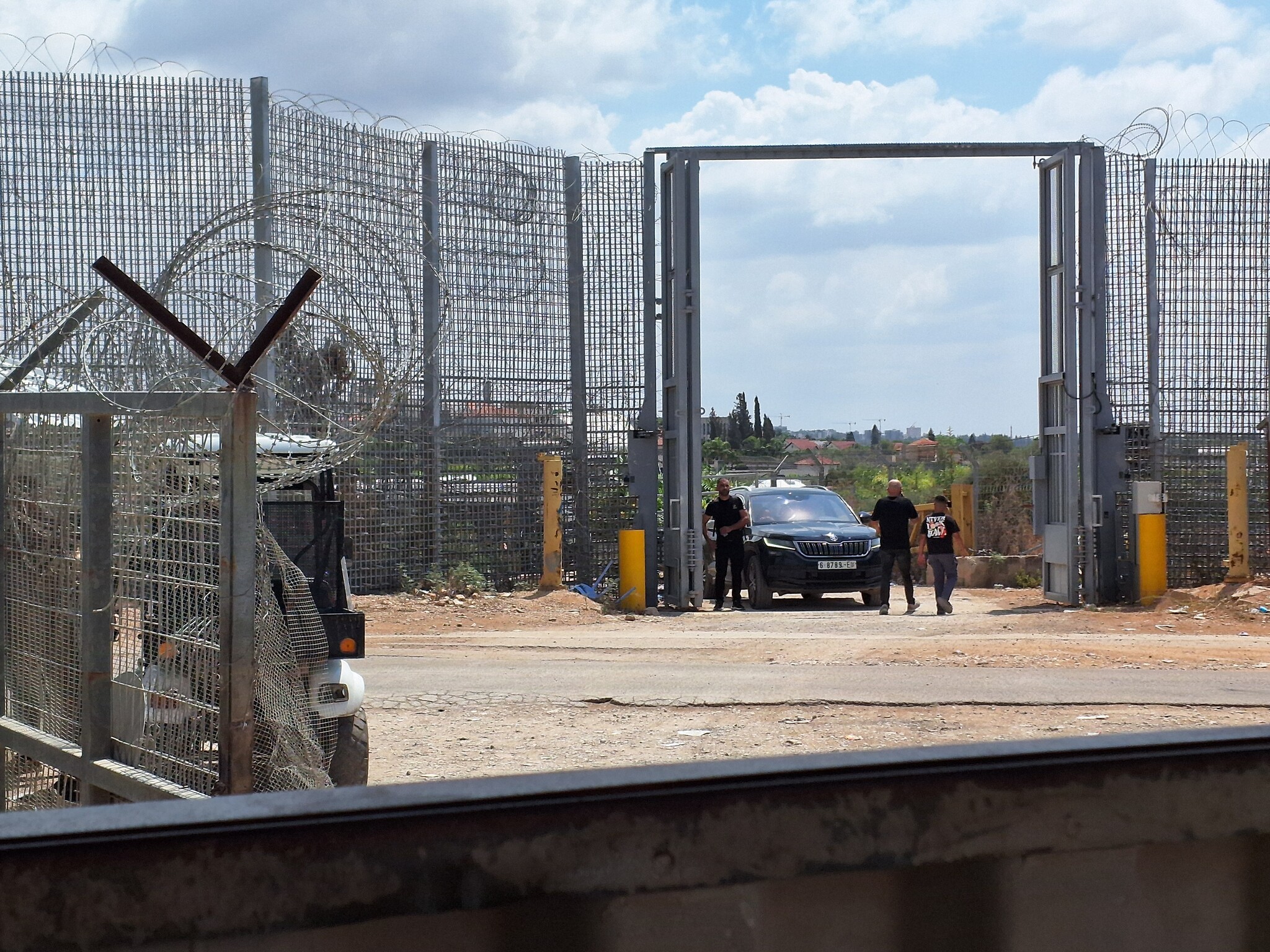 Ronit Dahan-RamatiAug-31-2026Habla. The gate is open
-
