
‘Azzun ‘Atma, Eliyahu Crossing, Falamiya, Habla, Tue 10.9.13, Morning
A quiet day, pleasant weather, no congestion at any checkpoint – the occupation routine, the system ticking along. People go through the Azzun Atma checkpoint: take off your belt, take out your belongings, place them on the concrete wall off to the side, ID on the scanner, finger on the second scanner and – OK – collect everything, put the belt back on and continue to “freedom.” Freedom for what? To look for work as a day laborer, for meager pay? Hope to find someone who’ll hire you, be disappointed when you don’t?
06:05 Azzun Atma checkpoint. A “fabric of life” crossing, open all day.
Many people already waiting, about 30 workers at the Hanson company returning from the night shift. Crossing is quick; whoever arrives – people keep coming – crosses in minutes. A car comes from the Israeli side with someone who lives in Azzun Atma and goes through.
Four new children selling coffee, none of them members of the family that had sold here for the past two years. The line lengthens from time to time and then shortens. The same routine: take off your belt, take out your belongings, place them on the concrete wall off to the side, ID on the scanner, finger on the second scanner and – OK – collect everything, put the belt back on and continue to “freedom.”
It turns out that the children with the coffee came from Azzun Atma through holes in the fence. At 07:00 they’ll go to school. They appear to be 8-10 years old.
At one stage a soldier approaches the groups waiting outside the gate and checks their IDs. One man was “caught;” he has a blue Israeli ID card and went through the fence. He’s immediately released.
07:00 Habla checkpoint. An agricultural gate, open two hours in the morning and an hour in the afternoon and evening.
It’s quiet, the line short – the gate should open at 06:30. The usual arrangement: someone keeps order, is argued with occasionally, five wait in front of the revolving gate to the inspection area.
We gave Sylvia’s phone number to a man whose son has been blacklisted from entering Israel. The father says the son has five children; he himself has a work permit. He hopes his son can be helped and be able to support his children.
The line doesn’t get any shorter. The girls’ school bus arrives at 07:30, stops, waits for inspection. A mule cart exits from the West Bank; many ride bicycles. The soldiers come through the gate to inspect the bus. Two people who appear very young who came on the bus but who have ID cards are taken off and sent to the inspection station. The bus goes through. Cars arrive and cross to the plant nurseries. The line has disappeared; whoever arrives crosses immediately. The boys’ bus arrives, is inspected and crosses. We drive on.
Eliyahu gate. It’s open all the time for crossing to Israel from the West Bank, used by Israelis and Palestinians with permits for the seam zone.
Few Palestinians on line for inspection.
Falamya checkpoint. An agricultural gate, open during daylight hours.
Quiet. The only change is that the lemon grove has been fenced. Not by the IDF, that’s for certain. A tractor crosses, a driver and two workers, and then turns around and returns. The workers got off, continued on foot, but the driver had forgotten his permit. He’s from Jayous, calls his son to bring the papers – what luck he has a phone in his pocket.
No one appears to be working on preparations for the new border fence.
A tractor arrives, loaded with sacks – feed for sheep – enters for inspection. Soldier: What is it? Do you have a permit from the DCO? How many kilos? He doesn’t have a DCO permit in hand. The tractor is sent to wait outside the fence, the soldiers check with the DCO.
The owner of the first tractor that’s waiting tells us his lands are located beyond the horizon and will remain outside the fence; he appears frustrated and angry. After about 20 minutes his son arrives on another tractor, brings the papers and the father crosses. After about 25 minutes the tractor with the feed is still waiting for the DCO’s authorization. We return to Israel.
'Azzun 'Atma
See all reports for this place-
'Azzun 'Atma
A Palestinian village of about 1,800 residents. The settlement of Sha'arei Tikva was established on its land adjacent to it, and the settlement of Oranit was established on its agricultural lands. By 2013, the separation fence had passed through the village and a checkpoint staffed by the army allowed the residents to cross from side to side. After building a massive wall surrounding the village and some of its agricultural lands, the residents went daily for five years to their lands that remained in the Seam Zone through the Oranit agricultural checkpoint (4). Since 2018 it has only opened during the olive harvest and the farmers have to pass daily at the Beit Amin / Abu Salman checkpoint (1447), about 3 kilometers north.From a report from March 24, 2021: "The farmers from Beit Amin and Azon Atma are happy that since February 21 the Oranit checkpoint .is going to be open 3 times a day, The farmers are really developing the place."
Report from July 14, 2024: "Ornit checkpoint is closed . The Beit Amin/Abu Salman agricultural checkpoint is closed (there is no contact with the military to check if it opens rarely), the Ezbat Jaloud checkpoint was opened once a day before the war.
Updated for July 2024
 Apr-11-2019Azoun: The main entrance to village blocked now for several weeks
-
Eliyahu CP (109) / Crossing
See all reports for this place-
Eliyahu CP (109) / Crossing This checkpoint, also known as the Fruit Crossing, is one of the main checkpoints between Israel and the West Bank. It is located on Route 55 between Alfei Menashe and the turn to Qalqilya and Zufin, more than 4 km east of the Green Line, in the separation fence, which separates Qalqilya from its lands to the south, thus leaving Alfei Menashe West of the fence - the Seam Zone. This checkpoint, a few kilometers across the Green Line, is intended for "Israeli settlement in the West Bank and the population of the Seam Zone." It is managed by a civil company. Palestinians with a special permit for their lands in the seam area are also allowed to pass through it, on foot, and sometimes by car.
-
Falamiya
See all reports for this placeHabla
See all reports for this place-
Habla CP (1393)
The Habla checkpoint (1393) was established on the lands of the residents of Qalqilya, on the short road that
connected it for centuries to the nearby town of Habla. The separation barrier intersects this road twice and cut off the residents of Qalqilya from their lands in the seam zone.(between the fence and the green line).
There is a passage under Road 55 that connects Qalqilya to the sabotage This agricultural barrier is used by the farmers and nursery owners established along Road 55 from the Green Line and on both sides of the kurkar road leading to the checkpoint.
This agricultural checkpoint serves the residents of Arab a-Ramadin al-Janoubi (detached from the West Bank), who pass through it to the West Bank and back to their homes. The opening hours (3 times a day) of this agricultural checkpoint are longer than usual, about an hour (recently shortened to 45 minutes), and are coordinated with the transportation hours of a-Ramadin children studying in the occupied in the West Bank.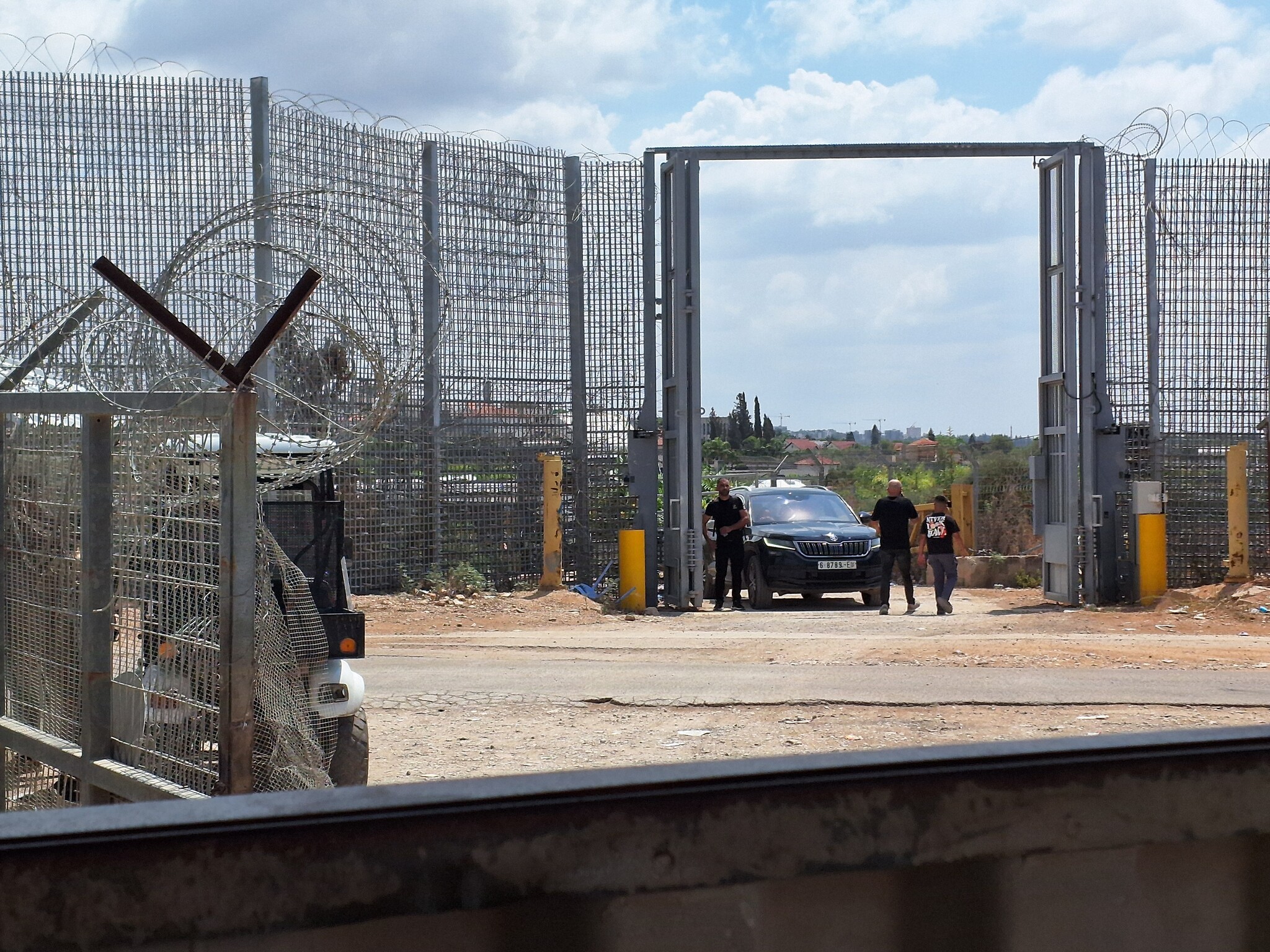 Ronit Dahan-RamatiAug-31-2026Habla. The gate is open
-
