
‘Azzun ‘Atma, Habla
This report was written on September 1, 2014, “Welcome, First Graders” in Israel, the start of a new school year accompanied by tidings such as: an initiative to cancel the status of Arabic as an official language in Israel (http://www.haaretz.co.il/news/education/1.2416209), the de-facto annexation of thousands of dunums of land occupied in 1967 in response to the murder of the three youths from Gush Etzion ( http://www.haaretz.co.il/news/politics/.premium-1.2420890) and new lesson plans for the Israeli school system to justify the occupation (http://www.haaretz.co.il/news/education/1.2421299).
What we saw and heard during the morning shift on 27.9.14 both at ‘Azzun ‘Atma and at Habla combines with the abovementioned tidings to create the intricate fabric called “occupation” which no longer seems possible to unravel.
05:50 ‘Azzun ‘Atma
Twenty to thirty people were always on line while we observed the checkpoint, wanting to leave for work. When more than five have gone through the revolving gate and wait to approach, individually, the two inspection stations, the female soldier scolds them: ”Hey, hey – Stop! Stop! Back, go back.”
An worker for Hansen is removed from the line, sent to sit off to the side. His crossing permit is valid until the end of September, 2014. Nora checked; he’d been blacklisted but it had been cancelled (with Sylvia’s help); he keeps being stopped because the cancellation doesn’t appear on the computer.
After we’d returned from our shift Nora checked with Sylvia: people who were blacklisted and have the blacklisting cancelled receive a crossing permit to Israel but are identified as “worth interrogating,” so the computer doesn’t recognize their permit. It’s not clear who “wins” such a permit, nor when and why the permit is recognized.
At 06:20 two more people with crossing permits joined the first man.
06:45 ID cards are returned to the three detainees who continue on their way to work for the Israeli economy.
Despite the lengthy delay (while they waited other shifts of workers came and went), the Hansen employee keeps his smile and sense of humor; “See you also tomorrow,” he tells the soldier.
06:45 We left.
07:15 Habla
About 20 people in line on the Habla side.
The procedure is five people at the inspection station and five at the revolving gate before it, waiting for the previous five to finish.
The pink school midibus waits on the Habla side.
Shortly after we arrived a male and a female soldier took a Palestinian to the guard post next to the gate leading to the plant nurseries. As if trying to hide him. We can’t clearly hear what they’re saying. The female soldier removes plastic ties from the other soldier’s vest. The Palestinian extends his hands. He’s cuffed.
We telephone the humanitarian office to complain about the cuffing. S., from the operations room, says he’ll look into it.
07:25 The school bus arrives. The midibus returns to Habla with one (?) pupil.
The handcuffed Palestinian, escorted by the two soldiers, sits in the guard post near the pedestrian gate on the way to the plant nurseries. The female soldier puts his ID card in her trouser pocket. She tells him “The police will come and there will be a bigger mess.” She points her smartphone at him. He objects to her photographing her. “It’s not something for discussion,” she says. “I’m not asking you.”
Again we call S. at the operations room. She’d spoken to the DCL. He’s an “imposter;” “The police are coming.” Nora asks the male soldier why the man is cuffed; “For a reason,” he answers. The Palestinian and those who cuffed him talk among themselves. What we hear is the soldier saying, “If I thought you were a terrorist I wouldn’t be sitting here with you.”
08:08 The soldiers should have finished their shift by now, but as the occupied is caught in a tangle they must wait with him and with another detainee, an employee of one of the plant nurseries who’s “blacklisted by the Shabak.”
Time passes; we learn the vocabulary: “Wanted;” “blacklisted” – “DCL blacklist,” “Shabak blacklist.”
That the soldiers are stuck there doesn’t make them any more sympathetic to an elderly Palestinian who arrives with a donkey cart after the time the checkpoint closes and wants to cross to Habla. The soldier admits he doesn’t like cuffing people, but in the past someone he didn’t cuff ran away.
08:38 The ID was returned to the “blacklisted” man who drove off with his employer.
08:45 We left Habla, the cuffed and the cuffers.
On the way to the occupied territories – a military jeep at the entrance to ‘Azzun. Half an hour later it was gone.
'Azzun 'Atma
See all reports for this place-
'Azzun 'Atma
A Palestinian village of about 1,800 residents. The settlement of Sha'arei Tikva was established on its land adjacent to it, and the settlement of Oranit was established on its agricultural lands. By 2013, the separation fence had passed through the village and a checkpoint staffed by the army allowed the residents to cross from side to side. After building a massive wall surrounding the village and some of its agricultural lands, the residents went daily for five years to their lands that remained in the Seam Zone through the Oranit agricultural checkpoint (4). Since 2018 it has only opened during the olive harvest and the farmers have to pass daily at the Beit Amin / Abu Salman checkpoint (1447), about 3 kilometers north.From a report from March 24, 2021: "The farmers from Beit Amin and Azon Atma are happy that since February 21 the Oranit checkpoint .is going to be open 3 times a day, The farmers are really developing the place."
Report from July 14, 2024: "Ornit checkpoint is closed . The Beit Amin/Abu Salman agricultural checkpoint is closed (there is no contact with the military to check if it opens rarely), the Ezbat Jaloud checkpoint was opened once a day before the war.
Updated for July 2024
 Apr-11-2019Azoun: The main entrance to village blocked now for several weeks
-
Habla
See all reports for this place-
Habla CP (1393)
The Habla checkpoint (1393) was established on the lands of the residents of Qalqilya, on the short road that
connected it for centuries to the nearby town of Habla. The separation barrier intersects this road twice and cut off the residents of Qalqilya from their lands in the seam zone.(between the fence and the green line).
There is a passage under Road 55 that connects Qalqilya to the sabotage This agricultural barrier is used by the farmers and nursery owners established along Road 55 from the Green Line and on both sides of the kurkar road leading to the checkpoint.
This agricultural checkpoint serves the residents of Arab a-Ramadin al-Janoubi (detached from the West Bank), who pass through it to the West Bank and back to their homes. The opening hours (3 times a day) of this agricultural checkpoint are longer than usual, about an hour (recently shortened to 45 minutes), and are coordinated with the transportation hours of a-Ramadin children studying in the occupied in the West Bank.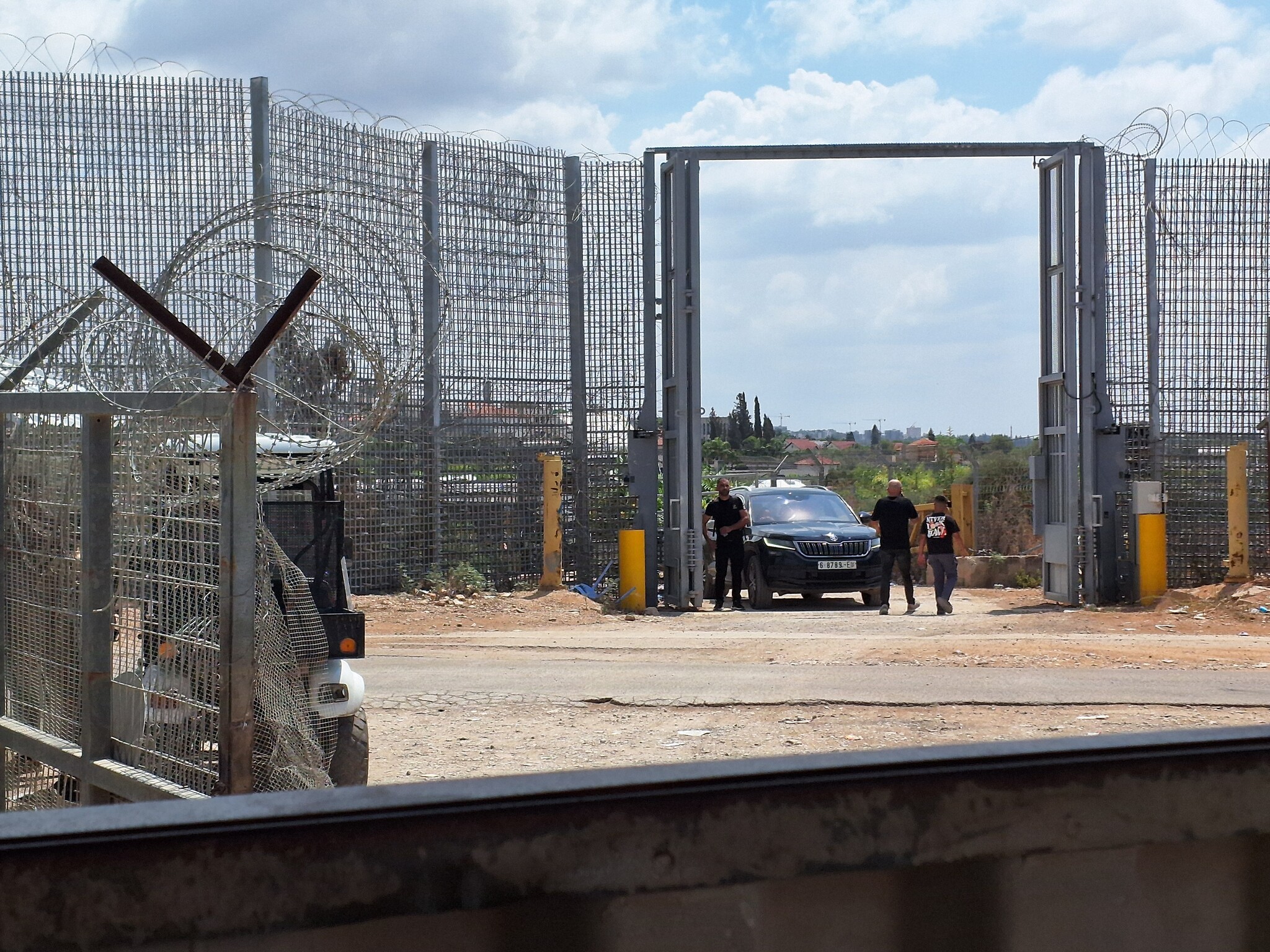 Ronit Dahan-RamatiAug-31-2026Habla. The gate is open
-
