
‘Azzun, ‘Azzun ‘Atma, Eliyahu Crossing, Falamiya, Habla, Mon 4.3.13, Morning
The agricultural gate at Falamya was closed because of a demonstration. The childrens' buses at Habla went through quickly.
06:05 'Azzun 'Atma
Many people have already come through; the gate is open and, behind it, is a line of about 60 people waiting. Every time, the same number of 4 people go through for inspection; when those are checked and released, another 4 go forward toward the gate. All the rest stand about one meter back from the gate; among them are soldiers who are watching them so that "they don't fight and so that they stand in line correctly". It is for their own good, the soldier tells me, because passing is fast which is to their advantage. During the time we were there, in spite of the fast passage, the line never got shorter since there were additional people coming all the time.
06:55 Habla
The soldiers have already opened the gate here, and at 07:00 the first people go through into the checkpoint. Here, as usual, the passage is slower than in 'Azzun 'Atma, but there is progress. In addition bicycles arrive, a wagon with horses, donkeys and a herd of sheep is allowed to cross to the grazing land along the border, after this has been denied them for more than 2 months by our authorities. They were punishing a shepherd, or, more exactly, his herd, for what the shepherd did which was not acceptable. At 07:20 the childrens' buses arrive and go through smoothly.
We continued by way of Eliyahu gate – 5 cars are being inspected and 5 wait in the pedestrian lane. On the way back, no one was in the pedestrian lane and there were also no cars awaiting inspection. The inspections were the same, with the dogs and everything.
'Azzun is open, there is no obstacle to entering the village.
It was quiet when we arrived, only a tractor with 4 passengers came to the gate – it makes a U-turn and returns. Strange.
And then we understood. The gate is closed and locked and there is no one in sight. No soldiers. In front of one of the closed gates, one can see a darkened area, as well as the gate itself, and then we understood that there had been a fire here. The tractor driver explained that a fire had been set yesterday, like in Jayyus a week ago. We hadn't known about that.
We rang the DCO, and they said that the gate had been set on fire yesterday evening and that they didn't know when it would be fixed, maybe today or tomorrow, but meanwhile there is no plan to open the gate, and there is also a technical problem as a result of the arson in opening it. He also said – they are "shooting themselves in the foot". We will follow-up by contacting the tractor driver again.
All this and we can only report that no one can claim that they didn't know there was any problem with the occupation, that it is awful, that civilians are oppressed and also "shoot themselves in the foot", since it apparently is no longer painful. During the past weeks, we frequently see things that the Palestinians do which could be called civil rebellion, even though it does harm their livelihood.
We continued to Madma in order to get the signature of a man on a petition to the court to release him from his status as "forbidden to work in Israel".
'Azzun
See all reports for this place-
Azoun (updated February 2019)
A Palestinian town situated in Area B (under civil Palestinian control and Israeli security control),
on road 5 between Nablus and Qalqiliya, east of Nabi Elias village. The inhabitants are allowed to construct and improve infrastructures. The Separation Fence has confiscated lands belonging to the town's people. In 2018 olive tree groves owned by one of its inhabitants were confiscated for the sake of paving a road to bypass Nabi Elias. Azoun population numbers 13,000, its economic state dire. Its infrastructures are poor, neglect and poverty rampant. In the meantime, the town council has completed paving an internal road for the inhabitants' welfare.
Because of its proximity to the Jewish settler-colony of Karnei Shomron and its outposts, the town suffers the intense presence of the Israeli army, especially at nighttime: soldiers enter homes, arrest suspects, trash the house and sometimes ruin it, as they do in numerous places in the West Bank. At times a checkpoint closes the entrance to the town, so no one can come in or get out.
-
'Azzun 'Atma
See all reports for this place-
'Azzun 'Atma
A Palestinian village of about 1,800 residents. The settlement of Sha'arei Tikva was established on its land adjacent to it, and the settlement of Oranit was established on its agricultural lands. By 2013, the separation fence had passed through the village and a checkpoint staffed by the army allowed the residents to cross from side to side. After building a massive wall surrounding the village and some of its agricultural lands, the residents went daily for five years to their lands that remained in the Seam Zone through the Oranit agricultural checkpoint (4). Since 2018 it has only opened during the olive harvest and the farmers have to pass daily at the Beit Amin / Abu Salman checkpoint (1447), about 3 kilometers north.From a report from March 24, 2021: "The farmers from Beit Amin and Azon Atma are happy that since February 21 the Oranit checkpoint .is going to be open 3 times a day, The farmers are really developing the place."
Report from July 14, 2024: "Ornit checkpoint is closed . The Beit Amin/Abu Salman agricultural checkpoint is closed (there is no contact with the military to check if it opens rarely), the Ezbat Jaloud checkpoint was opened once a day before the war.
Updated for July 2024
 Apr-11-2019Azoun: The main entrance to village blocked now for several weeks
-
Eliyahu CP (109) / Crossing
See all reports for this place-
Eliyahu CP (109) / Crossing This checkpoint, also known as the Fruit Crossing, is one of the main checkpoints between Israel and the West Bank. It is located on Route 55 between Alfei Menashe and the turn to Qalqilya and Zufin, more than 4 km east of the Green Line, in the separation fence, which separates Qalqilya from its lands to the south, thus leaving Alfei Menashe West of the fence - the Seam Zone. This checkpoint, a few kilometers across the Green Line, is intended for "Israeli settlement in the West Bank and the population of the Seam Zone." It is managed by a civil company. Palestinians with a special permit for their lands in the seam area are also allowed to pass through it, on foot, and sometimes by car.
-
Falamiya
See all reports for this placeHabla
See all reports for this place-
Habla CP (1393)
The Habla checkpoint (1393) was established on the lands of the residents of Qalqilya, on the short road that
connected it for centuries to the nearby town of Habla. The separation barrier intersects this road twice and cut off the residents of Qalqilya from their lands in the seam zone.(between the fence and the green line).
There is a passage under Road 55 that connects Qalqilya to the sabotage This agricultural barrier is used by the farmers and nursery owners established along Road 55 from the Green Line and on both sides of the kurkar road leading to the checkpoint.
This agricultural checkpoint serves the residents of Arab a-Ramadin al-Janoubi (detached from the West Bank), who pass through it to the West Bank and back to their homes. The opening hours (3 times a day) of this agricultural checkpoint are longer than usual, about an hour (recently shortened to 45 minutes), and are coordinated with the transportation hours of a-Ramadin children studying in the occupied in the West Bank.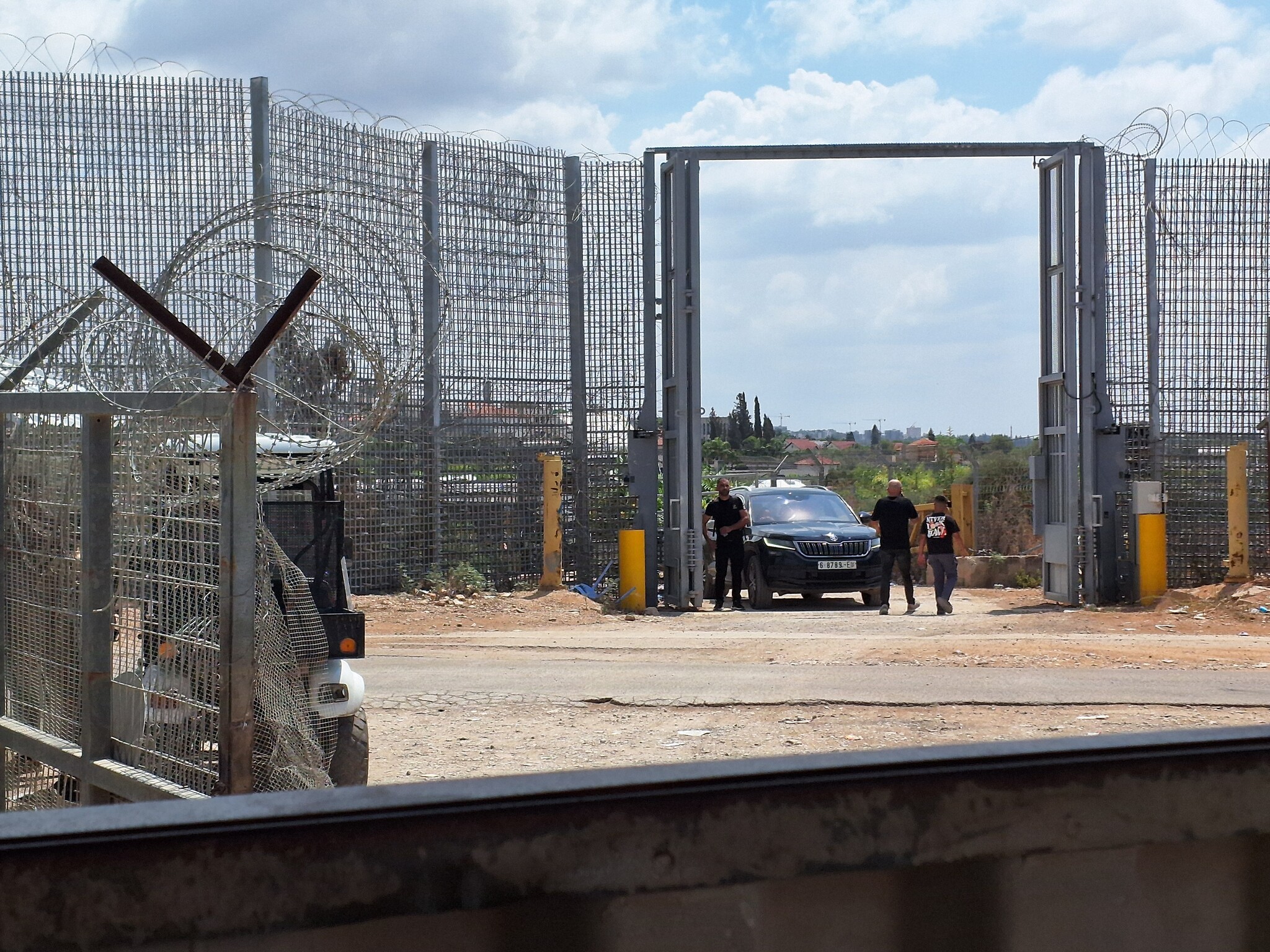 Ronit Dahan-RamatiAug-31-2026Habla. The gate is open
-
