
‘Azzun, ‘Azzun ‘Atma, Habla
05.50 Azzun Atma – It rains heavily, not many workmen pass through the three checking lanes. There is no pressure and no need for prolonged waiting, probably because of the rain, and the soldiers too are quite patient. They said that towards the end of the week less people go through to Israel.
It seems to us that perhaps on Thursday mornings, and certainly on rainy days, there is less need for a shift at this checkpoint.
06.40 HablaThe soldiers open the gate for vehicles, and within a few moments the Palestinians too, arrive. A young workman who works at one of the nurseries told us: The soldiers are good. We tried to check whether he means what he said, and it seemed he did. When we insisted he said, there are good ones and bad ones, but these are good. He asked where we were from and when we said from Tel Aviv he said with a great grin: Tel Aviv Ahla!
The workmen passed 5-5 without delays. After the student bus returned full, in the direction of Habla, we left.
08.00 Azzun.We arrived at the council building for a meeting with L., a young woman, and a member of the village council.
When we enteredH., one of the council workers, met us and showed us a letter that had reached them in the recent days, and which announced that the army was going to confiscate , for its purposes more of the village's territory. The letter was signed by Brigadier General Nitzan Alon.
H. as well as the head of the Council (who joined us in the course of the meeting with L.)seemed very worried by the contents of the letter and H. illustrated the situation; he put his palm on the area mentioned in the letter on the map which was attached to the letter, and said that after the army "put its hand on an area that meant its end….)
H. knows the women of Machsom Watch as far as their activities with women are concerned. L. has passed on to us through the intermediary of Nadim a request to come and meet her, after she had heard from her colleagues, the coordinators at Nabi Ilyas and Far'ata about the activities with us. These coordinators are council members in their villages and by virtue of their functions, meet for common activities. L. received us in the room of the Head of Council and on his chair. She explained smilingly that as a tribute to "The Day of the Woman" that is celebrated on this day, she serves as Head of Council for one day. On the occasion of this day presents were distributed in the village for each woman, and for the end of the month a trip is planned for women from several villages.
After a short conversation we agreed to check the possibility of beginning activities with the women at Azzun. They request instruction in handicraft, knitting and we asked them to find out whether it is possible to allot at each meeting some time to teach our colleagues Arabic, by one of the women of the village.
09.00 Azzun From the council we set out on behalf of Dalia G. to meet J. He too is a resident of an works at the Palestinian Workers Organization. He approached Dalia after he returned completely shaken from an ordeal at the loaded Eyal CP, and was hurt and agitated during the morning hours the whole week through and especially on Sundays.
J. repeated the difficult accounts which are known to us from the morning hours at Irtah, Qalandiya and Tarqumia, and asked us to help. His idea was that we should contact the General Workers Federation, and ask for its help, after he had found out that the "Histadrut" (The Israeli workers organization) collects 30 IS a month from each Palestinian worker who works with a pay slip in Israel.
We asked J. to prepare documentation and the relevant data on the situation of the workers, with the intention to try and assist in the matters he asked for and in others too.
'Azzun
See all reports for this place-
Azoun (updated February 2019)
A Palestinian town situated in Area B (under civil Palestinian control and Israeli security control),
on road 5 between Nablus and Qalqiliya, east of Nabi Elias village. The inhabitants are allowed to construct and improve infrastructures. The Separation Fence has confiscated lands belonging to the town's people. In 2018 olive tree groves owned by one of its inhabitants were confiscated for the sake of paving a road to bypass Nabi Elias. Azoun population numbers 13,000, its economic state dire. Its infrastructures are poor, neglect and poverty rampant. In the meantime, the town council has completed paving an internal road for the inhabitants' welfare.
Because of its proximity to the Jewish settler-colony of Karnei Shomron and its outposts, the town suffers the intense presence of the Israeli army, especially at nighttime: soldiers enter homes, arrest suspects, trash the house and sometimes ruin it, as they do in numerous places in the West Bank. At times a checkpoint closes the entrance to the town, so no one can come in or get out.
-
'Azzun 'Atma
See all reports for this place-
'Azzun 'Atma
A Palestinian village of about 1,800 residents. The settlement of Sha'arei Tikva was established on its land adjacent to it, and the settlement of Oranit was established on its agricultural lands. By 2013, the separation fence had passed through the village and a checkpoint staffed by the army allowed the residents to cross from side to side. After building a massive wall surrounding the village and some of its agricultural lands, the residents went daily for five years to their lands that remained in the Seam Zone through the Oranit agricultural checkpoint (4). Since 2018 it has only opened during the olive harvest and the farmers have to pass daily at the Beit Amin / Abu Salman checkpoint (1447), about 3 kilometers north.From a report from March 24, 2021: "The farmers from Beit Amin and Azon Atma are happy that since February 21 the Oranit checkpoint .is going to be open 3 times a day, The farmers are really developing the place."
Report from July 14, 2024: "Ornit checkpoint is closed . The Beit Amin/Abu Salman agricultural checkpoint is closed (there is no contact with the military to check if it opens rarely), the Ezbat Jaloud checkpoint was opened once a day before the war.
Updated for July 2024
 Apr-11-2019Azoun: The main entrance to village blocked now for several weeks
-
Habla
See all reports for this place-
Habla CP (1393)
The Habla checkpoint (1393) was established on the lands of the residents of Qalqilya, on the short road that
connected it for centuries to the nearby town of Habla. The separation barrier intersects this road twice and cut off the residents of Qalqilya from their lands in the seam zone.(between the fence and the green line).
There is a passage under Road 55 that connects Qalqilya to the sabotage This agricultural barrier is used by the farmers and nursery owners established along Road 55 from the Green Line and on both sides of the kurkar road leading to the checkpoint.
This agricultural checkpoint serves the residents of Arab a-Ramadin al-Janoubi (detached from the West Bank), who pass through it to the West Bank and back to their homes. The opening hours (3 times a day) of this agricultural checkpoint are longer than usual, about an hour (recently shortened to 45 minutes), and are coordinated with the transportation hours of a-Ramadin children studying in the occupied in the West Bank.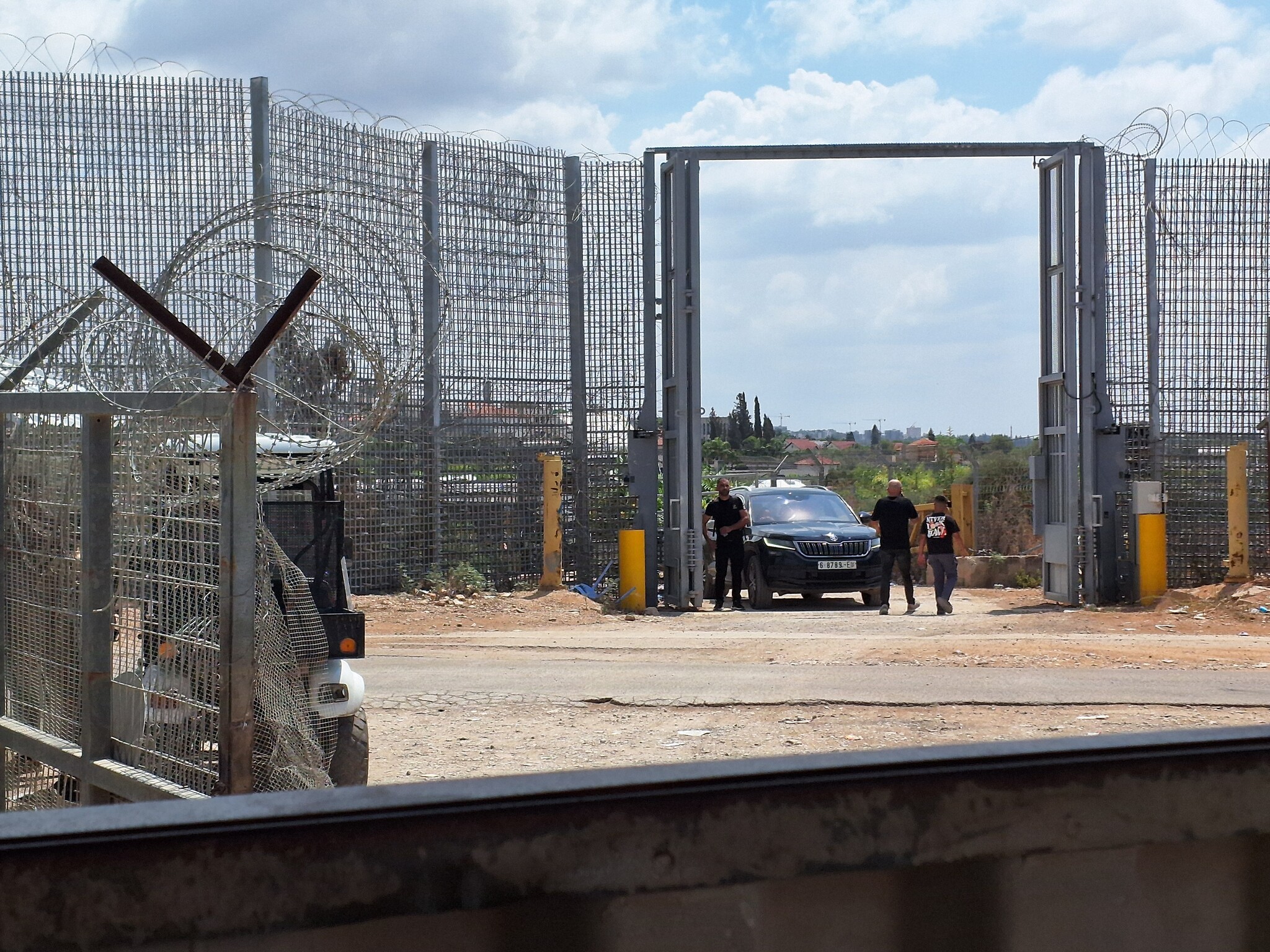 Ronit Dahan-RamatiAug-31-2026Habla. The gate is open
-
