
‘Azzun, ‘Azzun ‘Atma, Habla, Mon 8.11.10, Morning
Subject: trans. Agricultural crossing, Hablah, Azun Atmeh
Agricultural crossing Habla, ‘Azzun ‘Atma, Mon. AM, 8.11.10
07:30 Habla
The gate opened on time but, despite the late hour, there are still about 20 Palestinians waiting to cross. The soldiers are polite and make the crossing swift and well-organized.
07:50 ‘Azzun
There is a "hammer" opposite the entrance to ‘Azzun, observing those coming and going. We enter the village on our way to ‘Azzun ‘Atma. We travel the pleasant road through the villages Thulth, Sannirya and Bet Amin, and arrive at the abandoned gate which embittered the lives of the residents in the past. The olive harvest is almost over, and you only see individual pickers here and there. The burning and smelly garbage dump which was on the side of the road for many years, between Sannirya and Bet Amin, is extinguished and seems to be taken care of.
The entrance to the village of ‘Azzun ‘Atma passes at the foot of the houses of Sha'arei Tikvah. Their balconies are actually next to and attached to the fence. We pass by two schools and arrive at a very new attractive building which serves as a learning center and kindergarten. There are new playground toys in the courtyard, grass and flowers. Donated by the World Bank.
We reach the upper gate which is manned by soldiers and serves as an exit for workers in the nearby settlements. Also, Palestinians whose lands are on the other side of the fence "succeeded" in receiving permits to go out to their land. Dozens of cars of Palestinans from the nearby villages, who have work permits for the settlements, are parked on the roads leading to the checkpoint and in an improvised parking lot alongside the checkpoint.
We talked with some taxi drivers who were waiting for passengers about the present situation, which is a bit better than the past, but still pretty awful. For example, one of the taxi driver's family has an olive grove on the other side of the fence. His brother is unemployed, but didn't receive a permit to work during the harvest. In contrast, the brother who is a taxi driver and employed, did receive a permit but then lost work days so that he could help his elderly parents…They gave us other examples of hard-heartedness and difficulties.
In fact, our visit in the village was in preparation for a meeting with the residents who have lands along the seam line and even within the area between settlements which are near the village.
After a phone conversation with the head of the village, we traveled to the town hall and met with the village secretary. The town hall is in the lower portion of the village, in a large building which has a big auditorium on the ground floor which serves as an events hall for the residents. On the next floor, there is a public clinic with doctor and nurses and also the Physicians for Human Rights work there once a week. On the top floor are the village offices.
We met the village secretary, a very impressive man, a graduate of A-najah University in Nablus. Speaks excellent Hebrew. Before the building of the fence around the village, he had a fruit and vegetable shop near the entrance of the settlement Sha'arei Tikvah (on his own land). Israelis from the area would shop there, settlers and army personnel who passed through. In the year 1997, when the settlement was enlarged, he received a demolition order for the shop and, after it had been demolished 6 times, he gave up. Even now, Israelis call him up and ask how he is doing and how his father is, and speak sorrowfully of the present situation.
We spoke for a long time, about the situation in village and about the land problems and about his life and that of his family under the occupation. He and his extended family live in a house which is outside the fence, opposite the gate, and their daily dependence on going through the checkpoint all the time for work, for school, to the store and the doctor, is unbearable. We concluded that, after the holiday in the coming week, he would invite representatives from 3 families to meet us in the town hall, so that we could gather information in an organized and exact way. He agreed with us that one can't expect much regarding the "arrangement" of permits; the goal is to publicize the difficulties of the occupation, with an emphasis on the land problems.
We returned again through the villages and saw that, at this late hour, the shops and cafes were still open and there were a lot more people in the streets.
.
'Azzun
See all reports for this place-
Azoun (updated February 2019)
A Palestinian town situated in Area B (under civil Palestinian control and Israeli security control),
on road 5 between Nablus and Qalqiliya, east of Nabi Elias village. The inhabitants are allowed to construct and improve infrastructures. The Separation Fence has confiscated lands belonging to the town's people. In 2018 olive tree groves owned by one of its inhabitants were confiscated for the sake of paving a road to bypass Nabi Elias. Azoun population numbers 13,000, its economic state dire. Its infrastructures are poor, neglect and poverty rampant. In the meantime, the town council has completed paving an internal road for the inhabitants' welfare.
Because of its proximity to the Jewish settler-colony of Karnei Shomron and its outposts, the town suffers the intense presence of the Israeli army, especially at nighttime: soldiers enter homes, arrest suspects, trash the house and sometimes ruin it, as they do in numerous places in the West Bank. At times a checkpoint closes the entrance to the town, so no one can come in or get out.
-
'Azzun 'Atma
See all reports for this place-
'Azzun 'Atma
A Palestinian village of about 1,800 residents. The settlement of Sha'arei Tikva was established on its land adjacent to it, and the settlement of Oranit was established on its agricultural lands. By 2013, the separation fence had passed through the village and a checkpoint staffed by the army allowed the residents to cross from side to side. After building a massive wall surrounding the village and some of its agricultural lands, the residents went daily for five years to their lands that remained in the Seam Zone through the Oranit agricultural checkpoint (4). Since 2018 it has only opened during the olive harvest and the farmers have to pass daily at the Beit Amin / Abu Salman checkpoint (1447), about 3 kilometers north.From a report from March 24, 2021: "The farmers from Beit Amin and Azon Atma are happy that since February 21 the Oranit checkpoint .is going to be open 3 times a day, The farmers are really developing the place."
Report from July 14, 2024: "Ornit checkpoint is closed . The Beit Amin/Abu Salman agricultural checkpoint is closed (there is no contact with the military to check if it opens rarely), the Ezbat Jaloud checkpoint was opened once a day before the war.
Updated for July 2024
 Apr-11-2019Azoun: The main entrance to village blocked now for several weeks
-
Habla
See all reports for this place-
Habla CP (1393)
The Habla checkpoint (1393) was established on the lands of the residents of Qalqilya, on the short road that
connected it for centuries to the nearby town of Habla. The separation barrier intersects this road twice and cut off the residents of Qalqilya from their lands in the seam zone.(between the fence and the green line).
There is a passage under Road 55 that connects Qalqilya to the sabotage This agricultural barrier is used by the farmers and nursery owners established along Road 55 from the Green Line and on both sides of the kurkar road leading to the checkpoint.
This agricultural checkpoint serves the residents of Arab a-Ramadin al-Janoubi (detached from the West Bank), who pass through it to the West Bank and back to their homes. The opening hours (3 times a day) of this agricultural checkpoint are longer than usual, about an hour (recently shortened to 45 minutes), and are coordinated with the transportation hours of a-Ramadin children studying in the occupied in the West Bank.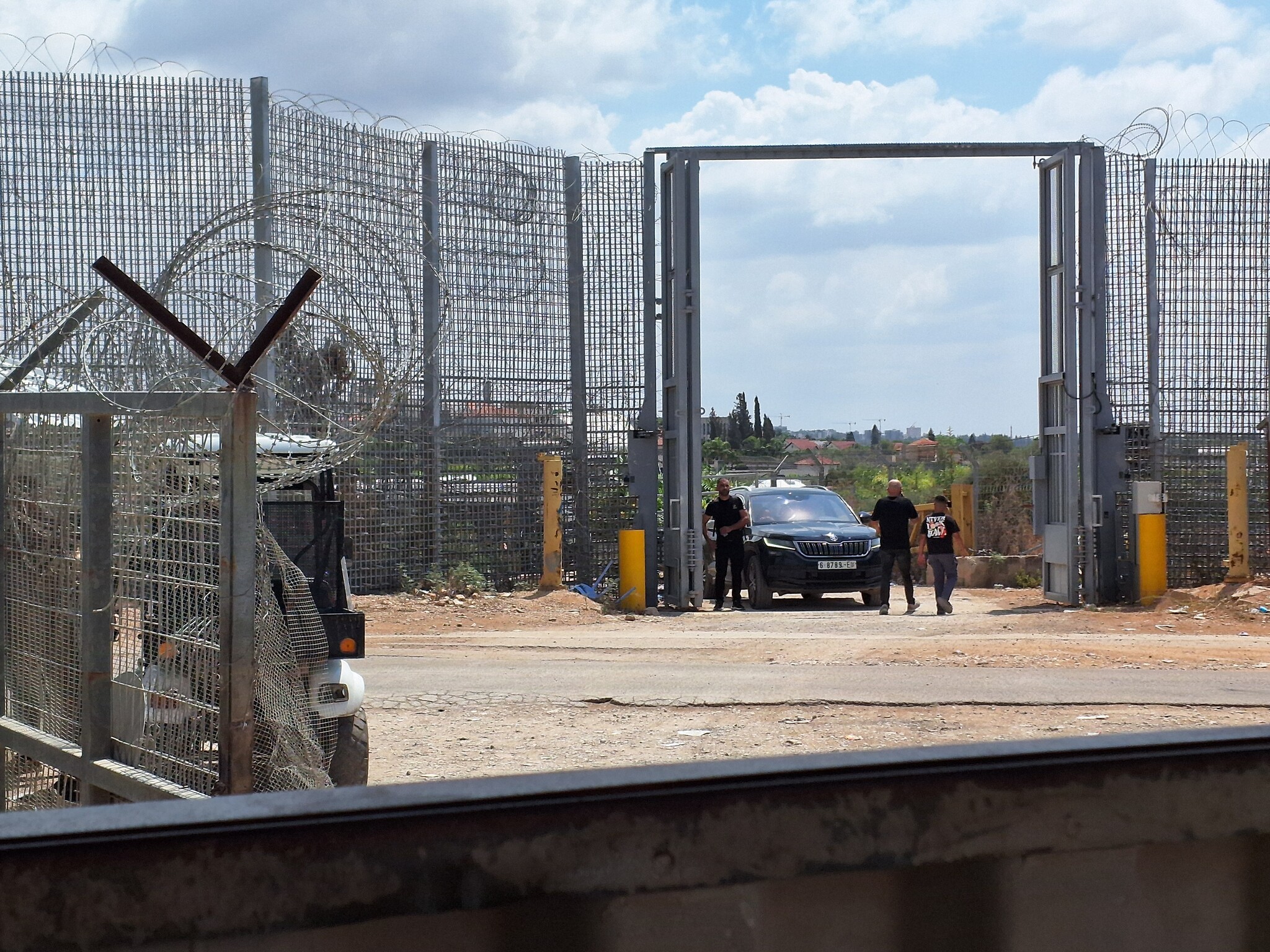 Ronit Dahan-RamatiAug-31-2026Habla. The gate is open
-
