
‘Azzun, Eliyahu Crossing, Falamiya, Habla, Jayyus

We met near the Falamiya CP with farmers from the village of Jamal, who wanted to protest against the considerable deterioration in their working conditions which will take effect when the CP will be moved owing to the change in the delineation of the fence.
We were witness to a "state visit" of the representative of the head of the Palestinian Authority at the pump of Habla.
10:30 Eliyahu crossing– there were no delays. There were cars in the checking facility.
10:40 Azzun – We brough Z. many parcels of clothes and household appliances, and heard about the fire that broke out at night in his shop, as a result of a short circuit, and which consumed the entire contents. "Everything that the fire didn't consume, was destroyed by the water", of the firemen who broke into the shop and extinguished the fire. His old computer was also destroyed, and he would be happy to receive another old computer.
11:00 Jayyus We collected two EAPPI volunteers who wished to join us and to hear about the problems concerning the Palamiya CP and we heard about their morning shift at Kapin.
11:30 Palamiya CP.About six Palestinian cars were parked along the road, waiting for their owners who work on the other side of the fence. We met a man who told us that he had very many Za'tar fields beyond the fence. The validity of his right of passage expired on 8/6 and he is prevented from reaching his land as he hasn't received a new permit. He is required each time to bring new documents and doesn't obtain a permit "I have DCO". His son too has a problem, the soldiers didn't make him sign when he returned from the fields, they hurried him on or he had already left the area, and on the morrow they told him that his permit was forged. He is trying to arrange the matter in Kalkilya. We took all the details.
11:40 A car arrived from the direction of the seamline zone. There were five persons in it who came to explain the problem of the Village of Jamal farmers. Their lands extend from Sal'it in the north to Tzur Natan and Kohav Yair. Today too they have difficulties in reaching their lands which are very far from the Palamiya gate and they are obliged to pass by way of the lands of other farmers who resent this. They understood that when the fence will be moved westwards, the Palamiya gate too will be moved 2-3 kms further away and this will make it even more difficults to reach their lands. It may be remembered that once there were 5 gates which enabled the passage of farmers from the village of Jamal near their lands. It is about two years that these gates aren't opened for them anymore.
We drove to see the Abu Assan gate which is near Zur Natan. We politely declined to have teaThe villagers have a simple practical solution. There is the gate no. 919, named after the veteran head of the village, Abu Assan, which is opened three times a day during the olive picking season. When the Palamiya gate will be moved, they would like to be able to pass through that gate all along the year. In order to enable them to reach their lands without having to pass through the lands of others a small chirurgical action is needed: to open an opening of 3 meters in the western fence, of the three fences constituting the separation blockage.
at his house and returned to Jaius by way of the villages Palamiya and Jama'l.
12:50 Habla gate. Three carts hitched to horses and donkeys and 12 persons waiting for the CP to be opened. The pump room was open, two persons entered with us, the pump operator and one of the hothouse owners, very elegantly dressed. The engine of the Disel pump was reestablished after they paid 7000 IS to get is back, but it is not connected as there is no pump.
On the wall there is a modern fuse box which waits since two months for the electrical pump which was confiscated. Everybody was waiting for the arrival of an important personality: The representative of the Head of the Authority for the region of Kilkilya. And indeed, when the gate was opened at 13:05 two cars with the distinguished guests arrive from Habla. Abed, the owner of the hothouse joins the group, and explains to the guests the whole story of the pumps. Later they visit the plant nursery of Omer.
It is difficult to understand the abuse of those owners who only wanted to exchange a 30 year old diesel pump for a modern electrical pump which was donated by the Government of Sweden.
'Azzun
See all reports for this place-
Azoun (updated February 2019)
A Palestinian town situated in Area B (under civil Palestinian control and Israeli security control),
on road 5 between Nablus and Qalqiliya, east of Nabi Elias village. The inhabitants are allowed to construct and improve infrastructures. The Separation Fence has confiscated lands belonging to the town's people. In 2018 olive tree groves owned by one of its inhabitants were confiscated for the sake of paving a road to bypass Nabi Elias. Azoun population numbers 13,000, its economic state dire. Its infrastructures are poor, neglect and poverty rampant. In the meantime, the town council has completed paving an internal road for the inhabitants' welfare.
Because of its proximity to the Jewish settler-colony of Karnei Shomron and its outposts, the town suffers the intense presence of the Israeli army, especially at nighttime: soldiers enter homes, arrest suspects, trash the house and sometimes ruin it, as they do in numerous places in the West Bank. At times a checkpoint closes the entrance to the town, so no one can come in or get out.
-
Eliyahu CP (109) / Crossing
See all reports for this place-
Eliyahu CP (109) / Crossing This checkpoint, also known as the Fruit Crossing, is one of the main checkpoints between Israel and the West Bank. It is located on Route 55 between Alfei Menashe and the turn to Qalqilya and Zufin, more than 4 km east of the Green Line, in the separation fence, which separates Qalqilya from its lands to the south, thus leaving Alfei Menashe West of the fence - the Seam Zone. This checkpoint, a few kilometers across the Green Line, is intended for "Israeli settlement in the West Bank and the population of the Seam Zone." It is managed by a civil company. Palestinians with a special permit for their lands in the seam area are also allowed to pass through it, on foot, and sometimes by car.
-
Falamiya
See all reports for this placeHabla
See all reports for this place-
Habla CP (1393)
The Habla checkpoint (1393) was established on the lands of the residents of Qalqilya, on the short road that
connected it for centuries to the nearby town of Habla. The separation barrier intersects this road twice and cut off the residents of Qalqilya from their lands in the seam zone.(between the fence and the green line).
There is a passage under Road 55 that connects Qalqilya to the sabotage This agricultural barrier is used by the farmers and nursery owners established along Road 55 from the Green Line and on both sides of the kurkar road leading to the checkpoint.
This agricultural checkpoint serves the residents of Arab a-Ramadin al-Janoubi (detached from the West Bank), who pass through it to the West Bank and back to their homes. The opening hours (3 times a day) of this agricultural checkpoint are longer than usual, about an hour (recently shortened to 45 minutes), and are coordinated with the transportation hours of a-Ramadin children studying in the occupied in the West Bank.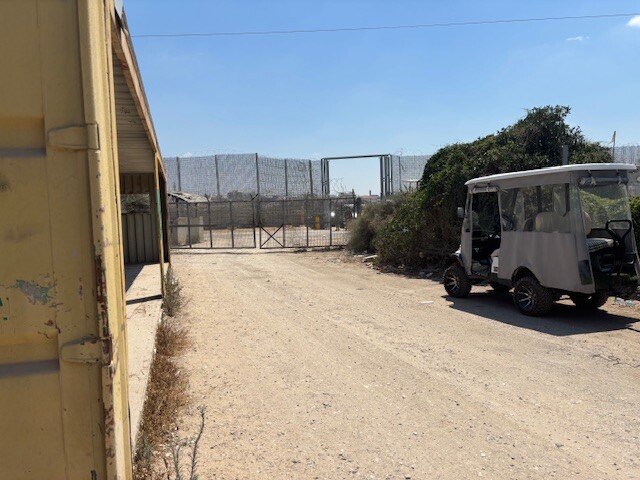 Nina SebaAug-18-2025Habla: The gate is in the process of closing
-
Jayyus North (935)
See all reports for this place