
‘Azzun, Eliyahu Crossing, Habla, Mon 10.9.12, Morning
06:30 Eliyahu Gate
A very small line for pedestrians. 3 cars being inspected. We continued immediately to the entrance of Qalqilya for a meeting with someone who had been blacklisted by the GSS, in order to get his signature on some forms.
7:00 Izbatt Tabib
All lot of children already leaving their houses on the way to school at Azun and Izbat Tabib. We decided to travel to the school, since we were told that there were problems and that the IDF had arrived and was harassing the children. It was quiet near the school. A youth came out and, despite our protests, he called M. and woke him up. He sat us on chairs near the entrance to the school, opposite the garden where the "protests" had been organized. There were a number of signs in Arabic and Hebrew, and a pergola. A Palestinian flag and some small flags. Chickens were wandering around on the road between the playground and the houses. We spent the next half an hour in conversation with M., after he got organized and prepared coffee for us. Meanwhile, the children were arriving at school, happy and cheerful and they stood in ranks for the beginning of the school day. We heard a megaphone broadcasting slogans and songs, and then quiet – they entered the classrooms.
M. says that the IDF arrives from time to time and sets up flying checkpoints,etc., but he didn't say anything about harassment of the children, except when they go to their homes and search for children who "threw stones". M. said, "How can they throw stones on the road after they have built the fence?" According to him there are 50 children in the school, and also someone came from Ramadin (a Bedouin tribe which lives on the Israeli side of the fence) who brought children to the school, which he considered to be better than the school in his area. There are 40 houses in the village, out of which about 35 have demolition orders. The village is in Area C, so they can't get building permits, or permits for "natural growth", as they can on the Jewish settlements. He also told us that the village was created because his grandfather bought 100 dunams there and settled one of his wives there. The others lived with him in the area of Raanana, in a village named Tubsur. When they were evicted in 1948, the whole family moved to live near their fields here, and they are here since then. Today a lawyer is due to submit a petition at the High Court, against the demolition of the school.
08:20 Habla
Very few people are waiting, and they go through quickly; everyone who arrives, goes through quickly on both directions, including cars belonging to Omar, the owner of the nursery, and others.
—
'Azzun
See all reports for this place-
Azoun (updated February 2019)
A Palestinian town situated in Area B (under civil Palestinian control and Israeli security control),
on road 5 between Nablus and Qalqiliya, east of Nabi Elias village. The inhabitants are allowed to construct and improve infrastructures. The Separation Fence has confiscated lands belonging to the town's people. In 2018 olive tree groves owned by one of its inhabitants were confiscated for the sake of paving a road to bypass Nabi Elias. Azoun population numbers 13,000, its economic state dire. Its infrastructures are poor, neglect and poverty rampant. In the meantime, the town council has completed paving an internal road for the inhabitants' welfare.
Because of its proximity to the Jewish settler-colony of Karnei Shomron and its outposts, the town suffers the intense presence of the Israeli army, especially at nighttime: soldiers enter homes, arrest suspects, trash the house and sometimes ruin it, as they do in numerous places in the West Bank. At times a checkpoint closes the entrance to the town, so no one can come in or get out.
-
Eliyahu CP (109) / Crossing
See all reports for this place-
Eliyahu CP (109) / Crossing This checkpoint, also known as the Fruit Crossing, is one of the main checkpoints between Israel and the West Bank. It is located on Route 55 between Alfei Menashe and the turn to Qalqilya and Zufin, more than 4 km east of the Green Line, in the separation fence, which separates Qalqilya from its lands to the south, thus leaving Alfei Menashe West of the fence - the Seam Zone. This checkpoint, a few kilometers across the Green Line, is intended for "Israeli settlement in the West Bank and the population of the Seam Zone." It is managed by a civil company. Palestinians with a special permit for their lands in the seam area are also allowed to pass through it, on foot, and sometimes by car.
-
Habla
See all reports for this place-
Habla CP (1393)
The Habla checkpoint (1393) was established on the lands of the residents of Qalqilya, on the short road that
connected it for centuries to the nearby town of Habla. The separation barrier intersects this road twice and cut off the residents of Qalqilya from their lands in the seam zone.(between the fence and the green line).
There is a passage under Road 55 that connects Qalqilya to the sabotage This agricultural barrier is used by the farmers and nursery owners established along Road 55 from the Green Line and on both sides of the kurkar road leading to the checkpoint.
This agricultural checkpoint serves the residents of Arab a-Ramadin al-Janoubi (detached from the West Bank), who pass through it to the West Bank and back to their homes. The opening hours (3 times a day) of this agricultural checkpoint are longer than usual, about an hour (recently shortened to 45 minutes), and are coordinated with the transportation hours of a-Ramadin children studying in the occupied in the West Bank.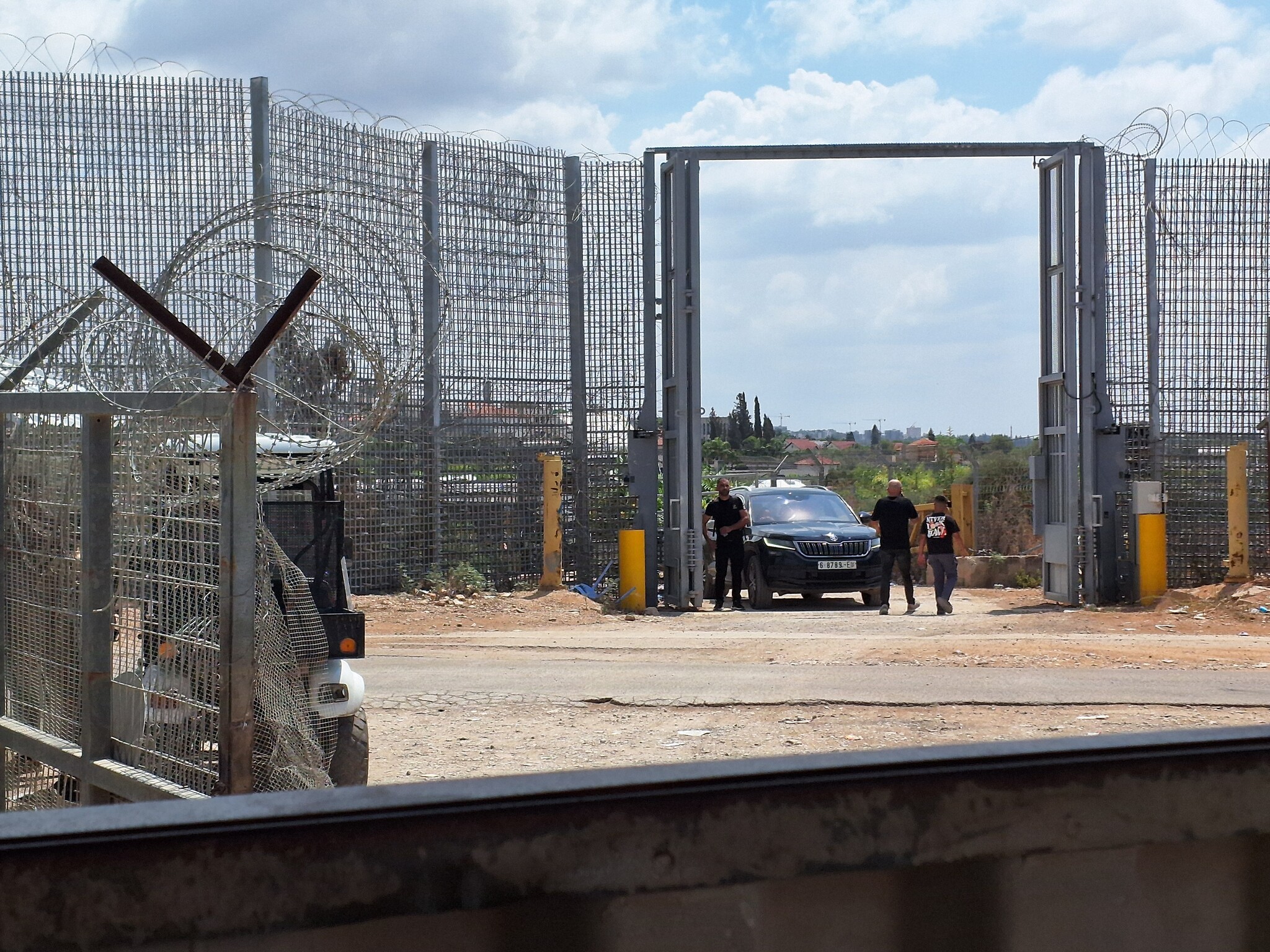 Ronit Dahan-RamatiAug-31-2026Habla. The gate is open
-
