
‘Azzun, Eliyahu Crossing, Habla, Mon 31.10.11, Morning
The gates are locked to the fields in the seam zone that belong to farmers from Kafr Jimal.
06:30 Habla crossing
The gate is open, a large truck crosses, loaded with seedlings, and another follows. The MP quickly inspects the drivers’ documents.
People on foot go through the inspection building rapidly.
Two officers approach us and introduce themselves as the commanders of the paratroop unit now in charge of checkpoints in the area. They want to know about us, what we think about this checkpoint and about the checkpoints in general. We express our views about the occupation. They listen quietly, without expressing an opinion.
06:55 Eliyahu crossing (109)
We see 4-5 cars being inspected in the area where cars belonging to Arab Israelis and Palestinians are checked, their doors open, riders standing outside, and people also waiting to go through the pedestrian gate. We saw out of the corner of our eye the children’s bus, empty, parked on the side, the driver and Israeli police standing outside the bus.
Unfortunately, we’d already passed the entrance to the parking lot and couldn’t stop, because when we slowed a security person was on his way over to us and we didn’t want to get a ticket for parking on a yellow line…you can’t turn around there!
07:00 Many laborers wait for rides at the entrance to 'Azzun.
07:05 The Jayyus agricultural gate is open and many people and vehicles, including donkeys and carts, are waiting. People cross quickly and the soldiers seem to know those going through.
A farmer crossing asks us whether we’ve seen any other place in the world where people need a permit to access their own lands…
He says that only he got a permit for the olive harvest; his sons went to the DCO a few days ago but didn’t get a permit.
At 07:30 exactly they close the gate. In response to my question, the soldier says that because of the olive harvest many more people cross through Jayyus’ southern gate.
A tractor with two men arrives late; we give a ride to the passenger who tells us the tractor driver doesn’t have a permit to go through.
07:35 Falamiya
We meet a farmer from Falamiya who arrives by car, parks and takes a bicycle out of the trunk. He doesn’t have a permit for the car, so he rides the bike. He’s bringing sacks for the olives. He also has land closer to the Sal’it checkpoint but that’s only open infrequently so he prefers a permit for the Falamiya checkpoint which is open all day. He didn’t know that residents of Jayyus could obtain permits for two checkpoints; he said he’d find out at the DCO.
A very elderly couple arrives in a cart harnessed to a donkey. The husband walks with great difficulty. They’re the only ones in the family who received harvest permits. They tell us that many people in Jayyus didn’t get permits.
A man on horseback rides into the checkpoint; the MP reproaches him.
08:00 We leave and drive via Falamiya to Kafr Jimal, stop at Z’s, who owns the grocery, and his lovely wife. Z.’s Hebrew is excellent; he’s happy to see us and immediately invites us to tea with sage, and despite our protests his wife serves us an amazing breakfast.
A neighbor arrives and tells us very angrily about an incident that occurred yesterday and hasn’t been resolved. It turns out that, in addition to the main gate in the separation fence, there are also fences and gates between fields in the seam zone. They’re locked; the army is supposed to open them every morning so people can go to their fields. The army locks them in their fields and in the afternoon soldiers come to open them in time for them to return before the main gate is closed (I don’t know what happens if someone feels ill during the day and wants to return home, and in fact, as I’m writing this, I think of more questions I failed to ask yesterday…). Anyway, that day the soldiers didn’t come in the afternoon to release the workers, and despite shouting, telephone calls and calling out to soldiers who were seen passing at a distance, no one came to open the gates, and when it got late they managed to get over the fence and return with great difficulty, after a long detour (they left behind the tractor with which they arrived, their tools and the olives they’d picked). The following day (while we were at the crossing) the owner of the tractor walked to the field and found the gate locked…he came back boiling with anger; the owner of the grocery called him over to tell us what had happened. He didn’t want to hear what Tedesa had to say (I completely sympathize).
Tedesa already knew about the matter, said the soldiers were late and when they arrived the people were no longer there and they saw only the tractor, and next morning they forgot to come open the gate! He’ll immediately send soldiers to open it… And regarding the basic issue of locking people in their fields, he said it was done for security reasons, and can’t be changed, and with regard to the complaint that during the summer people with permits to work their fields can’t do so because they’re locked, he said that can’t be changed either.
I told Tami and Yael, who spoke the same day to the head of the DCO, and received more or less the same unsatisfactory replies. We left our phone numbers with Z., the owner of the grocery, and his neighbor the farmer so they could report similar incidents, or others.
We drove on to the village of Jayyus to meet the son of the owner of the grove we’d helped harvest olives two weeks ago. A., aged 60+, a retired history teacher, speaks English well, is the only member of his large family who received a permit to harvest his lovely olive trees. The Shabak has blacklisted all his sons, and there’s no way to remove their names. They can’t assist him, nor can his handicapped wife.
Today we came to buy oil pressed from the olives we picked and had a long conversation with the son about himself and his extended family.
11:00 We returned through the settlers’ lane at the Eliyau crossing with heavy hearts and with no delays.
)
'Azzun
See all reports for this place-
Azoun (updated February 2019)
A Palestinian town situated in Area B (under civil Palestinian control and Israeli security control),
on road 5 between Nablus and Qalqiliya, east of Nabi Elias village. The inhabitants are allowed to construct and improve infrastructures. The Separation Fence has confiscated lands belonging to the town's people. In 2018 olive tree groves owned by one of its inhabitants were confiscated for the sake of paving a road to bypass Nabi Elias. Azoun population numbers 13,000, its economic state dire. Its infrastructures are poor, neglect and poverty rampant. In the meantime, the town council has completed paving an internal road for the inhabitants' welfare.
Because of its proximity to the Jewish settler-colony of Karnei Shomron and its outposts, the town suffers the intense presence of the Israeli army, especially at nighttime: soldiers enter homes, arrest suspects, trash the house and sometimes ruin it, as they do in numerous places in the West Bank. At times a checkpoint closes the entrance to the town, so no one can come in or get out.
-
Eliyahu CP (109) / Crossing
See all reports for this place-
Eliyahu CP (109) / Crossing This checkpoint, also known as the Fruit Crossing, is one of the main checkpoints between Israel and the West Bank. It is located on Route 55 between Alfei Menashe and the turn to Qalqilya and Zufin, more than 4 km east of the Green Line, in the separation fence, which separates Qalqilya from its lands to the south, thus leaving Alfei Menashe West of the fence - the Seam Zone. This checkpoint, a few kilometers across the Green Line, is intended for "Israeli settlement in the West Bank and the population of the Seam Zone." It is managed by a civil company. Palestinians with a special permit for their lands in the seam area are also allowed to pass through it, on foot, and sometimes by car.
-
Habla
See all reports for this place-
Habla CP (1393)
The Habla checkpoint (1393) was established on the lands of the residents of Qalqilya, on the short road that
connected it for centuries to the nearby town of Habla. The separation barrier intersects this road twice and cut off the residents of Qalqilya from their lands in the seam zone.(between the fence and the green line).
There is a passage under Road 55 that connects Qalqilya to the sabotage This agricultural barrier is used by the farmers and nursery owners established along Road 55 from the Green Line and on both sides of the kurkar road leading to the checkpoint.
This agricultural checkpoint serves the residents of Arab a-Ramadin al-Janoubi (detached from the West Bank), who pass through it to the West Bank and back to their homes. The opening hours (3 times a day) of this agricultural checkpoint are longer than usual, about an hour (recently shortened to 45 minutes), and are coordinated with the transportation hours of a-Ramadin children studying in the occupied in the West Bank.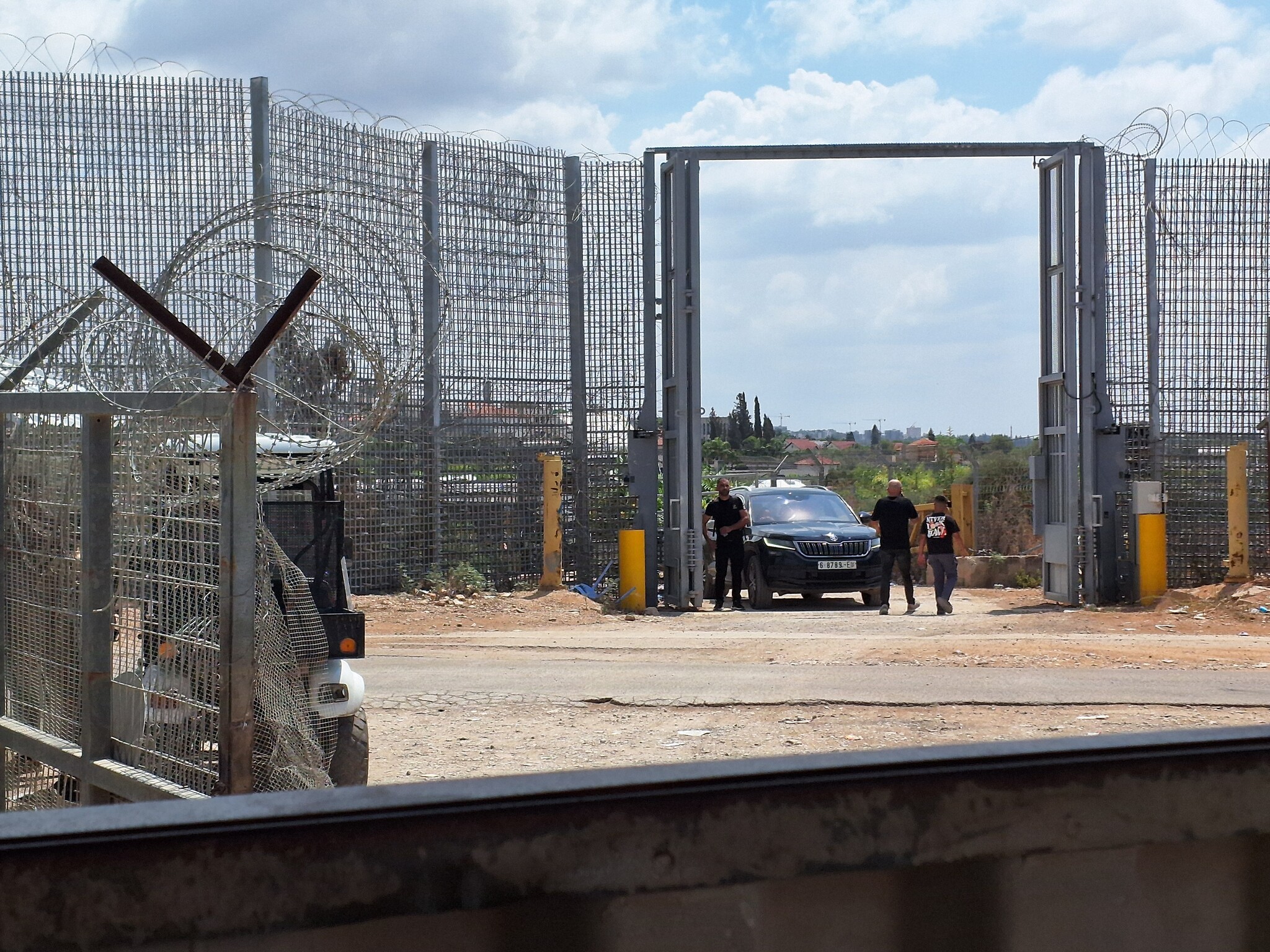 Ronit Dahan-RamatiAug-31-2026Habla. The gate is open
-
