
‘Azzun, Habla, Imatin
9:50 Azzun Due to heavy traffic and jammed roads we arrived late this time. Within a short while over 20 women gathered, mostly ages 40-60, some younger ones with small children. The plan was to divide the group according to each woman’s interest in the activities we had discussed last time, 2-3 women chose to continue their handicraft work with Ruti. About half the group immediately entered the room assigned for Sarah’s yoga instruction. About 45 minutes later they exited, looking very happy. The others stayed on for a while to chat in the central space, then proceeded to study Hebrew with Dafna and Sarale, and prepare a vocabulary basis for word games that the two had prepared for them.
Later on we began a conversation with the English-speaking coordinator. We spoke about the Occupation and this time heard some harsh criticism from her about the cruelty and injustice that Israelis inflict upon Palestinians. She did not spare us harsh descriptions of the suffering of their children and landgrab, and expressed her explicit demand to leave their lands! We agreed with her, expressed our sorrow and empathy with what she was feeling. She did not spare the Palestinian establishment her criticism, either, claiming angrily that neither of their two leading political movements cares for the people, only for themselves and for the welfare of their leaders and cohorts.
Unlike the positive feelings we usually experience upon leaving after our activity with the village women and children, this time we drove away heavy-hearted. Hopefully M. experienced some relief after venting her sorrow and anger.
10:00 Imatin, Nurit reporting:
The women were waiting for me and were surprised that Sarah did not come with me.
I promised she would arrive later. There were 9 women in the class. We had a nice conversation, practiced and refreshed numbers, the time of day, dates, ages as well as time units, articles of clothing and colors.
I handed out a reading page, some of them can identify letters and words, and enjoy reading. Class ended at 11:30 as Sarah arrived to instruct a Yoga session. As usual, the women greatly enjoyed it.
'Azzun
See all reports for this place-
Azoun (updated February 2019)
A Palestinian town situated in Area B (under civil Palestinian control and Israeli security control),
on road 5 between Nablus and Qalqiliya, east of Nabi Elias village. The inhabitants are allowed to construct and improve infrastructures. The Separation Fence has confiscated lands belonging to the town's people. In 2018 olive tree groves owned by one of its inhabitants were confiscated for the sake of paving a road to bypass Nabi Elias. Azoun population numbers 13,000, its economic state dire. Its infrastructures are poor, neglect and poverty rampant. In the meantime, the town council has completed paving an internal road for the inhabitants' welfare.
Because of its proximity to the Jewish settler-colony of Karnei Shomron and its outposts, the town suffers the intense presence of the Israeli army, especially at nighttime: soldiers enter homes, arrest suspects, trash the house and sometimes ruin it, as they do in numerous places in the West Bank. At times a checkpoint closes the entrance to the town, so no one can come in or get out.
-
Habla
See all reports for this place-
Habla CP (1393)
The Habla checkpoint (1393) was established on the lands of the residents of Qalqilya, on the short road that
connected it for centuries to the nearby town of Habla. The separation barrier intersects this road twice and cut off the residents of Qalqilya from their lands in the seam zone.(between the fence and the green line).
There is a passage under Road 55 that connects Qalqilya to the sabotage This agricultural barrier is used by the farmers and nursery owners established along Road 55 from the Green Line and on both sides of the kurkar road leading to the checkpoint.
This agricultural checkpoint serves the residents of Arab a-Ramadin al-Janoubi (detached from the West Bank), who pass through it to the West Bank and back to their homes. The opening hours (3 times a day) of this agricultural checkpoint are longer than usual, about an hour (recently shortened to 45 minutes), and are coordinated with the transportation hours of a-Ramadin children studying in the occupied in the West Bank.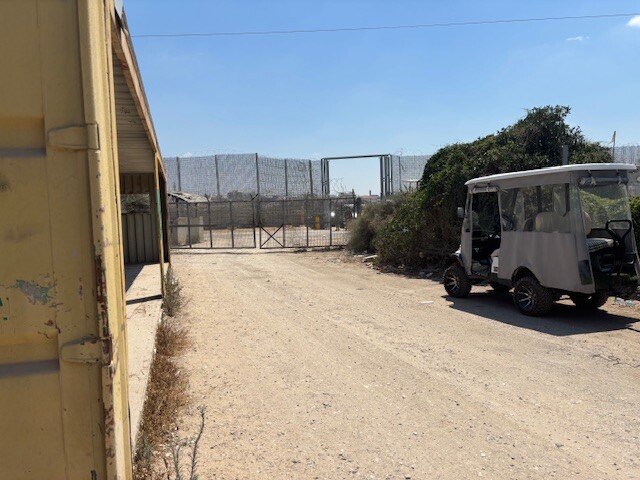 Nina SebaAug-18-2025Habla: The gate is in the process of closing
-
Imatin
See all reports for this place-
Imatin This village lies in the West Bank, 19 kilometers southwest of Nablus city and 23 kilometers east of the city of Qalqiliya. Its inhabitants' number 799, all members of four families from the neighboring village of Imatin. Far’ata is identified with the Biblical Far’atoun, and an archeological survey has identified findings on a timeline from the Second Iron Age until the days of the Ottoman Empire. After the Oslo Accords, the built-up area of the village was categorized as Area B, but 80% of its farmlands were classified as Area C. In 2002, settlers founded the outpost of Havat Gil’ad, which they claim is located on privately-owned land purchased by the Zar family. The Palestinians claim they own the land. The Civil Administration has issued demolition orders for all the structures in this outpost and they were declared illegal, but nothing was done about it. On February 4, 2018, the Israeli government unanimously ruled to regulate this outpost by defining it as a new settlement or by erecting a new settlement next to it. Beginning in 2012, the Palestinian Authority ruled to include Far’ata in the local council of Imatin, a larger community. For further information: http://vprofile.arij.org/qalqiliya/pdfs/vprofile/immatin_vp_en.pdf

 +-
+-
-