
‘Azzun, Habla, Shave Shomron, Wed 9.6.10, Afternoon
Summary
It's time to take an honest look at what the so called "Tel Aviv group" does on its shifts. Perhaps the routes we now take throughout the West Bank need to be reviewed critically in terms of the goals of MW: the course of our travels throughout the West Bank takes us to no checkpoints, at least none around Nablus, Qalqilya or Tulkarm (all have been removed), and one, maybe two agricultural gates; the overall itinerary has little to do with our goals of bearing witness, of monitoring the "freedom of movement" of Palestinians, the basic human right on which MachsomWatch was based, and reporting on the same. We're rarely there when trouble with settlers occurs and never when the IDF makes yet another incursion, a nightly occurrence in Nablus. The terminal buildings, which a couple of shifts monitor a couple of times a week, are something else, but as in Bethlehem, we rely on the Ecumenical Accompaniers on the Palestinian side. So, where are we, the Central group of MachsomWatchers? And what are we doing? And why?
In spite of all the above concerns, not new, there is still something to report from today's shift!
Route 55
11:00 — there's a third huge advertising sign (joining the other two which have graced this junction for some years), on the turnoff to the settlement of Alfei Menashe, advertising brand new housing (color mainly a bright orange: surely no accident!).
Azzun
A Border Police jeep stands across the roadway, and we note that the soldier stopping the minibus is quite elderly, probably a volunteer. A passerby tells us that this jeep is "always there… checking IDs," but no sign of it on our return journey.
Shvut Ami
The telltale house, taken over by settler youth a couple of years ago, is now painted blue!
Qedumim
New houses going up apace, no building stoppage here.
Jit Jct. and on the way to Sarra
Recently, it was announced that more checkpoints have been removed in the West Bank. Sarra has not been accessible for a number of years, but the mathematics of the Occupier seem to be wrong. Here, on the roadway leading up to the village, there is a brand new barrier, made of cement blocks, adding to the one which was already there, a little further up the hill.
Shavei Shomron
There's now only one entrance to the settlement, on its brand new roadway. Route 60 is closed, and roadwork is proceeding there. A large sign, "US AID," also bears the American flag and Palestinian Authority insignia: "Bizzarriya-Deir Sharaf road. A gift from the American people in cooperation with the Ministry of Public Works and Housing."
Orange signs, in Arabic, English and Hebrew point the way to Nablus or Jenin, the latter approachable only via Anabta because of the roadwork.
12:30 Habla Gate 139
We arrive at the same time as the Hummer from which soldiers (religious) descend and fumble with the many locks on the many gates that make up this "agricultural gate." There are seven people waiting to cross from the side where we stand, plus the inevitable donkey cart.
There's a plethora of flags here now: two Israeli, another half green and half black (Armored Corps), yet another completely black and a third orange and blue. Two soldiers take their time checking on the far side of the checkpoint as people where we stand wait and wait. A third soldier finally emerges from the Hummer, leaving a woman soldier sitting inside, doing nothing.
A Palestinian tells us of a new ruling about gate opening times, as of tomorrow. Sure enough, on the open gate, so that so one can see it, is a hastily hand written notice about new opening times:
6:45-8:00
13:45-15:00
17:00-18:30
These times, we're told, are hugely inconvenient to the Palestinians and will cause them many problems, so what else is new, but we promised to take this up with the DCO, or whoever can instill some sense (decency) into the Occupier.
The soldiers function as automatons — but thorough automatons. Every pickup truck is thoroughly examined, each tractor checked inside and out, and plastic bags of produce fondled and peeped into; it matters not at all if the Palestinians are coming out of Habla or going into Habla. All IDs are given to a soldier who marches with them off to the concrete checking booth as people stand in the sweltering noontime heat.
One soldier, in particular, stands out. He has no greeting for anybody, just suspicious eyes which survey each person, woman or man, with undisguised disdain.
12:55 — the line of vehicles coming from the Habla side has to wait as the three soldiers confer in the middle of the checkpoint. The muezzin sounds in the near distance, and four people, men and women, plant something into the dry earth where, just two months ago, we saw potatoes being harvested. And the seasons roll on ….
'Azzun
See all reports for this place-
Azoun (updated February 2019)
A Palestinian town situated in Area B (under civil Palestinian control and Israeli security control),
on road 5 between Nablus and Qalqiliya, east of Nabi Elias village. The inhabitants are allowed to construct and improve infrastructures. The Separation Fence has confiscated lands belonging to the town's people. In 2018 olive tree groves owned by one of its inhabitants were confiscated for the sake of paving a road to bypass Nabi Elias. Azoun population numbers 13,000, its economic state dire. Its infrastructures are poor, neglect and poverty rampant. In the meantime, the town council has completed paving an internal road for the inhabitants' welfare.
Because of its proximity to the Jewish settler-colony of Karnei Shomron and its outposts, the town suffers the intense presence of the Israeli army, especially at nighttime: soldiers enter homes, arrest suspects, trash the house and sometimes ruin it, as they do in numerous places in the West Bank. At times a checkpoint closes the entrance to the town, so no one can come in or get out.
-
Habla
See all reports for this place-
Habla CP (1393)
The Habla checkpoint (1393) was established on the lands of the residents of Qalqilya, on the short road that
connected it for centuries to the nearby town of Habla. The separation barrier intersects this road twice and cut off the residents of Qalqilya from their lands in the seam zone.(between the fence and the green line).
There is a passage under Road 55 that connects Qalqilya to the sabotage This agricultural barrier is used by the farmers and nursery owners established along Road 55 from the Green Line and on both sides of the kurkar road leading to the checkpoint.
This agricultural checkpoint serves the residents of Arab a-Ramadin al-Janoubi (detached from the West Bank), who pass through it to the West Bank and back to their homes. The opening hours (3 times a day) of this agricultural checkpoint are longer than usual, about an hour (recently shortened to 45 minutes), and are coordinated with the transportation hours of a-Ramadin children studying in the occupied in the West Bank.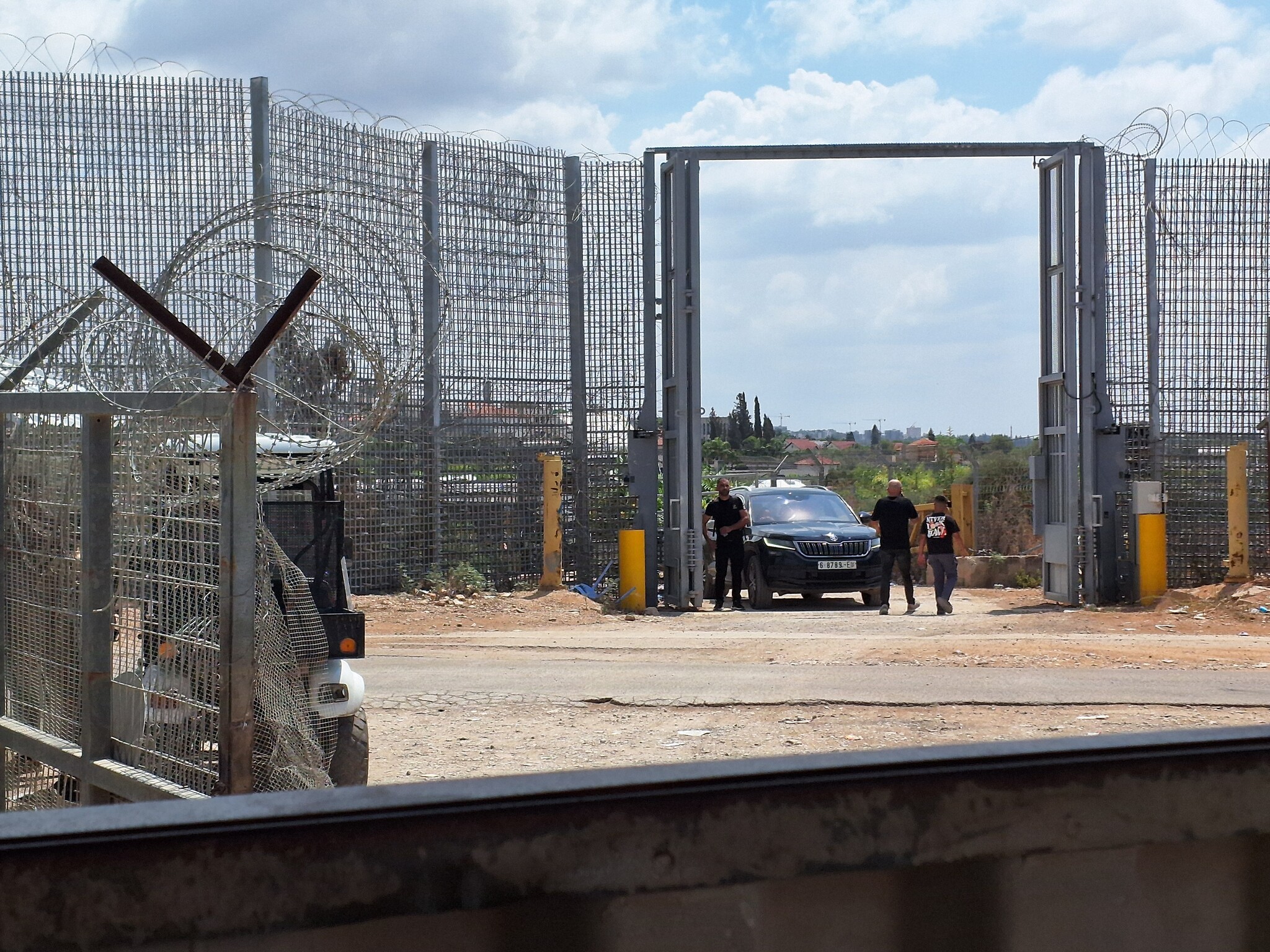 Ronit Dahan-RamatiAug-31-2026Habla. The gate is open
-
Shave Shomron Checkpoint
See all reports for this place-
The checkpoint is on Route 60 (the main road to the northern West Bank), opposite settlement. Has been blocked to Palestinians since disengagement from Gaza and northern Samaria.
-
