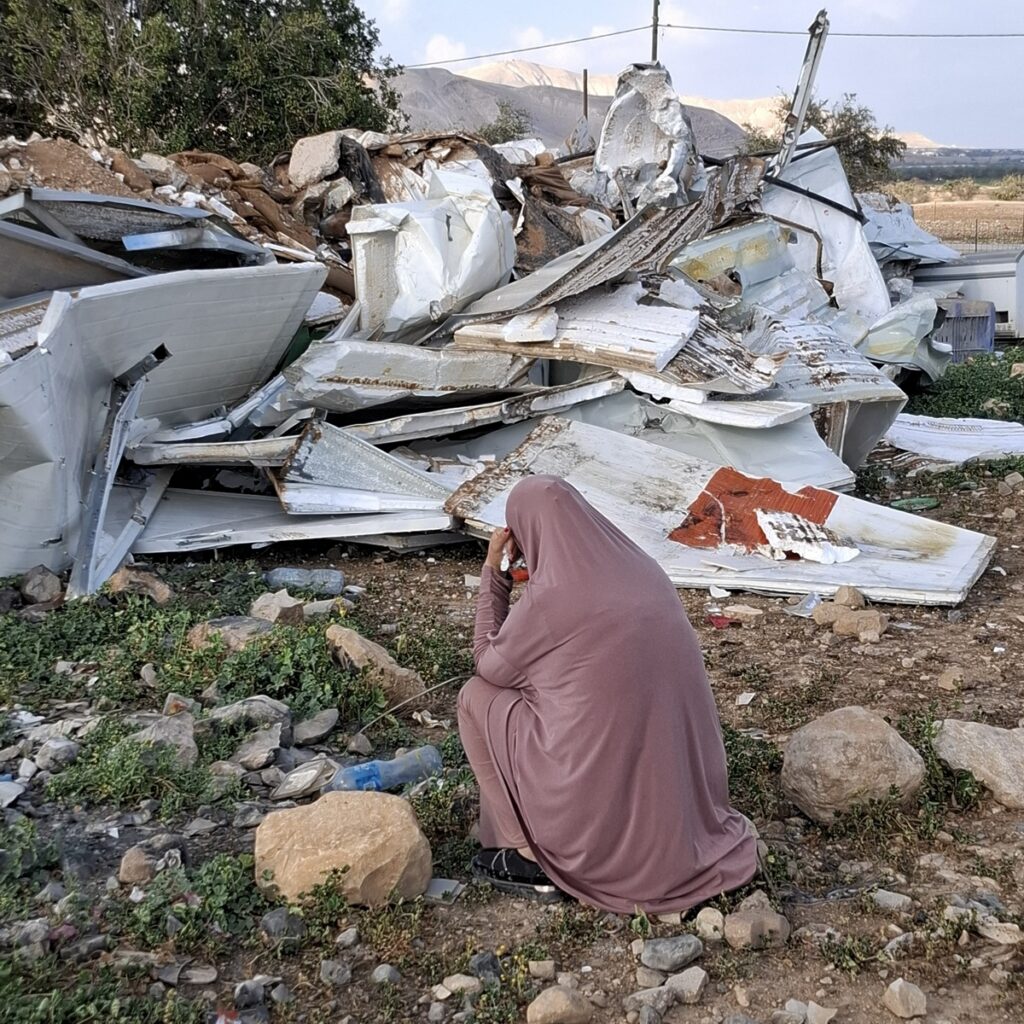
'Azzun - The army comes to ‘Azzun daily
On the way to ‘Azzun, our first stop, a long line of vehicles beyond the Eliyahu checkpoint waiting for their drivers. Heavy equipment continues paving the road on the right.
‘Azzun – We unload the parcels at Z’s home. Three children at home on school break help carry them. Z.’s waiting for his appointment at Hadassah in a few days. We’re hoping they’ll help him return to a normal life and find work.
The army comes to ‘Azzun daily. The military vehicles harass the children who throw stones at them. That’s how an unnecessary confrontation begins. What’s the army looking for here? Let them live in peace.
No soldiers at the entrance to ‘Azzun.
We continue to Nabi Ilyas. Despite the new bypass road, many of the signs are in Hebrew and the owner of the garage told us that many Israelis come to him; he’s not short of work. (Of course – Israelis would rather pay less…). I’m not sure other business people would have given the same answer. Some of the shops appeared pretty empty.
Habla – We arrived at 13:45; the checkpoint gates were already open. Heavy vehicular traffic from both directions, mostly heading for the plant nurseries filled with seedlings. Despite efforts to add netting to the fence there’s no door at the opening to the left for people on foot, and there’s an opening on the right that even a 4 x 4 vehicle could go through. On our previous shift we saw them bringing furniture through immediately after the gates were locked and the soldiers left. So what’s the point?
A truck doesn’t cross. We couldn’t learn why, and it’s not clear what finally happened.
A pleasant Palestinian woman tell us she’s a widow, is working hard and is exhausted. She also has back trouble, will undergo surgery and is somewhat anxious. She allowed us to photograph her.
Of course, we finally visited O., our old friend. We bought flower and vegetable seedlings very cheaply (we’re also entitled to get something out of our tour), then sat with him for coffee and stories. A. says the female soldiers on this shift aren’t pleasant and don’t behave well towards those going through. One of them took the documents from a group of Palestinians and disappeared. They waited. When she returned A. asked her why she did it. Her response: Who are you? I’m their boss, he replies. I need them to work, and you’re holding them up.
The female soldier isn’t impressed. Shoshi says that on the previous shift soldiers took documents from a Palestinian who had a merchant’s permit to enter Israel. He sat waiting for about an hour for them to return. When they came back they interrogated him a bit and then returned his documents.
A. is excited to have received an entry permit to Israel. He intends to take his young daughters on a train ride, and we plan to invite him to Tel Aviv and give him an “all-inclusive” tour.
As we left toward the bridge over Highway 6 we see excavation and road work. We don’t know what they’re for, but the land clearly belongs to Palestinians.


חבלה – הגענו בשעה 13:45 והשערים במחסומים היו כבר פתוחים. תנועה ערה של רכבים משני הצדדים, בעיקר יוצאים למשתלות, עמוסים בשתילים. למרות המאמצים להוסיף רשת צפופה לגדר, משמאל אין בכלל דלת לעוברים ברגל, ומימין פתח שגם כלי רכב (4X4) יכול לעבור דרכו. במשמרת הקודמת ראינו שהעבירו רהיטים דרכו דקה אחרי נעילת השערים ועזיבת הרכב הצבאי. נו, אז בשביל מה??

משאית אחת לא עוברת. לא הצלחנו לברר מדוע ולא ברור מה היה בסוף.

פלסטינית חביבה מספרת לנו שהיא אלמנה ועומדת לעבור ניתוח והיא קצת מפחדת. הסכימה להצטלם.

ביקור במשתלה. קניות, תה וסיפורים.
'Azzun
See all reports for this place-
Azoun (updated February 2019)
A Palestinian town situated in Area B (under civil Palestinian control and Israeli security control),
on road 5 between Nablus and Qalqiliya, east of Nabi Elias village. The inhabitants are allowed to construct and improve infrastructures. The Separation Fence has confiscated lands belonging to the town's people. In 2018 olive tree groves owned by one of its inhabitants were confiscated for the sake of paving a road to bypass Nabi Elias. Azoun population numbers 13,000, its economic state dire. Its infrastructures are poor, neglect and poverty rampant. In the meantime, the town council has completed paving an internal road for the inhabitants' welfare.
Because of its proximity to the Jewish settler-colony of Karnei Shomron and its outposts, the town suffers the intense presence of the Israeli army, especially at nighttime: soldiers enter homes, arrest suspects, trash the house and sometimes ruin it, as they do in numerous places in the West Bank. At times a checkpoint closes the entrance to the town, so no one can come in or get out.
-
A-Nabi Elias
See all reports for this place-
A-Nabi Elias this is a Palestinian village in the northern West Bank, east of Qalqilia on Road 55, north-east of Alfei Menashe colony and west of Karnei Shomron colony and the Palestinian city of Nablus. As of 2016, the village was populated by 1,458 inhabitants.
Near the village is a maqam (holy site memorializing a sanctified person) - the prophet Elisha. Until 2021 Road 55 crossed the village. Then a bypass road was paved through olive groves that were sequestered from the villagers. Consequently, the farmers were left with small olive groves that they could not access nor cultivate. Inhabitants protested against the road for weeks, supported by peace activists, but nothing helped and the road is now a given fact.
The village's main street had been a shopping center for all residents, including colonists. We even saw a Kashrut (kosher food) inspector in a butcher shop close to the falafel stand… The bypass road, according to tradesmen, has impacted their businesses and clients, while others claim that there are customers now for parking has become easier.
Alfei Menashe and Tzofim colonies nibble at the village lands from the north and south and get closer to it all the time. Colonists of Alfei Menashe have outdone themselves, sending their surplus sewage from the oxygenation pools toward a-Nabi Elias land, even reaching the houses.
The villagers are known as seekers of peace. For years there was no hostility towards Israelis. On the contrary, we were always welcomed warmly and stopped there to enjoy their delicious, inexpensive falafel.
-
Habla CP (1393)
See all reports for this place-
Habla CP (1393)
The Habla checkpoint (1393) was established on the lands of the residents of Qalqilya, on the short road that
connected it for centuries to the nearby town of Habla. The separation barrier intersects this road twice and cut off the residents of Qalqilya from their lands in the seam zone.(between the fence and the green line).
There is a passage under Road 55 that connects Qalqilya to the sabotage This agricultural barrier is used by the farmers and nursery owners established along Road 55 from the Green Line and on both sides of the kurkar road leading to the checkpoint.
This agricultural checkpoint serves the residents of Arab a-Ramadin al-Janoubi (detached from the West Bank), who pass through it to the West Bank and back to their homes. The opening hours (3 times a day) of this agricultural checkpoint are longer than usual, about an hour (recently shortened to 45 minutes), and are coordinated with the transportation hours of a-Ramadin children studying in the occupied in the West Bank.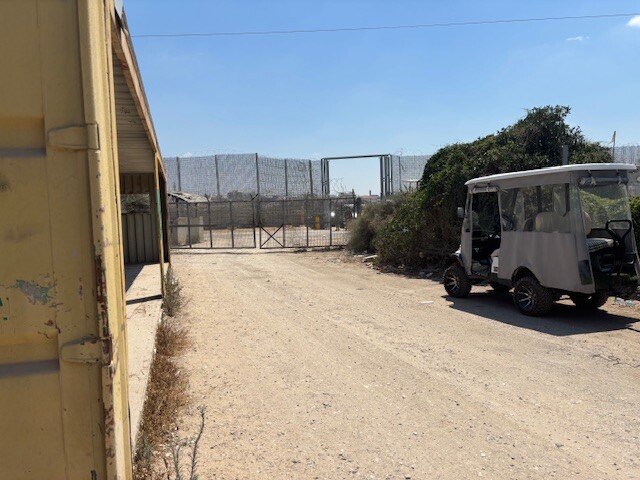 Nina SebaAug-18-2025Habla: The gate is in the process of closing
-