
Beit Furik, Huwwara, Za’tara (Tapuah), יום ב’ 13.10.08, בוקר
Translation: Suzanne O.
Summary: At Beit Furiq they ‘halted life' until we left the roadblock and, later, the Brigad C.O. of Shomron declared the area a ‘closed military zone' in order to get us away from the roadblock.
Someone burnt down the kiosk at Beit Furiq roadblock.
One of the soldiers photographs us. Is this a personal initiative or a new roadblock routine?
Beit Furiq
7:20 – 8:00 a.m.
As we arrived the roadblock commander came over and informed us that this is a ‘closed military zone' and we are not permitted to be at the roadblock. Since this is not the first time this has been said to get us out of the way we asked to see the order in writing, otherwise it is not valid. He returned to his position, and another soldier came out and told us that we are not permitted to speak to the Palestinians. We did not reply to him. Then he informed us that if we do not leave the roadblock they will cease the inspections (what is called in the military lingo "halting life"). And, indeed, they instructed the people in the queue to go back.
We did not want to cause distress to the people waiting, therefore, we distanced ourselves from the roadblock, but not before we went over to the soldiers' position and told the commander what we thought of his action. We telephone the ‘humanitarian' centre and Zaharan from the Nablus DCO. We stood opposite, near the red signpost. The inspection recommenced. In total the cessation lasted less than 5 minutes.
About a quarter of an hour later we saw two elderly women arguing with one of the soldiers for a long time and finally being refused their request. We went over to ask them what the problem was. They told us that they live in one of the villages in the vicinity and one of them wants to visit her cousin who lives in Beit Furiq. The second one is accompanying her. We are not necessarily able to help. To the best of our knowledge only residents of Beit Furiq can cross the roadblock. Until we can find out we returned speedily to our previous position because we knew that they would stop the inspections again until we moved away. But – they again ‘halted life' and continued it even when we moved further away, right up to Hamdan's car.
We called Zaharan again and he said that obviously it is our right to be at the roadblock and he would come over immediately.
Meanwhile the roadblock commander explained to those waiting in the queue that the hold up is because of us, pointing in our direction. A few people came over and asked us not to cause them harm. We then saw a military jeep approaching and thought that it was Zaharan. A lieutenant got out and came over to us waving a document. It appeared to be a ‘closed military zone' order from 12:10 – 16:00 and from 13:10 – 16:00 (??) signed by Brigade C.O. Shomron, Colonel Bar (his first name escapes us). On the other side of the page was a photograph of what appeared the to be the area of the roadblock from the air, showing the boundary of the order. With no alternative, we left.
This whole process took not more than half an hour. At 8:00 a.m. the order arrived. The order did not apply to the Palestinians who recommenced crossing the roadblock. In fact, it was intended just for us.
It is not clear what the fuss was about. We actually had no complaints about the running of the roadblock. All the time we were there a steady flow of people crossed in the direction of Nablus. A lot of students: they crossed the roadblock quickly. All the passengers of a bus alighted, all young women, and crossed empty in the direction of Nablus. The driver told us that this is a DCO order.
If it had not been for the fact that we had to deal with the soldiers' provocation, we would more than likely have left earlier.
As we left we saw that the improvised kiosk in the car park had been burnt down. It was burnt two nights ago, it is not known by whom. We are new at this roadblock and we don't know the man who lost his business.
Awarta
There are 6 vehicles queuing in the direction of Nablus, one of them a lorry.
Huwwara.
8:25 – 9:45 a.m
The moment we arrived one of the soldiers hurried to photograph us with his mobile phone. This happened to us on our last shift too. Are they preparing a photograph album for us at Huwwara roadblock?
The queue leaving Nablus is long – in our estimation (from our distant viewpoint – the blue line) about 60 or 70 people. This is the queue of young men crossing via the magnometer. Women and men over 45 cross quickly. A woman standing near us waiting for her husband to be inspected has been waiting for an hour already.
Men and women are continuously being sent from the queues to the x-ray machine for luggage situated across the road.
There is a detainee in the cell. The commander, 1st sergeant N. (Nathaniel) explained that he is a ‘bingo', i.e.: his number came up on the computer as wanted by the Shabak. According to him he has been held for 5 minutes. Later he goes to talk to the detainee. He asks how to say ‘number' in Arabic. He appears to be trying to explain to him in Arabic why he has to wait. The man is released in a little over an hour.
8:45 a.m.
The queue is still long. Only two checkpoints are working.
9:15 a.m.
In the car park we meet a man who has been married for the last 9 years to a Jordanian woman and they have two children. They cannot live together. She will not be given even a temporary resident's permit for the territories and if she lives with him she will be a criminal – illegal resident – and could be banished at any time. He cannot live permanently in Jordan either. Neither country wishes to increase its Palestinian population. It bears a resemblance to hard times in the history of our own people. His solution is to spend a month in Jordan every few months. What sort of solution is that?!
9:25 a.m.
An inhabitant of Beit Furiq comes over to us; two of his daughters are ill, suffering from a surplus of protein. They need special food which he buys in a particular shop in Petach Tikva (he has a special permit to enter Israel). One of them, aged 18, apparently because of the illness, is permanently in nappies. All of this comes to a total of NIS2,500 per month – a huge amount in the terms of the territories. He has approached all kinds of humanitarian organisations in the territories and has not received any help. He asks if he can be helped by an organisation in Israel. I contacted Ada H., to see if she could find out if ‘Doctors for Human Rights' can help. Does anyone know of any other possibilities?
An elderly man requests permission to go to the olive grove opposite the roadblock, across the road, on the mountainside below the settlement of Bracha. The grove belongs to him. Although picking days have been allocated to him next week, he is not permitted to enter his grove apart from those days. He wants to see how his olives are progressing. The DCO representative Mohand (a reservist) coordinates so that no one harms him (at least from the army). Later we see him return. His visit passed off peacefully.
A man with a Zimmer frame alights from a taxi near the roadblock and crosses via the road (he is unable to cross using the lane for entering Nablus via the turnstile).
A woman with her eyes veiled goes into a special cell together with a female soldier, while a male soldier guards outside, to check if her face and the photograph in her ID card match.
9:45 a.m.
We leave.
Za'atra Junction
There were no long queues on the way in or on the way back.
Beit Furik checkpoint
See all reports for this place-
One of the three internal checkpoints that closed on the city of Nablus - Beit Furik to the east, Hawara to the south, Beit Iba to the west. The checkpoint is located at the junction of Roads 557 (an apartheid road that was forbidden for Palestinians), leading to the Itamar and Alon Morea settlements and Road 5487. The checkpoint was established in 2001 for pedestrians and vehicles; The opening hours were short and the transition was slow and very problematic.Allegedly, the checkpoint is intended to monitor the movement to and from Nablus of the residents of Beit Furik and Beit Dajan, being the only opening outside their villages. Since May 2009 the checkpoint is open 24 hours a day, the military presence is limited, vehicles can pass through it without inspections, except for random inspections. (Updated April 2010)
-
Huwwara
See all reports for this place-
The Huwwara checkpoint is an internal checkpoint south of the city of Nablus, at the intersection of Roads 60 and 5077 (between the settlements of Bracha and Itamar). This checkpoint was one of the four permanent checkpoints that closed on Nablus (Beit Furik and Awarta checkpoints to the east and the Beit Iba checkpoint to the west). It was a pedestrian-only barrier. As MachsomWatch volunteers, we watched therre since 2001 two shifts a day - morning and noon, the thousands of Palestinians leaving Nablus and waiting for hours in queues to reach anywhere else in the West Bank, from the other side of the checkpoint the destination could only be reached by public transport. In early June 2009, as part of the easing of Palestinian traffic in the West Bank, the checkpoint was opened to vehicular traffic. The passage was free, with occasional military presence in the guard tower. Also, there were vehicle inspections from time to time. Since the massacre on 7.10.2023, the checkpoint has been closed to Palestinians.
On February 26, 2023, about 400 settlers attacked the town's residents for 5 hours and set fire to property, such as houses and cars. Disturbances occurred in response to a shooting of two Jewish residents of Har Bracha by a Palestinian Terrorist. The soldiers stationed in the town did not prevent the arson and rescued Palestinian families from their homes only after they were set on fire. No one was punished and Finance Minister Smotrich stated that "the State of Israel should wipe out Hawara." Left and center organizations organized solidarity demonstrations and support actions for the residents of Hawara.Hawara continued to be in the headlines in all the months that followed: more pogroms by the settlers, attacks by Palestinians and a massive presence of the army in the town. It amounted to a de facto curfew of commerce and life in the center of the city. On October 5, 2023, MK Zvi established a Sukkah in the center of Hawara and hundreds of settlers backed the army blocked the main road and held prayers in the heart of the town all night and the next day. On Saturday, October 7, 23 The "Swords of Iron" war began with an attack by Hamas on settlements surrounding Gaza in the face of a poor presence of the IDF. Much criticism has been made of the withdrawal of military forces from the area surrounding Gaza and their placement in the West Bank, and in the Hawara and Samaria region in particular, as a shield for the settlers who were taking over and rioting.
On November 12, 2023, the first section of the Hawara bypass road intended for Israeli traffic only was opened. In this way, the settlers can bypass the road that goes through the center of Hawara, which is the main artery for traffic from the Nablus area to Ramallah and the south of the West Bank. For the construction of the road, the Civil Administration expropriated 406 dunams of private land belonging to Palestinians from the nearby villages. The settlers are not satisfied with this at the moment, and demand to also travel through Hawara itself in order to demonstrate presence and control.(updated November 2023)
.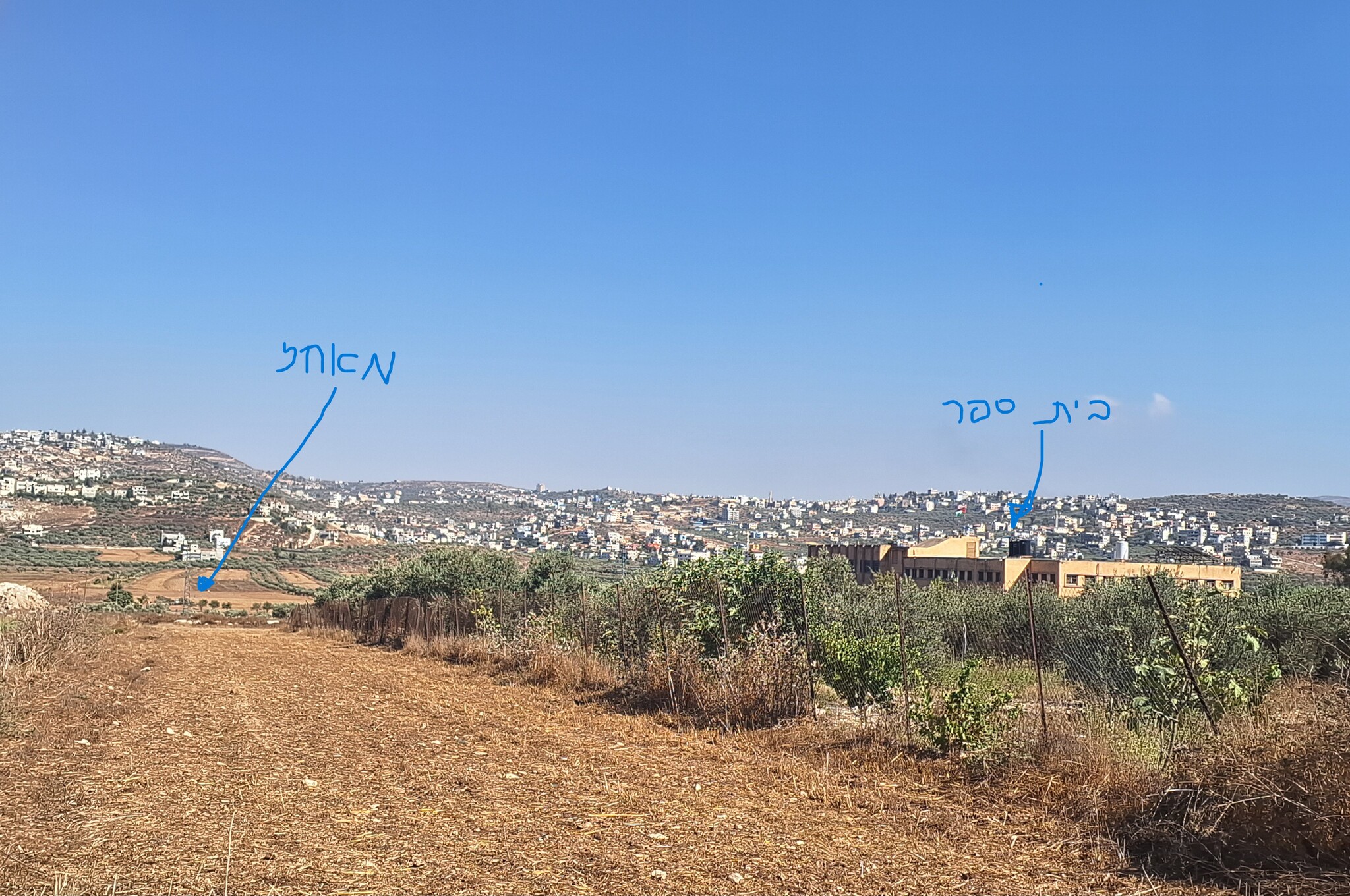 Ronit Dahan-RamatiAug-24-2026Huwara: The school on the outskirts of town and an outpost hidden among the trees
-
Za'tara (Tapuah)
See all reports for this place-
Za'tara (Tapuah) Za'tara is an internal checkpoint in the heart of the West Bank, at the intersection of Road 60 and Road 505 (Trans-Samaria), east of the Tapuah settlement. This checkpoint is the "border" marked by the IDF between the north and south of the West Bank, in accordance with the policy of separation between the two parts of the West Bank that has been in place since December 2005. At the Za'tara checkpoint, there are separate routes for Israelis and Palestinians. In the route for Israelis, there are no inspections and the route for Palestinians inspects. The queue lengthens and shortens suits. The checkpoint is open 24 hours a day. The checkpoint is partially staffed and the people who pass through it are checked at random.
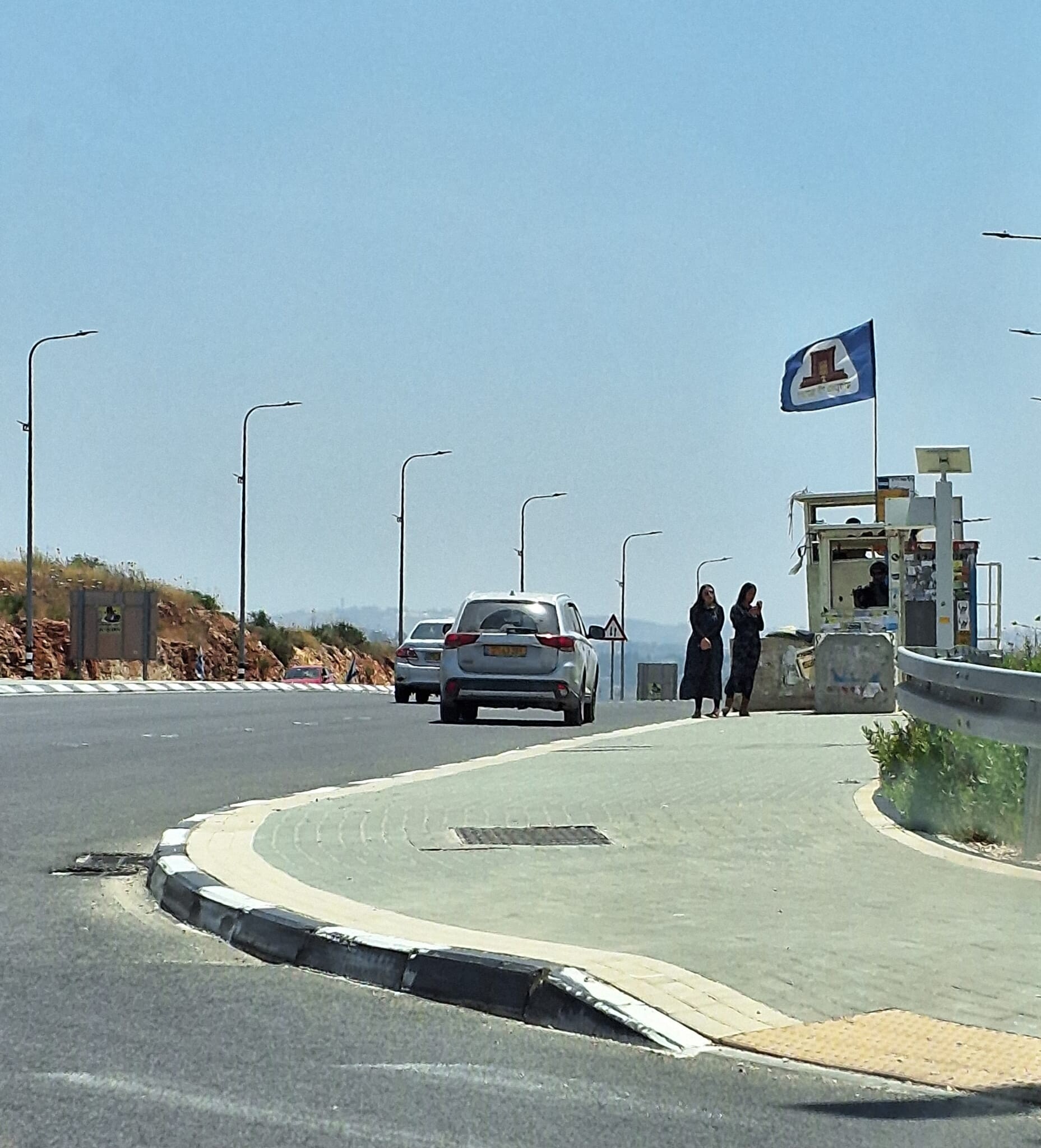 Ronit Dahan-RamatiJun-9-2026Za'atara (Tapuach Junction). The Temple Flag Above a Station
-
