
Beit Iba PM
BEIT IBA, Wednesday 7 April 2004 PM Observers: Dafna, Nili, Hava, Irit (reporting color =red>At the flying checkpoint at Jitt, four of our colleagues split off and went to Huwwara from which there will be a separate report. 13:55: Beit Iba When we arrived, the checkpoint had been closed for three hours. There were some 25 detainees most of whom claimed that they had been waiting since the morning. The soldiers insisted that this was a lie. Our attempts to speed their release, whether by appealing directly to the soldiers or by telephone calls to the humanitarian hotline, were almost entirely unsuccessful. The one instance where perhaps we helped was with a detainee who said he had been there since 07:30 and who in fact got his documents back last of all (despite the fact that we started to intercede on his behalf from the first minute we arrived). He was eventually released at 17:45, in other words just a quarter of an hour before the checkpoint closed at 18:00. We sense the continuation of a process that began some months ago:In the first stage, we were forbidden to make any direct approach to the military authorities on the spot (unit or brigade commanders) who had formerly helped us to solve the problems of Palestinians at the checkpoints. We were told that we could apply only to the army’s district coordinating office (DCO). Subsequently we were told not to approach the DCO, but only the humanitarian hotline. In other words, all those telephone numbers which we had been so at pains to collect, and which were quite useful every now and then, are today useless. The only address for any approaches we may make is a group of soldiers who staff that office which for some reason or other enjoys the name “humanitarian” (and which is, incidentally, a part of the DCO); nor do these soldiers often succeed in helping very much (or perhaps they don’t always try). The upshot of all this is that despite — or perhaps because of — the talks we hold with senior army personnel, we no longer have anyone to talk to with a view to speeding up procedures, and this seriously weakens our effectiveness. There is an irony in all this: it is as if we have been (metaphorically speaking ) swallowed up by the military establishment, and we are now the “humanitarians” on the spot who provide the evidence for the claim that this is a humanitarian army. And now the situation is even worse, because the Centre for the Defence of the Individual is not functioning , and we have nowhere to refer Palestinians in need of legal advice. What on earth are we to do?! This is clearly a problem we will all have to address urgently.As we stand at the checkpoint, more and more people start to arrive from the direction of Nablus. The soldier on duty behaves fairly, quietly and efficiently. H., the battalion commander, has given an order that even when an answer does come through about a detainee, no one is to be released without his personal endorsement. So now he has turned off his cellular phone and gone off to a lengthy meeting at which “we can’t disturb him!” The tougher the soldiers get, the more aggressively polite are the answers we receive from them: along the lines of : “There’s nothing to be done, these are the army’s priorities”, etc. etc.H. is the politest of all . He talks very fluently in a rather didactic manner : he has his line off pat and is only too keen to spread the message of his beliefs. When we ask about this or that detainee, or perhaps suggest that another line could be set up to start processing those who want to go through the checkpoint, or ask him to consider increasing the staff attending to the telephones and checking on ID numbers so that the detainees get released sooner, then he will explain at length and in a very polished manner that his aim is identical to ours, although we have different motives: he is very interested to free the detainees as quickly as possible because their presence endangers his life. He is also at pains to point out that this checkpoint has prevented terror attacks that could well have claimed the lives of our families. When Dafna managed to get a word in edgeways and interrupt his flow, she said that all this should be happening on the border with Israel [and not between two Palestinian areas], to which he shot back: “This is the border”! Our reactions didn’t shift him an inch.15:45 — Investigation of a woman student’s bag reveals a propaganda leaflet on the back of which she has made some notes. It’s just one single sheet. But she is held and sent to the section reserved for the detainees. She is in a terrible panic and is weeping. We get in touch with the humanitarian hotline. About an hour later, she is released. 17:00 — A big crowd of men and women builds up, with everyone anxious to go through before the checkpoint closes. O., an officer from the DCO., as usual halts all movement until some semblance of order emerges. An extra line is set up to deal with professionals (i.e. teachers, doctors etc.). “Everything’s OK, all normal!” And the more it’s “all normal”, the more horrifying it all is.
Beit Iba
See all reports for this place-
A perimeter checkpoint west of the city of Nablus. Operated from 2001 to 2009 as one of the four permanent checkpoints closing on Nablus: Beit Furik and Awarta to the east and Hawara to the south. A pedestrian-only checkpoint, where MachsomWatch volunteers were present daily for several hours in the morning and afternoon to document the thousands of Palestinians waiting for hours in long queues with no shelter in the heat or rain, to leave the district city for anywhere else in the West Bank. From March 2009, as part of the easing of the Palestinian movement in the West Bank, it was abolished, without a trace, and without any adverse change in the security situation.
 Jun-4-2014Beit-Iba checkpoint 22.04.04
-
Huwwara
See all reports for this place-
The Huwwara checkpoint is an internal checkpoint south of the city of Nablus, at the intersection of Roads 60 and 5077 (between the settlements of Bracha and Itamar). This checkpoint was one of the four permanent checkpoints that closed on Nablus (Beit Furik and Awarta checkpoints to the east and the Beit Iba checkpoint to the west). It was a pedestrian-only barrier. As MachsomWatch volunteers, we watched therre since 2001 two shifts a day - morning and noon, the thousands of Palestinians leaving Nablus and waiting for hours in queues to reach anywhere else in the West Bank, from the other side of the checkpoint the destination could only be reached by public transport. In early June 2009, as part of the easing of Palestinian traffic in the West Bank, the checkpoint was opened to vehicular traffic. The passage was free, with occasional military presence in the guard tower. Also, there were vehicle inspections from time to time. Since the massacre on 7.10.2023, the checkpoint has been closed to Palestinians.
On February 26, 2023, about 400 settlers attacked the town's residents for 5 hours and set fire to property, such as houses and cars. Disturbances occurred in response to a shooting of two Jewish residents of Har Bracha by a Palestinian Terrorist. The soldiers stationed in the town did not prevent the arson and rescued Palestinian families from their homes only after they were set on fire. No one was punished and Finance Minister Smotrich stated that "the State of Israel should wipe out Hawara." Left and center organizations organized solidarity demonstrations and support actions for the residents of Hawara.Hawara continued to be in the headlines in all the months that followed: more pogroms by the settlers, attacks by Palestinians and a massive presence of the army in the town. It amounted to a de facto curfew of commerce and life in the center of the city. On October 5, 2023, MK Zvi established a Sukkah in the center of Hawara and hundreds of settlers backed the army blocked the main road and held prayers in the heart of the town all night and the next day. On Saturday, October 7, 23 The "Swords of Iron" war began with an attack by Hamas on settlements surrounding Gaza in the face of a poor presence of the IDF. Much criticism has been made of the withdrawal of military forces from the area surrounding Gaza and their placement in the West Bank, and in the Hawara and Samaria region in particular, as a shield for the settlers who were taking over and rioting.
On November 12, 2023, the first section of the Hawara bypass road intended for Israeli traffic only was opened. In this way, the settlers can bypass the road that goes through the center of Hawara, which is the main artery for traffic from the Nablus area to Ramallah and the south of the West Bank. For the construction of the road, the Civil Administration expropriated 406 dunams of private land belonging to Palestinians from the nearby villages. The settlers are not satisfied with this at the moment, and demand to also travel through Hawara itself in order to demonstrate presence and control.(updated November 2023)
.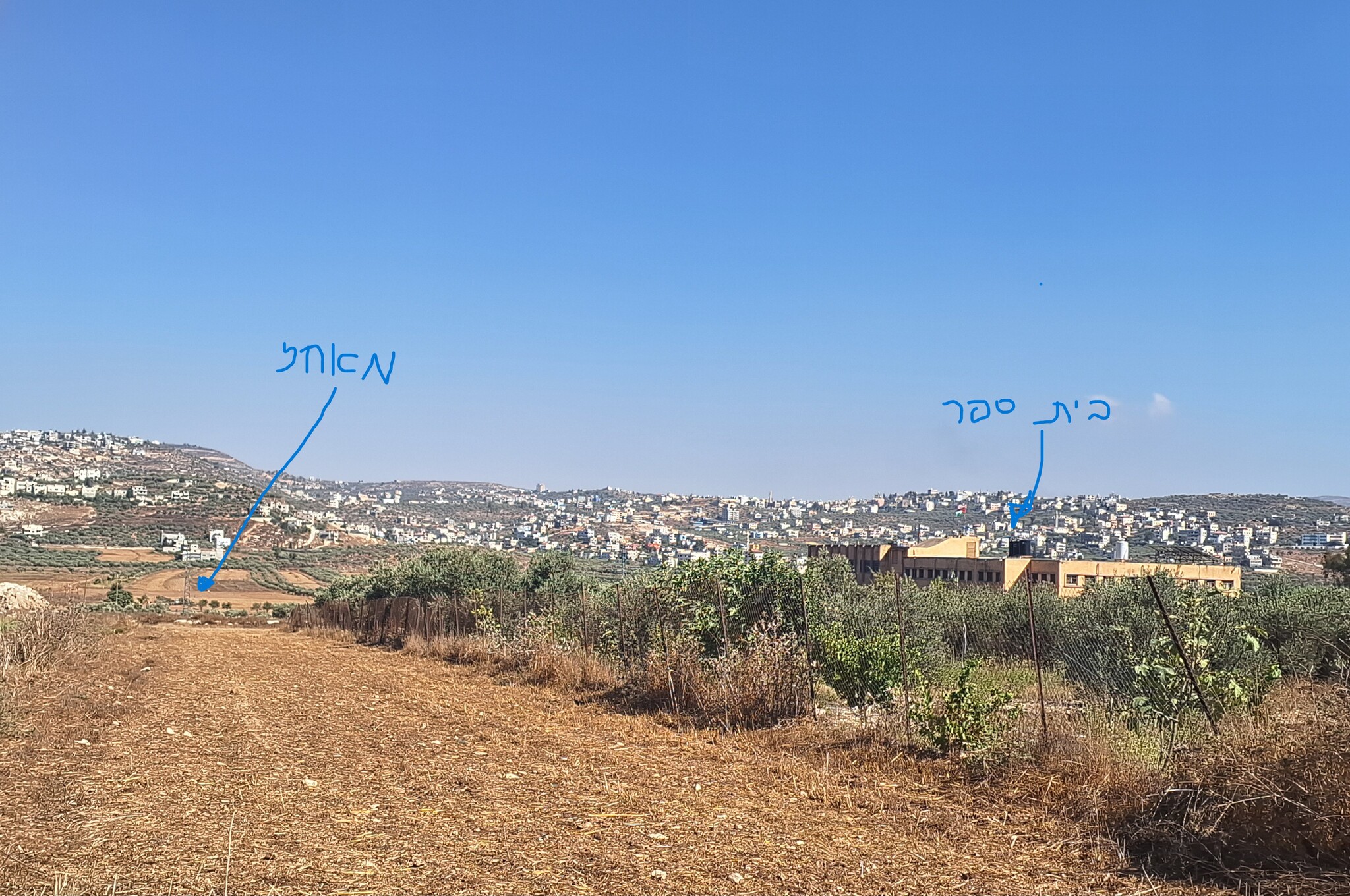 Ronit Dahan-RamatiAug-24-2026Huwara: The school on the outskirts of town and an outpost hidden among the trees
-
