
Bethlehem, Etzion DCL, Qalandiya, Wed 22.4.09, Afternoon
Hussan, Al-Aroub.
From 2:00 till 5:30 PM.
Hussan: there were many yellow cabs parked at the entrance to Hussan and hardly any buses arrived to drop potential passengers. A few drivers complained bitterly about the behaviour of the soldiers in Al-Aroub. They claim that mainly in the morning between 6:30 and 8:00 AM they confiscate their keys and disappear, because they stop to pick up passengers at a spot, which endangers traffic. Sometimes the drivers have to wait an hour or more before they get the car keys back and thus are unable to make any money during the only busy hours of the day.
Al-Aroub: we headed straight to the Al-Aroub refugee camp and parked in front of the grocery store. We approached the soldiers under the watchtower who were very impolite and told some of the drivers to move away from where they were dropping or picking up passengers, telling them to stop ‘beyond the pole’, but then changing the directions they had given earlier. We also were told in no uncertain terms that we should get lost, since we parked in a dangerous spot. Since when are these soldiers responsible for road safety?
When we asked to whom we might complain we were referred to the regional commander (‘khatmar’).
Etzion DCL: as we drove up to the DCL we saws that the regional commander is right above it, so we decided to go in. the soldier at the gate was adamant not to let us in, but suggested we call the war-room (khamal) and gave us the number.
We made the calls from the almost empty DCL waiting room and found out that Yoav, with whom we were supposed to speak was in a meeting. A man from Saloniki with dual citizenship accompanied a friend who did not get permission to visit the Christian Church in Jerusalem to which he belongs.
After we called, he was allowed to re-enter and was issued a magnetic card and told to apply with it to the Palestinian DCL and request the desired permit. A group of four youngsters under 16 exited angrily – they had been denied permit to enter Jerusalem to pray in Christian Churches. Then some men came out and got into a car with a red-numbered license plate, it turns out that they work in the Bethlehem DCL and had come to coordinate permits with the officers here. They told us that youngsters under 16 who are not in possession of their own ID card can only enter Israel with their parents.
Bethlehem – Checkpoint 300: on the door of CP 300 a new sheet with directions in Arabic was posted. A Druze (blue) policeman explained to us that the regulations were aimed at preventing illegal workers from getting into Israel. The main object is to ensure that whoever enters in the morning exits at the same place in the afternoon and this will from now on be checked. It will also ensure that people who have to be back into the West Bank do not overstay their allotted time. This will be enforced as of June 1st. This will certainly affect VERY NEGATIVELY those Palestinians entering via Qalandiya, since they could till now leave Jerusalem without any checking and if this causes long delays after a day of work it will cause additional bitterness. At the Bethlehem passage they have had to show their papers also when coming back from Jerusalem, but could have gone through the tunnels or any other way with their employers.
Bethlehem (300)
See all reports for this place-
Located adjacent to the Separation Wall ("Jerusalem Wrap") at the north entrance to Bethlehem, this checkpoint cuts off Bethlehem and the entire West Bank from East Jerusalem, with all the serious implications for health services, trade, education, work and the fabric of life. The checkpoint is manned by the Border police and private security companies. It is an extensive infrastructure barrier and is designated as a border terminal, open 24 hours a day for foreign tourists. Israeli passport holders are not allowed to pass to Bethlehem, and Palestinian residents are not allowed to enter Jerusalem, except those with entry permits to Israel and East Jerusalem residents. Israeli buses are allowed to travel to Bethlehem only through this checkpoint.The checkpoint, which demonstrated harsh conditions of crowding and extreme passage delays for years, started employing advanced electronic identification posts and has upgraded its gates' system as of the middle of 2019 - and conditions improved.Adjacent to the checkpoint, in an enclosure between high walls and another passage, is the historic Rachel's Tomb, which is now embedded within a concrete fortified building. It contains prayer and study complexes for Jews only, as well as a residential complex. updated November 2019 .
-
Etzion DCO
See all reports for this place-
serves residents of Bethlehem and surrounding villages who need magnetic cards, work permits for Israel, permits for one-time entry for religious or health reasons, various police permits, etc.
-
Qalandiya Checkpoint / Atarot Pass (Jerusalem)
See all reports for this place-
Click here to watch a video from Qalandiya checkpoint up to mid 2019 Three kilometers south of Ramallah, in the heart of Palestinian population. Integrates into "Jerusalem Envelope" as part of Wall that separates between northern suburbs that were annexed to Jerusalem in 1967: Kafr Aqab, Semiramis and Qalandiya, and the villages of Ar-Ram and Bir Nabala, also north of Jerusalem, and the city itself. Some residents of Kafr Aqab, Semiramis and Qalandiya have Jerusalem ID cards. A terminal operated by Israel Police has functioned since early 2006. As of August 2006, northbound pedestrians are not checked. Southbound Palestinians must carry Jerusalem IDs; holders of Palestinian Authority IDs cannot pass without special permits. Vehicular traffic from Ramallah to other West Bank areas runs to the north of Qalandiya. In February 2019, the new facility of the checkpoint was inaugurated aiming to make it like a "border crossing". The bars and barbed wire fences were replaced with walls of perforated metal panels. The check is now performed at multiple stations for face recognition and the transfer of an e-card. The rate of passage has improved and its density has generally decreased, but lack of manpower and malfunctions cause periods of stress. The development and paving of the roads has not yet been completed, the traffic of cars and pedestrians is dangerous, and t the entire vicinity of the checkpoint is filthy. In 2020 a huge pedestrian bridge was built over the vehicle crossing with severe mobility restrictions (steep stairs, long and winding route). The pedestrian access from public transport to the checkpoint from the north (Ramallah direction) is unclear, and there have been cases of people, especially people with disabilities, who accidentally reached the vehicle crossing and were shot by the soldiers at the checkpoint. In the summer of 2021, work began on a new, sunken entrance road from Qalandiya that will lead directly to Road 443 towards Jerusalem and Tel Aviv. At the same time, the runways of the old Atarot airport were demolished and infrastructure was prepared for a large bus terminal. (updated October 2021)
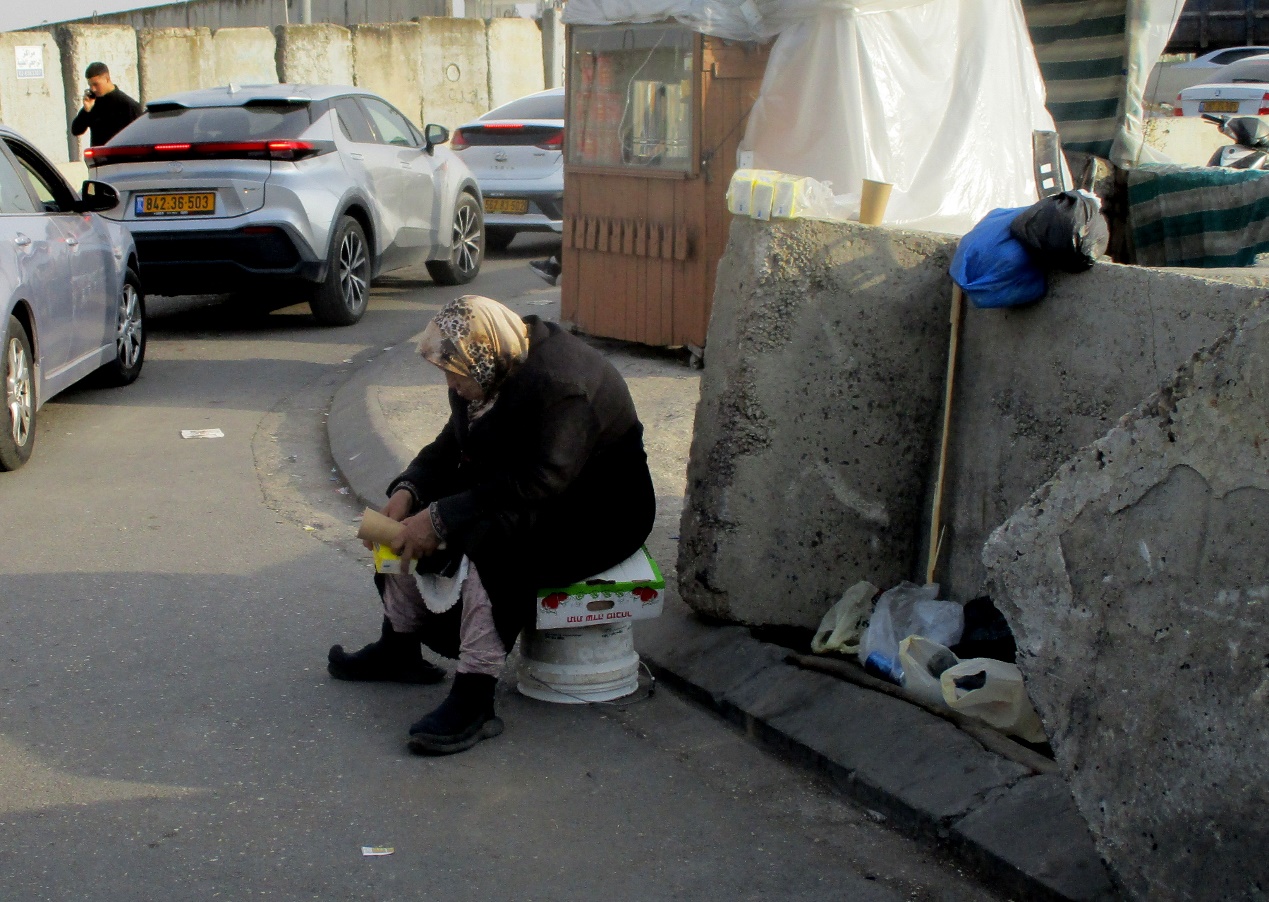 Tamar FleishmanOct-11-2026Qalandiya. Female Beggar
-
