
Burin farmers are coping with the burning of whole olive groves

The farmers from Burin are coping now with the results of the burning of whole olive groves in the past few weeks. Most of the fires were at the foot of Har Bracha and the outpost next to it, Giv’at Ronen. The permits for olive-picking near the settlements have not yet been issued, but the residents can already see the settlers getting to the trees that are left and harvesting them.
Habla 1393, 13:50
The vehicles going out are carefully inspected and extremely slowly, even though most of them belong to the owners of the nurseries. We didn’t observe any special delays. They go out loaded down with empty vessels, but without saplings. Those must go out through the Eliyahu passage.
Jit Junction
The station over the road is manned, but the road is open.
Burin
We climbed up to the house of Doha to hear about how the residents are coping with the fires. We found her in a good mood, as usual, with her beautiful daughter, Mona, at her side, a students of English and Hebrew language at A-Najah University. Within minutes, the table was covered with cool water, a pile of pomegranates, which Doha took apart and put into our plates, as well as fragrant coffee. She generously added packages of pomegrantes to each one of us for the New Year.
Doha tells us that the outpost, Giv’at Ronen, abuts the olive groves of Burin. A majority of the tree were burnt, and now they are waiting to harvest what is left. But this is where the dog is buried (??)
The problems of the olive harvest
As during every year, the ability of harvesting near the settlements requires permits. They never know when they will receive the permits. The usual procedure of the DCO is that one day before they announce to the residents by loud speaker that there is permission to harvest, usually only for 3 days. But the settlers of Giv’at Ronen don’t wait. The owners of the houses nearest to the grove see the settlers entering the area where there are some trees left which are not burnt and start harvesting. When we ask why do they not photograph them, the answer is that they are totally discouraged and fed up. Years of presenting photos and other evidence has not initiated any acts of punishment or prevention.
So, their only struggle to stick to their land and not give up is to try to take care of and rejuvenate the land. They have already begun to trim the remainder of the tree trunks, to allow them to produce new branches. A stury which takes years, but the trees will grow again, they say.
Burin (Yitzhar)
See all reports for this place-
Burin (Yitzhar)
This is a Palestinian village in the Nablus governorate, a little south of Nablus, on the main road passing through the West Bank. The settlements: Yitzhar and Har Bracha, settled in locations that surrounded the village, placed fences so it is cut off the main road.
There are around 4000 inhabitants. Most of them are engaged in agriculture and pasture, although many graduates of the two secondary schools continue to study at the university. Academic positions are hardly available, they find work as builderd, or leave for the Gulf countries.
The village lands were appropriated several times for the establishment of Israeli settlements and military bases, and as a result, Burin's land and water resources dwindled. lSince 1982, more than 2,000 dunams of village land have been declared "state land" and then transferred to Har Bracha settlement.
Over the past few years and more so since 2017, the villagers have been terrorized by the residents of Yitzhar and Har Bracha, the Givat Ronen outpost and others. Despite the close proximity of soldiers to an IDF base close to one of the village's schools, residents are suffering from numerous stone-throwing events, vehicle and fire arson, also reported in the press.
In 2023, the prevention of the olive harvest in the village plot was more violent than ever. Soldiers and settlers walked with drawn weapons between the houses of the village and demanded that people stop harvesting in the village itself and in the private plots outside the village. The settlers from Yitzhar and Giv'at Roned raided the olive groves and stole crops. 300 olive trees belonging to the residents of Burin, near Yitzhar, were uprooted. The loss of livelihood from the olives causes long-term economic damage to the farmers' families, bringing them to the point of starvation.
(updated for November 2023)
-
Habla CP (1393)
See all reports for this place-
Habla CP (1393)
The Habla checkpoint (1393) was established on the lands of the residents of Qalqilya, on the short road that
connected it for centuries to the nearby town of Habla. The separation barrier intersects this road twice and cut off the residents of Qalqilya from their lands in the seam zone.(between the fence and the green line).
There is a passage under Road 55 that connects Qalqilya to the sabotage This agricultural barrier is used by the farmers and nursery owners established along Road 55 from the Green Line and on both sides of the kurkar road leading to the checkpoint.
This agricultural checkpoint serves the residents of Arab a-Ramadin al-Janoubi (detached from the West Bank), who pass through it to the West Bank and back to their homes. The opening hours (3 times a day) of this agricultural checkpoint are longer than usual, about an hour (recently shortened to 45 minutes), and are coordinated with the transportation hours of a-Ramadin children studying in the occupied in the West Bank.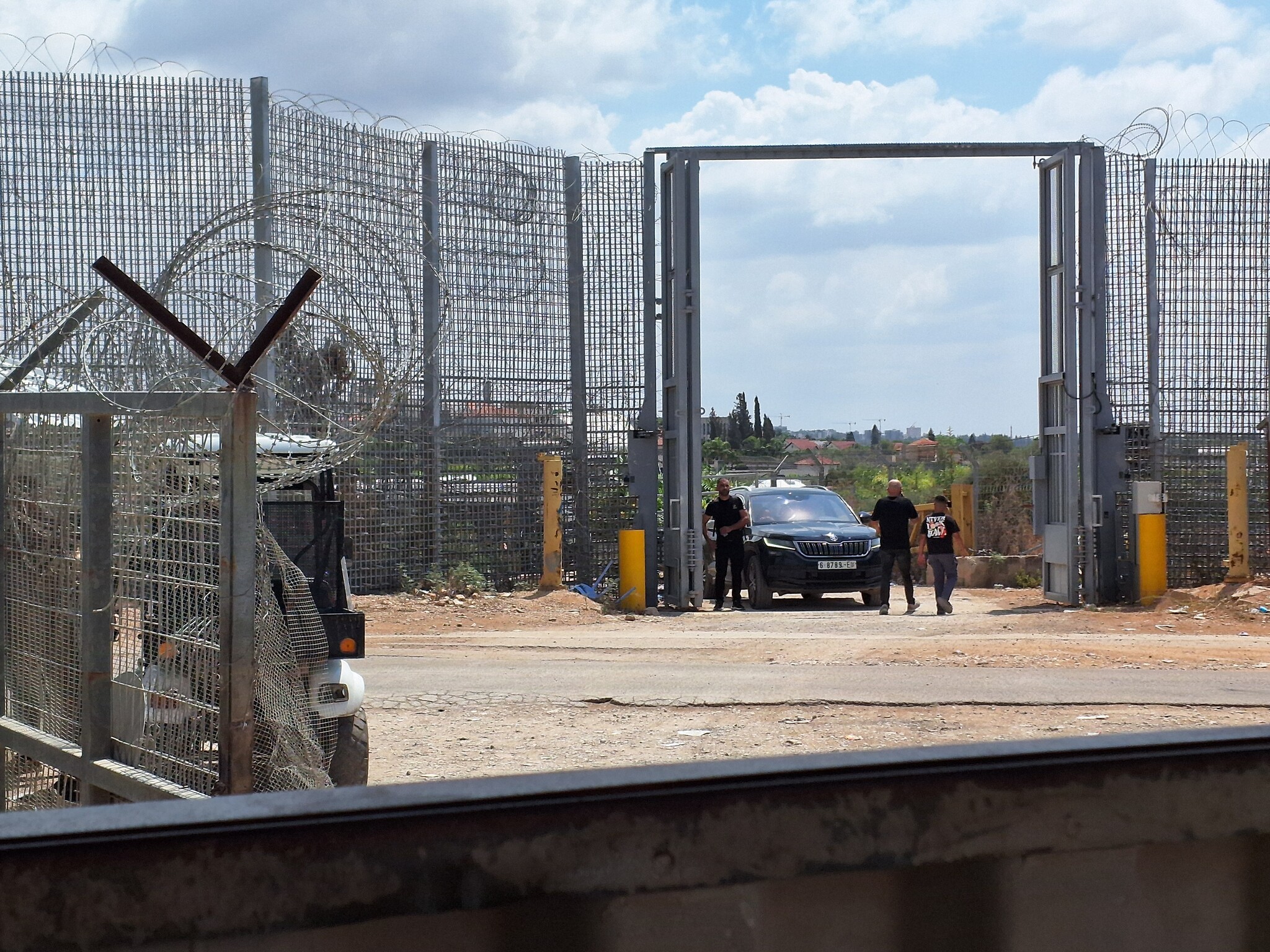 Ronit Dahan-RamatiAug-31-2026Habla. The gate is open
-
