
Dura-Al Fawwar Junction, Halhul, South Hebron Hills, Zif Junction
The son of A says: They nearly killed me yesterday.
We went knowing that there had been a serious incident this to Hebron. We decided not to go into the town. M. prefers not to meet the army on such a day. Everything looks quiet and routine.
Even the entrance to El Fawwar and Dura is open with no army presence.
At the entrance to El Fawwar we met a man who gave us money to give to Ronit Dahan-Ramati who will deal with the problem of his security clearance.
Reports of the partial enclosure of Bani Naim because the murderer of Halel Ariel left from there.
Truly army vehicles and soldiers block the way to the village.
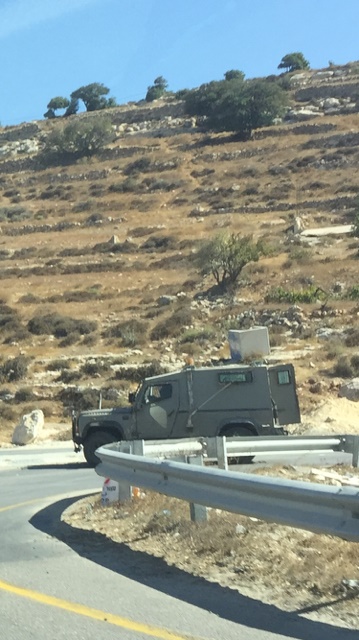
We went to Halhul on behalf of Sylvia where a man gave us documents to have his son’s belonging released from prison. When people are released from prison they are sent off without their documents, telephone, money and are left somehow to fend for themselves. We went to pick it up for them.
Beit Anun at the entrance to Hebron is blocked.

Also on the other side of the road leading to Shuyukh the entrance is blocked
On the way we passed the entrance to Kiryat Arab –Hebron and we saw that it was good that we had not tried to enter. Soldiers guard the hiking post with drawn guns. The entire circle at the entrance to the city n front of the checkpoint is full of soldiers and the emergency squad of Kiiryat Arba with drawn weapons and looking at us with looks so full of terror. So though I thought to photograph we drove into the filling station and immediately went out again. I realized it was better not to photograph. The tension was so great that it seems that the incident took place there.
Then M. our driver told me that the previous day he had spoken to his son A. who lives close to the “Path of the Worshippers”. This is a road built only for the settlers which leads from Kiryat Arba to the Cave of the Patriarchs and Palestinians are not allowed on this road. They have to take another narrow, unpaved and difficult path which is right next to the paved area).
The man, a young carpenter, was walking with his toolbox to the carpentry shop which is not far from the House of Contention. For those who do not know what this is, here is a link https://en.wikipedia.org/wiki/
Because a few settlers families are living in the house (which is a fortification of the army)there is a checkpoint which does not allow free movement of the families of the area. When the young man came up the soldier demanded that he strip almost completely and checked his toolbox. It happened that there was a Japanese knife amongst other things. “A knife. You are detained” said the soldier and phoned his commander . The commander came at a run shouting at the soldier, “Why did you not shoot. What did you not killed him immediately.” They decided to detain him . The man tried to explain to them as to where he had been headed and that it was only to work and suggested to them that they could come to see the carpentry shop. “DEEEETTTATAINNNED”. A. was called to the place and fainted when he arrived there. When he recovered he tried to explain to the soldiers the good intentions of his son . He was in a state of shock thinking that in another moment they would have shot him. He again fainted. They were kept for four hours at the checkpoint. In the end the soldiers realized that they had made a mountain out of a molehill and released them. “You realize that they nearly killed me” He told M.
Who knows how many times, behind the laconic announcement on the radio, that the terrorist had been “neutralized” the true story was that in his toolbox there had been a knife.
Maybe after the affair of Elor Azariah our moral army does not want to be bothered with moral ethics at all.
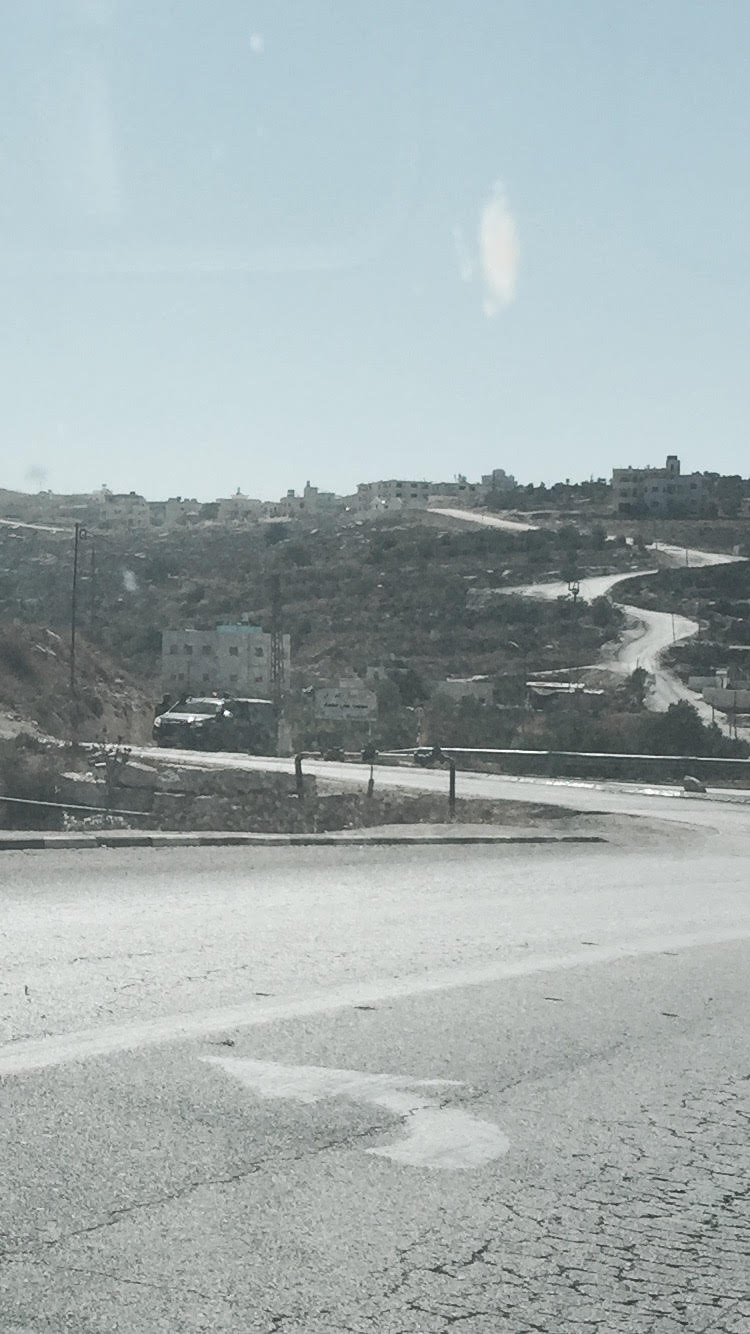
On the way back the soldiers were still standing with their vehicles blocking the entrance to Bani Naim.
.
We returned through road 317 as we had to collect more documents so as to retrieve belongings of a young man who was released from the Ofer prison and who really needs his ID.
Dura Al-Fawwar Junction
See all reports for this place-
Junction on Route 60: west - the town of El Dura, east - the Al Fawwar refugee camp. There is a manned pillbox at the junction. From time to time the army sets up flying checkpoints at the entrance to El Fawwar and Al Dura. Al-Fawwar is a large refugee camp (7,000 inhabitants in 2007) established in 1949 to accommodate Palestinian refugees from Be'er Sheva and Beit Jubrin and environs. There are many incidents of stone-throwing. In the vicinity of the pillbox there are excellent agricultural areas, Farmers set up stalls adjacent to the plots close to the road. In recent months the civil administration has set up dirt embankments thereby blocking access to the stalls, and making it impossible for the farmers to sell their vegetables. Updated April 2021, Michal T.
-
Halhul-Hebron Bridge
See all reports for this place-
Generally allows free flowing traffic, except for sudden checks by soldiers stationed permanently in the pillbox, on Route 35 in the southern West Bank.
-
South Hebron Hills
See all reports for this place-
South Hebron Hills
South Hebron Hills is a large area in the West Bank's southern part.
Yatta is a major city in this area: right in the border zone between the fertile region of Hebron and its surroundings and the desert of the Hebron Hills. Yatta has about 64,000 inhabitants.
The surrounding villages are called Masafer Yatta (Yatta's daughter villages). Their inhabitants subsist on livestock and agriculture. Agriculture is possible only in small plots, especially near streams. Most of the area consists of rocky terraces.Since the beginning of the 1980s, many settlements have been established on the agricultural land cultivated by the Palestinians in the South Hebron Hills region: Carmel, Maon, Susia, Masadot Yehuda, Othniel, and more. Since the settlements were established and Palestinians cultivation areas have been reduced; the residents of the South Hebron Hills have been suffering from harassment by the settlers. Attempts to evict and demolish houses have continued, along with withholding water and electricity. The military and police usually refrain from intervening in violent incidents between settlers and Palestinians do not enforce the law when it comes to the investigation of extensive violent Jewish settlers. The harassment in the South Hebron Hills includes attacking and attempting to burn residential tents, harassing dogs, harming herds, and preventing access to pastures.
There are several checkpoints in the South Hebron Hills, on Routes 317 and 60. In most of them, no military presence is apparent, but rather an array of pillboxes monitor the villages. Roadblocks are frequently set up according to the settlers and the army's needs. These are located at the Zif Junction, the Dura-al Fawwar crossing, and the Sheep Junction at the southern entrance to Hebron.
Updated April 2022
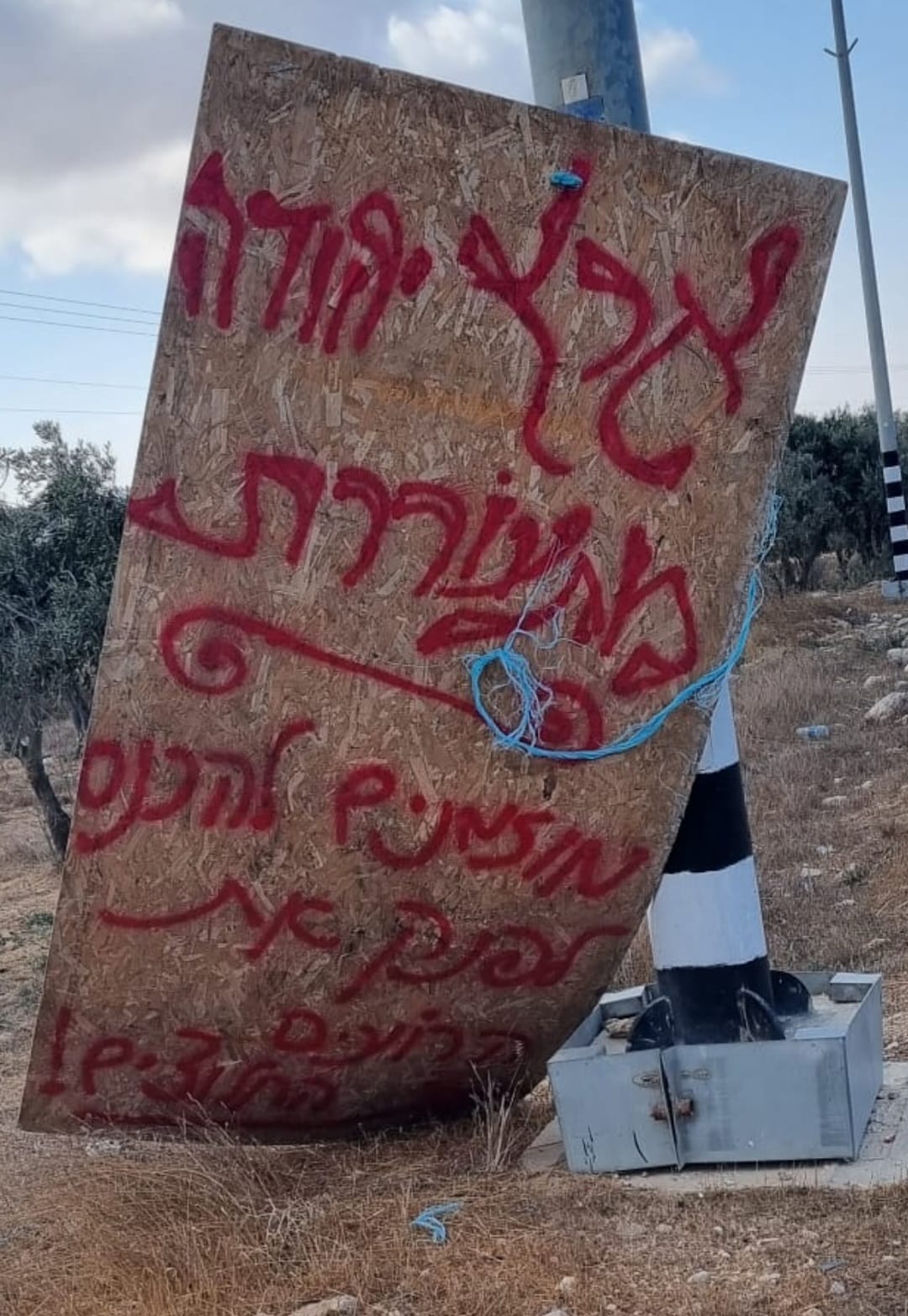 Smadar BeckerOct-17-2026A sign placed by those who call themselves the Pioneer Shepherds, at the outpost adjacent to Qawawis
-
Zif Junction
See all reports for this place-
Zif Junction located on the crossroads that directs towards Road 356 to Yata. Yata is the district city of the southern Hebron Mountains. Usually, this junction is open to traffic. The nearby pillbox is unmanned. But the army and police are present occasionally, sometimes setting up a checkpoint and sometimes detaining residents from the big city. Often, the Israeli policemen inspect vehicles and distribute driving reports to Palestinian vehicles. s
-
