
Dura-Al Fawwar Junction, Hebron
And this is what we saw:
Two additional vehicle lanes have been opened at the Meitar crossing. Today it’s possible to enter and exit via four inspection stations. The line has really become shorter.
The balloon floats above Beit Haggai.
At the Dura al-Fawwar junction – seven youths throwing stones, seven soldiers confronting them. The jeep approaches them and fires tear gas and smoke grenades. The gas spreads also to where we’re standing and our eyes tear. An additional military jeep is parked beyond the junction, next to the grove of trees, waiting for the stone throwers, but they’re not there. There’s also a flying checkpoint there on our way back.
At the Beit Haggai checkpoint every car leaving Hebron is inspected. At any given moment we counted at least 22 cars. A traffic jam was created at the entry and exit. Yaron, the Beit Haggai security coordinator, came to check us. We didn’t give him our IDs before he showed us a police ID. We parted with a handshake.
There’s a similar checkpoint at Kvasim junction, though cars there are checked randomly. Another military jeep at the entrance to Bani Na’im guards a police car imposing fines.
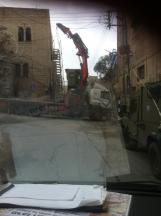
Renovations continue as Hassam HaShoter/Tarpat checkpoint. New Hebrew signs on the buildings up to Tel Rumeida – “Tarpat Street.”
The soldier next to Beit HaMeriva who provides security for the Jewish settlers inspects permits allowing vehicle passage. Very few cars receive permits. Only 28 people have permits at present, out of 40,000 Palestinians living in Area H2.
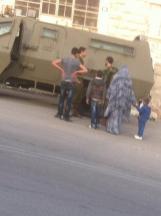
Soldiers at the Worshippers Route stop a boy and ask him for an ID. He’s young, doesn’t have one yet. They call his mother to come from home and the soldiers release the boy.
Many paratroops flags opposite the Cave of the Patriarchs. Tables set on the grass. Today the unit’s commander is being relieved and there’s a party for him. That’s why there are more soldiers in Hebron today than usual.
The occupation goes on.
Dura Al-Fawwar Junction
See all reports for this place-
Junction on Route 60: west - the town of El Dura, east - the Al Fawwar refugee camp. There is a manned pillbox at the junction. From time to time the army sets up flying checkpoints at the entrance to El Fawwar and Al Dura. Al-Fawwar is a large refugee camp (7,000 inhabitants in 2007) established in 1949 to accommodate Palestinian refugees from Be'er Sheva and Beit Jubrin and environs. There are many incidents of stone-throwing. In the vicinity of the pillbox there are excellent agricultural areas, Farmers set up stalls adjacent to the plots close to the road. In recent months the civil administration has set up dirt embankments thereby blocking access to the stalls, and making it impossible for the farmers to sell their vegetables. Updated April 2021, Michal T.
-
Hebron
See all reports for this place-
According to Wye Plantation Accords (1997), Hebron is divided in two: H1 is under Palestinian Authority control, H2 is under Israeli control. In Hebron there are 170,000 Palestinian citizens, 60,000 of them in H2. Between the two areas are permanent checkpoints, manned at all hours, preventing Palestinian movement between them and controlling passage of permit holders such as teachers and schoolchildren. Some 800 Jews live in Avraham Avinu Quarter and Tel Rumeida, on Givat HaAvot and in the wholesale market.
Checkpoints observed in H2:
- Bet Hameriva CP- manned with a pillbox
- Kapisha quarter CP (the northern side of Zion axis) - manned with a pillbox
- The 160 turn CP (the southern side of Zion axis) - manned with a pillbox
- Avraham Avinu quarter - watch station
- The pharmacy CP - checking inside a caravan with a magnometer
- Tarpat (1929) CP - checking inside a caravan with a magnometer
- Tel Rumeida CP - guarding station
- Beit Hadassah CP - guarding station
Three checkpoints around the Tomb of the Patriarchs
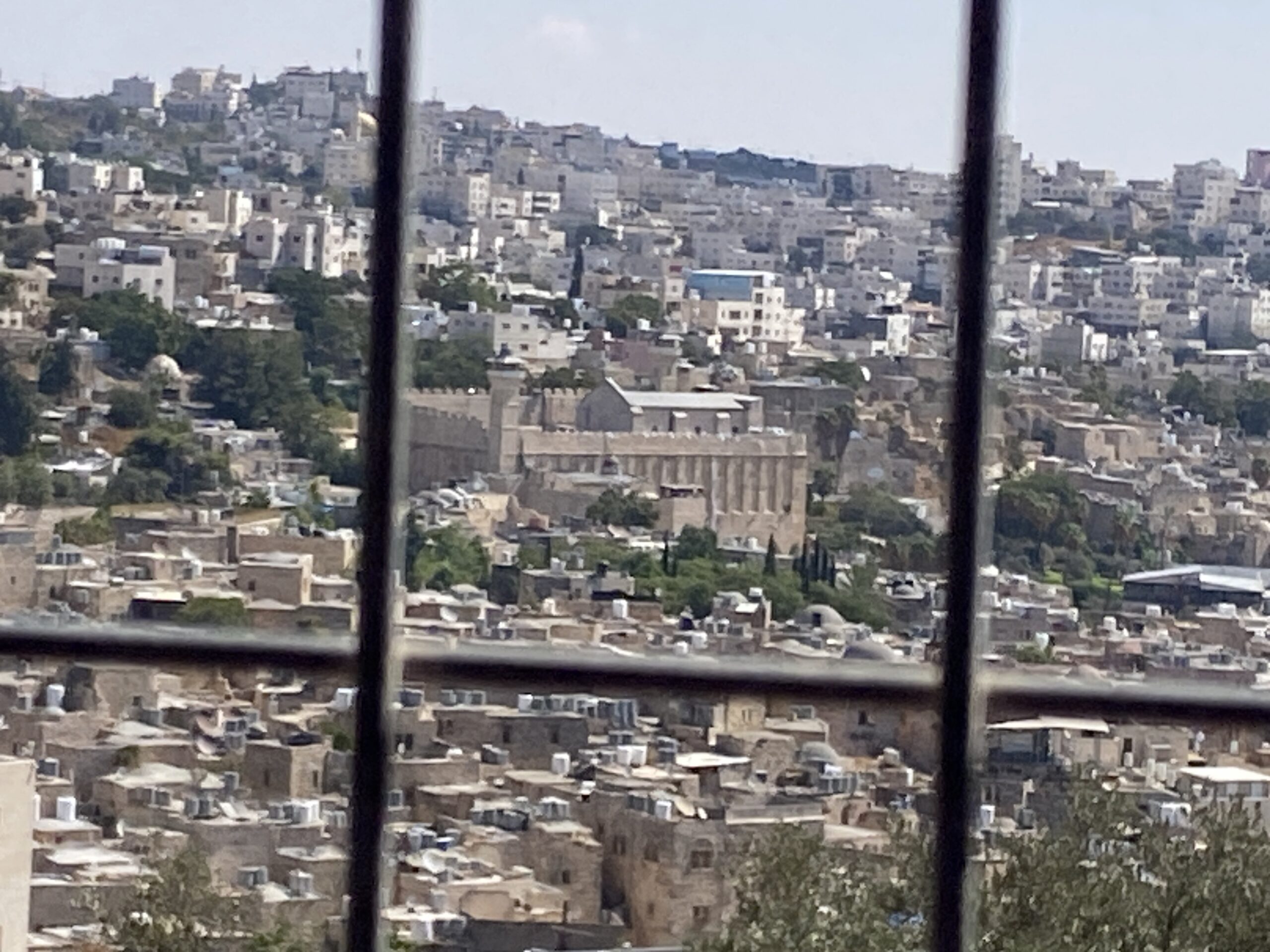 Yael ZoranSep-24-2026Hebron and the Cave of the Patriarchs from Beit Hashalom
-
