
Dura-Al Fawwar Junction, Sansana (Meitar Crossing), South Hebron Hills

The Meitar checkpoint is open but Muhammad reported heavy traffic in the morning, parking lot is packed and cars are parked behind the traffic circle on Road 60 (beyond the checkpoint). On the Israeli side there are more people than usual, maybe families. They are waiting for shuttles and rides, including women – it seems that they are not workers. Maybe families of the prisoners who missed the transport.
Highway 60 is pretty quiet. We turn onto Route 317 toward Tuwani because we wanted to hear first hand about the action at the spring on Friday. We did not find Nasser and continued to the little house of the Italian “Operation Dove” volunteers. Two volunteers were home and greeted us warmly in spite of the freezing cold. This was not the first time we had visited, but this time we noticed the very harsh conditions. They don’t have hot water and there is no possibility of doing laundry or having a shower. The house is leaking in the rain. It turns out that although each delegation includes six people, the volunteers are divided into groups of at least two. They serve 10 days or two weeks and then have leave which they spend in an apartment in Bethlehem, where conditions are better. And there are always at least two who stay in the village. As for their work, they said that at present accompanying of the children of Umm Tuba by the army is being conducted well. Soldiers arrive on time and accompany the children on foot rather than by car, which is more effective and safe.
“There is a new commander who seems to take the escorting of the children from Umm Tuba seriously. The soldiers walk besides them rather than riding in their vehicles as they did previously. However the commander does not let the Dove volunteers join the escort, they have to leave that to the soldiers.
Friday activity: Planting trees near the spring that the Abigail outpost “conquered” from the Palestinians: There was a military presence and a border guard, but they separated settlers and Palestinians and allowed Palestinians to plant without interruption. To international and Israeli activists a boundary was set beyond which they were not allowed to go, but in practice they ignored this and the activists simply went to help in the planting. They were from International Solidarity Movement, Jews for Justice of Palestinians and Taayush.
After the activity of course came the “reality” and the army put a curfew on the village (see photos). Although the closure was removed after two days but according to the map the curfew included the settlement Maon and not just Tuwani.
One volunteer said he needed to return to Italy to renew his visa and he hoped that the Israeli authorities would let him back. Some volunteers have been refused entry into Israel before and it is never sure that they will be allowed to enter. In contrast, they have a good relationship with the villagers who appreciate their help. Brave people.
We returned via al Fawwar on Road 60, which was closed for two days (Friday, Saturday): They could only enter on foot and not by car. Today the village was open.
It should be noted that we saw a few more military vehicles than usual and when we went back through the Meitar checkpoint the guard demanded to see everyone’s ID cards not just that of Mohammad, which is unusual
Dura Al-Fawwar Junction
See all reports for this place-
Junction on Route 60: west - the town of El Dura, east - the Al Fawwar refugee camp. There is a manned pillbox at the junction. From time to time the army sets up flying checkpoints at the entrance to El Fawwar and Al Dura. Al-Fawwar is a large refugee camp (7,000 inhabitants in 2007) established in 1949 to accommodate Palestinian refugees from Be'er Sheva and Beit Jubrin and environs. There are many incidents of stone-throwing. In the vicinity of the pillbox there are excellent agricultural areas, Farmers set up stalls adjacent to the plots close to the road. In recent months the civil administration has set up dirt embankments thereby blocking access to the stalls, and making it impossible for the farmers to sell their vegetables. Updated April 2021, Michal T.
-
Meitar checkpoint / Sansana
See all reports for this place-
Meitar Checkpoint / Sansana The checkpoint is located on the Green Line and serves as a border crossing between Israel and the West Bank. It is managed by the Border Crossing Authority of the Defense Ministry. It is comprised of sections for the transfer of goods as well as a vehicle checkpoint (intended for holders of blue identity cards, foreign nationals or diplomats and international organizations). Passing of Palestinians is prohibited, except for those with entry permits to Israel. Palestinians are permitted to cross on foot only. The crossing has a DCO / DCL / DCL / DCL (District Coordination Office), a customs unit, supervision, and a police unit. In the last year, a breach has been opened in the fence, not far from the crossing. This breach is known to all, including the army. There does not appear to be any interest in blocking it, probably as it permits needed Palestinian workers without the bureaucratic permits to get to work in Israel. Food stalls and a parking area economy have been created, but incidents of violent abuse by border police have also been recorded. Updated April 2022
-
South Hebron Hills
See all reports for this place-
South Hebron Hills
South Hebron Hills is a large area in the West Bank's southern part.
Yatta is a major city in this area: right in the border zone between the fertile region of Hebron and its surroundings and the desert of the Hebron Hills. Yatta has about 64,000 inhabitants.
The surrounding villages are called Masafer Yatta (Yatta's daughter villages). Their inhabitants subsist on livestock and agriculture. Agriculture is possible only in small plots, especially near streams. Most of the area consists of rocky terraces.Since the beginning of the 1980s, many settlements have been established on the agricultural land cultivated by the Palestinians in the South Hebron Hills region: Carmel, Maon, Susia, Masadot Yehuda, Othniel, and more. Since the settlements were established and Palestinians cultivation areas have been reduced; the residents of the South Hebron Hills have been suffering from harassment by the settlers. Attempts to evict and demolish houses have continued, along with withholding water and electricity. The military and police usually refrain from intervening in violent incidents between settlers and Palestinians do not enforce the law when it comes to the investigation of extensive violent Jewish settlers. The harassment in the South Hebron Hills includes attacking and attempting to burn residential tents, harassing dogs, harming herds, and preventing access to pastures.
There are several checkpoints in the South Hebron Hills, on Routes 317 and 60. In most of them, no military presence is apparent, but rather an array of pillboxes monitor the villages. Roadblocks are frequently set up according to the settlers and the army's needs. These are located at the Zif Junction, the Dura-al Fawwar crossing, and the Sheep Junction at the southern entrance to Hebron.
Updated April 2022
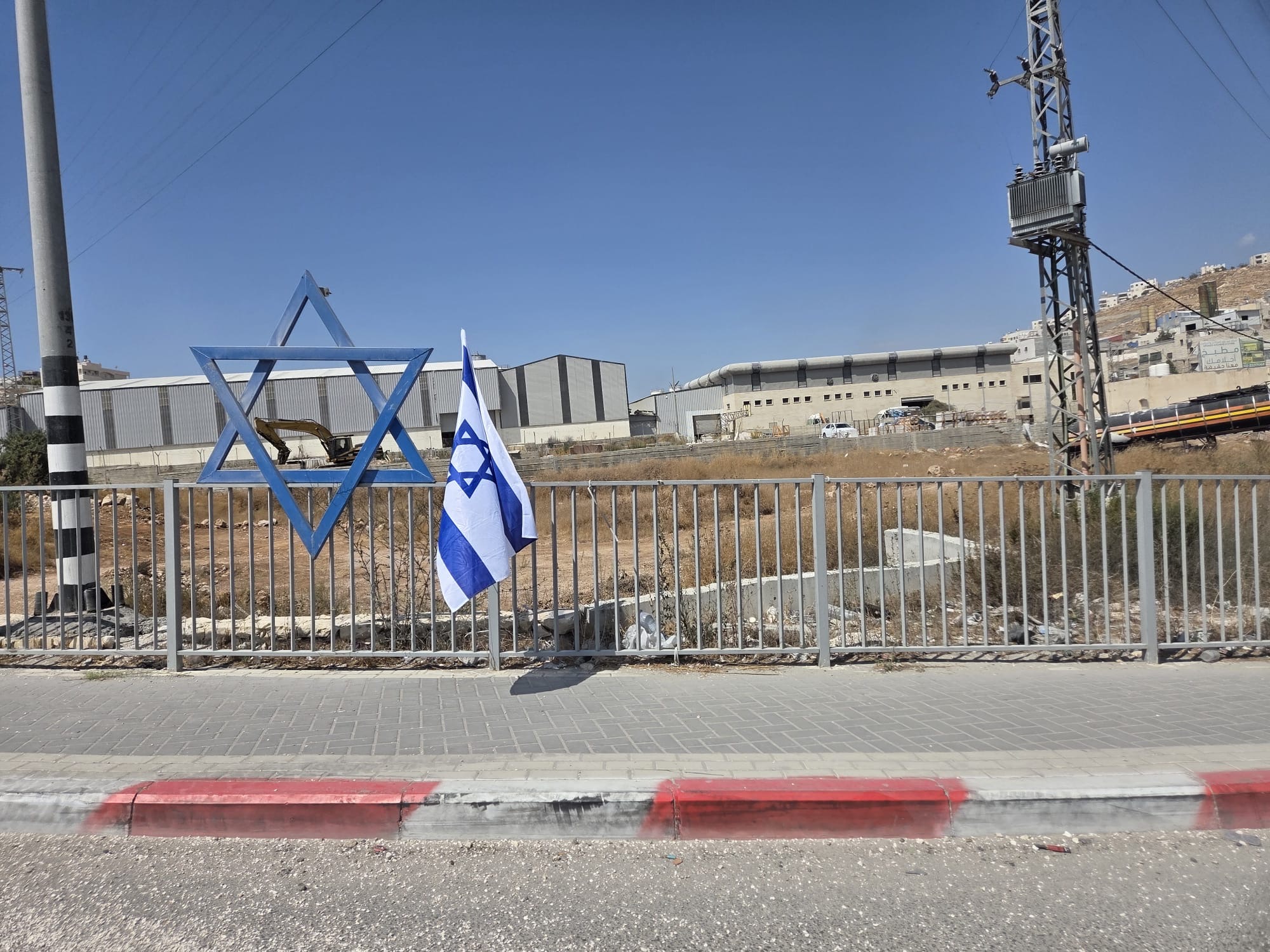 Timna OrevSep-24-2026Replacing flags on Highway 6
-
