
Dura-Al Fawwar Junction, Sansana (Meitar Crossing), South Hebron Hills, Zif Junction
he Meitar checkpoint was empty after the usual pressure after heavy traffic, accoding to Muhammas,as usual for Sunday.
On the Israeli side, police vehicles were hunting illegal workers and at the bend of highway 60 (immediately after the checkpoint) groups of illegal workers were waiting for the police to leave! The road itself is quite busy, evidently the holiday season.
We turned onto Route 317 and after the checkpoint of Metzadot Yehuda (Beit Yatir). We Did not visit Abu Kbeita this time. The checkpoint was quiet. We continued on Route 317 and entered Zif (the part of the village that is in Area C) and we visited the Amal Garden. Contrary to what we have seen in the past when there were about 15 or 20 children and two assistants, this time were only 4 children. They were happy, but a very small group. Amal says that parents just can’t pay the fee for the kindergarten (about NIS 40 per month per child). Amal claims NIS 500-600 per month, a general amount, not per child would allow her to take more children free of charge. She herself is investing a lot of effort and love in the kindergarten. We all in this shift want to think how to help. It is unclear to us how many children are concerned or how many children go to the kindergarden of the Palestinian Authority and what are the conditions there.
ack on Road 60 and Hursa (we didn’t stop there though) we saw that the checkpoints at El Fawwar and Dura were open.
From Hursa we drove on a the road that bypassed the checkpoint next to the divan there (about which we have often reported) and we descended towards the settlement of Negohot (45 families). The last time we were there, about a year ago, at the checkpoint at the end of the long road (surrounded by beautiful views) we were not allowed to go through, although it’s unclear why. This time the guard did not even ask for documents! We went back on Route 354 (an apartheid road, Palestinians are not allowed to travel there), which is parallel to the separation fence (on the Israeli side), an area beautiful but usually with no human prescence.
Dura Al-Fawwar Junction
See all reports for this place-
Junction on Route 60: west - the town of El Dura, east - the Al Fawwar refugee camp. There is a manned pillbox at the junction. From time to time the army sets up flying checkpoints at the entrance to El Fawwar and Al Dura. Al-Fawwar is a large refugee camp (7,000 inhabitants in 2007) established in 1949 to accommodate Palestinian refugees from Be'er Sheva and Beit Jubrin and environs. There are many incidents of stone-throwing. In the vicinity of the pillbox there are excellent agricultural areas, Farmers set up stalls adjacent to the plots close to the road. In recent months the civil administration has set up dirt embankments thereby blocking access to the stalls, and making it impossible for the farmers to sell their vegetables. Updated April 2021, Michal T.
-
Meitar checkpoint / Sansana
See all reports for this place-
Meitar Checkpoint / Sansana The checkpoint is located on the Green Line and serves as a border crossing between Israel and the West Bank. It is managed by the Border Crossing Authority of the Defense Ministry. It is comprised of sections for the transfer of goods as well as a vehicle checkpoint (intended for holders of blue identity cards, foreign nationals or diplomats and international organizations). Passing of Palestinians is prohibited, except for those with entry permits to Israel. Palestinians are permitted to cross on foot only. The crossing has a DCO / DCL / DCL / DCL (District Coordination Office), a customs unit, supervision, and a police unit. In the last year, a breach has been opened in the fence, not far from the crossing. This breach is known to all, including the army. There does not appear to be any interest in blocking it, probably as it permits needed Palestinian workers without the bureaucratic permits to get to work in Israel. Food stalls and a parking area economy have been created, but incidents of violent abuse by border police have also been recorded. Updated April 2022
-
South Hebron Hills
See all reports for this place-
South Hebron Hills
South Hebron Hills is a large area in the West Bank's southern part.
Yatta is a major city in this area: right in the border zone between the fertile region of Hebron and its surroundings and the desert of the Hebron Hills. Yatta has about 64,000 inhabitants.
The surrounding villages are called Masafer Yatta (Yatta's daughter villages). Their inhabitants subsist on livestock and agriculture. Agriculture is possible only in small plots, especially near streams. Most of the area consists of rocky terraces.Since the beginning of the 1980s, many settlements have been established on the agricultural land cultivated by the Palestinians in the South Hebron Hills region: Carmel, Maon, Susia, Masadot Yehuda, Othniel, and more. Since the settlements were established and Palestinians cultivation areas have been reduced; the residents of the South Hebron Hills have been suffering from harassment by the settlers. Attempts to evict and demolish houses have continued, along with withholding water and electricity. The military and police usually refrain from intervening in violent incidents between settlers and Palestinians do not enforce the law when it comes to the investigation of extensive violent Jewish settlers. The harassment in the South Hebron Hills includes attacking and attempting to burn residential tents, harassing dogs, harming herds, and preventing access to pastures.
There are several checkpoints in the South Hebron Hills, on Routes 317 and 60. In most of them, no military presence is apparent, but rather an array of pillboxes monitor the villages. Roadblocks are frequently set up according to the settlers and the army's needs. These are located at the Zif Junction, the Dura-al Fawwar crossing, and the Sheep Junction at the southern entrance to Hebron.
Updated April 2022
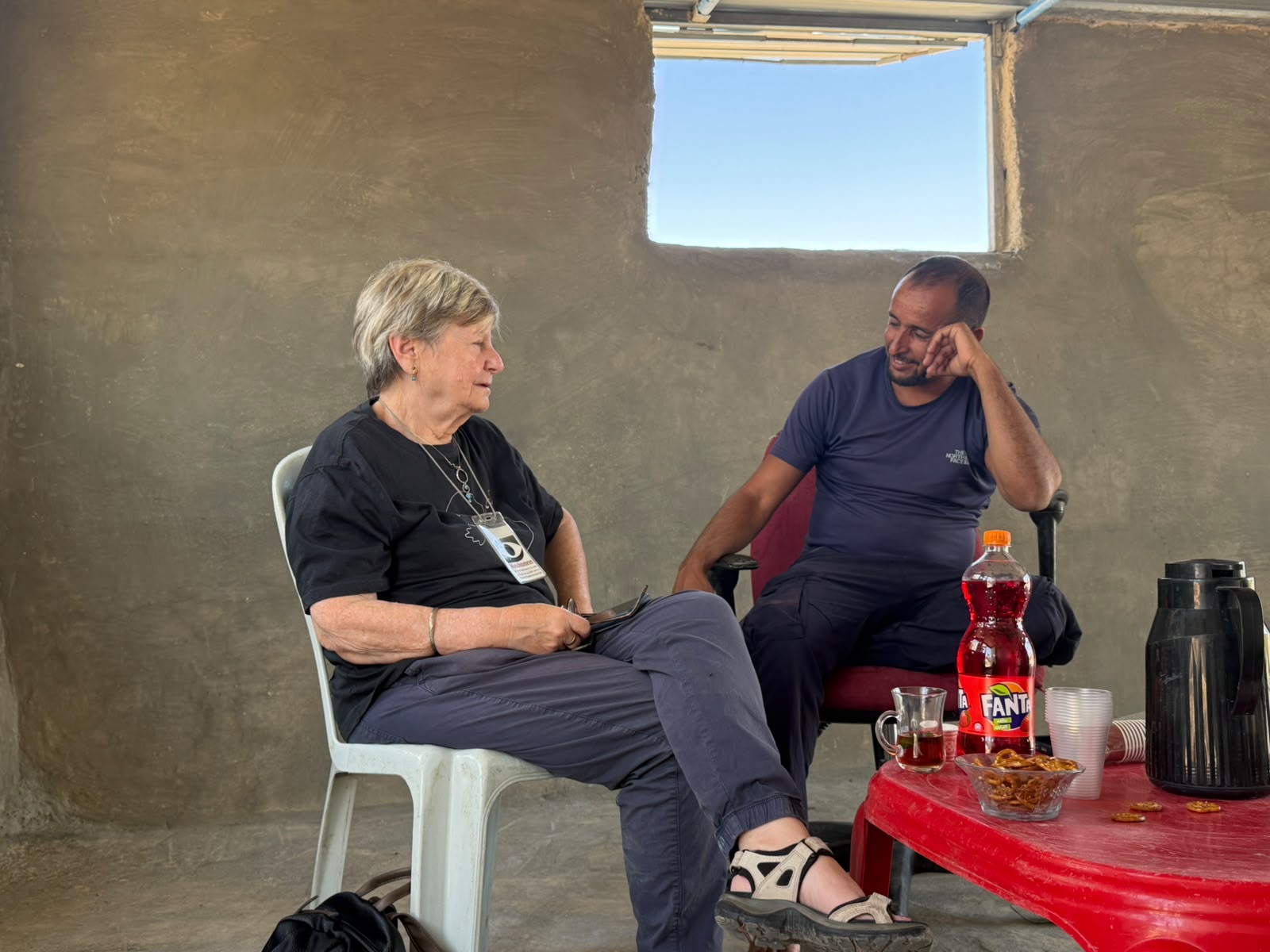 Muhammad D.Oct-10-2026Smadar with Najeh in Umm Qusa
-
Zif Junction
See all reports for this place-
Zif Junction located on the crossroads that directs towards Road 356 to Yata. Yata is the district city of the southern Hebron Mountains. Usually, this junction is open to traffic. The nearby pillbox is unmanned. But the army and police are present occasionally, sometimes setting up a checkpoint and sometimes detaining residents from the big city. Often, the Israeli policemen inspect vehicles and distribute driving reports to Palestinian vehicles. s
-
