
Eliyahu Crossing, Eyal Crossing, Habla, Irtah (Sha’ar Efrayim), Wed 15.12.10, Morning
Until the sun came up it was terribly cold and we asked ourselves how the Palestinians arrive at the CP in the middle of the night – those who are house builders, agricultural laborers, cleaning staff and otherwise engaged in different tasks which the Israelis despise or are unwilling to fulfill for the wages that are paid for them – standing in this cold and then still have to perform physical labor.
Irtah
04:50
– Those who have already left the checking areas are dispersed in small groups at the junction, in the parking lot, at the square attached to the CP, the same square in which, until a few months ago, the vehicles which transport the workers to their destinations in Israel, could stand.
The iron arm which blocked the road leading to the CP has been removed.
At the side of the entrance to the site the turnstiles are still. But immediately after our arrival they were activated and the people hurried in. At each opening of the turnstile 30-50 people manage to push in, in front of the magnometer. Every minute is precious (a minute which isn't saved while waiting for the check in the "rooms") and the people put on the table the objects which could activate the magnometer (for example canned goods).
The hidden voice which emanates from the loudspeaker usually speaks today to the people entering in a calm and quiet voice. However, the slightest delay in removing objects and placing them on the table, immediately provokes the raing of the voice and an impatient tone: "Yallah, pass on!"
And again the turnstiles are still. Five minutes later they are activated. And thus it goes on.
05:05
A woman returns. "What happened"? "hawiya" – papers. But she already passed the turnstiles
and it wasn't clear what the problem with her ID card was.
It is still dark, but one can see that on the path leading to entrance to the CP very many people stand in a crowd. From time to time the voice of the people changes into a call of resentment because of the lengthy wait. The voice is borne on the air, but there is no living being on the other side that seems to have been actually heeding the heartfelt grievance.
A man returns and then another but both refuse to elaborate on the reason why.
05:30 We are at the exit point from the building. People come out all the time but at varying speed. A man who comes out says that inside there are no people, and yet there are many people outside who await their turn to go in.
05:40 We left.
Eyal
06:05 –
At the parking lot there are many people and many vehicles. Among the vehicles there are also busses waiting for the arrival of the relatives of Palestinians imprisoned in Israel. They are due to arrive at 07:30.
On the path that leads from Kalkilya to the CP the turnstile is activated and people pass one by one. It is still dark and the silhouette movement of the people entering seems like a film projected in slow motion. There is no crowding on the pass and a rough estimate of the number of people who have not yet entered to be checked is 300.
We pass on to the turnstile on the exit path from the installation, and a man tells us while walking to the parking lot: "There is nothing harder than this life".
06:30 –
We left.
We drove through the Zofin CP. A border-policeman seems embarrassed or perplexed about the car that bears the Machsom-Watch flag. With a hesitant gesture he signals us to stop. "Where are you from ?" "I am asking because of the flag. The car begins to drive, and he again signals us to stop. This time he wishes to check the trunk of the car.
Later on we looked back on what not long ago has been the Kalkilya CP. Now there an enormous advertisement signpost is hoisted above the road, on the spot where the CP had been.
06:45 – Eliyahu Passage.
People continue arriving at the checking station for Palestinians who were lucky to obtain a work permit in the settlement of Alfey Menashe. About 15 men and women were standing there.
Habla
07:05 – Two busses carrying students from the Bedouine diaspora of Arb A-Ramadin, arrive. These children study at Habla and Kilkilya. A soldier mounts on the bus and performs a check.
The driver of one of the buses asks that when the students return at noon the gate should be opened for them at 13:15 instead of at 13:45. The busses with the students arrive at 13:15 and are obliged to wait. This waiting period is sure to cause problems and the driver expresses his apprehension that children (as is their wont) may act stupidly.
07:37 –
We left. There are still a number of people waiting to pass on to their lands
.
Eliyahu CP (109) / Crossing
See all reports for this place-
Eliyahu CP (109) / Crossing This checkpoint, also known as the Fruit Crossing, is one of the main checkpoints between Israel and the West Bank. It is located on Route 55 between Alfei Menashe and the turn to Qalqilya and Zufin, more than 4 km east of the Green Line, in the separation fence, which separates Qalqilya from its lands to the south, thus leaving Alfei Menashe West of the fence - the Seam Zone. This checkpoint, a few kilometers across the Green Line, is intended for "Israeli settlement in the West Bank and the population of the Seam Zone." It is managed by a civil company. Palestinians with a special permit for their lands in the seam area are also allowed to pass through it, on foot, and sometimes by car.
-
Eyal Checkpoint / Crossing
See all reports for this place-
Eyal Checkpoint is intended for pedestrians and Palestinians only. This is the main barrier for workers to cross from the center of the West Bank. Workers with a work permit to enter Israel can pass through it for trade, medicine, and visiting prisoners. The checkpoint was built on the Green Line north of Qalqilya in the separation barrier that surrounds the city. The checkpoint began operating in 2004 by the military. Opening hours on weekdays from 04:00 to 19:00. We started holding shifts there in 2007. We arrived at the checkpoint before it opened at 4 in the morning. We reported on the difficult conditions and the long and cramped queues of workers who must continue their journey by commuting to work throughout Israel. At the end of June 2009, the checkpoint was operated by a civil security company, The transit time has been gradually shortened, today it is faster, but the Palestinians still have to arrive very early to make it to the transportation. Usually, about 15,000 people pass through.
-
Habla
See all reports for this place-
Habla CP (1393)
The Habla checkpoint (1393) was established on the lands of the residents of Qalqilya, on the short road that
connected it for centuries to the nearby town of Habla. The separation barrier intersects this road twice and cut off the residents of Qalqilya from their lands in the seam zone.(between the fence and the green line).
There is a passage under Road 55 that connects Qalqilya to the sabotage This agricultural barrier is used by the farmers and nursery owners established along Road 55 from the Green Line and on both sides of the kurkar road leading to the checkpoint.
This agricultural checkpoint serves the residents of Arab a-Ramadin al-Janoubi (detached from the West Bank), who pass through it to the West Bank and back to their homes. The opening hours (3 times a day) of this agricultural checkpoint are longer than usual, about an hour (recently shortened to 45 minutes), and are coordinated with the transportation hours of a-Ramadin children studying in the occupied in the West Bank.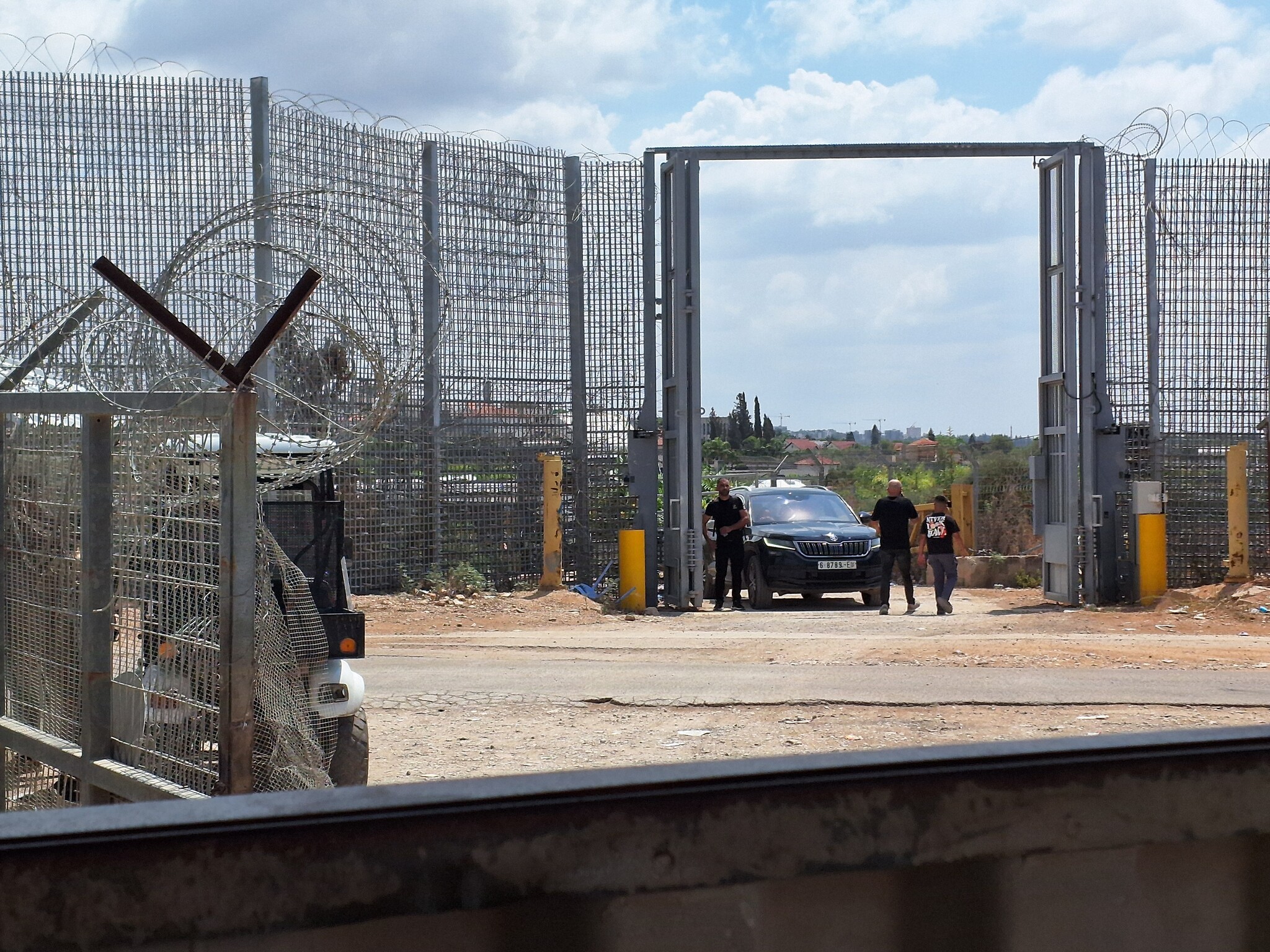 Ronit Dahan-RamatiAug-31-2026Habla. The gate is open
-
Irtah (Sha'ar Efrayim)
See all reports for this place-
The checkpoint is for Palestinians only. It is the main barrier to the passage of workers from the northern West Bank to Israel. Workers with a permit to work in Israel and also for trade (with appropriate permissions), medicine, and visiting prisoners. One can cross the checkpoint only on foot. The checkpoint is located north of Road 557 and south of Tulkarm. Operated by a civil security company, opening hours: between 4:00 and 19:00 on weekdays. As members of Machsom Watch, we began our shifts to this location in 2007. We arrived before it opened at 4 in the morning and report since, on the harsh conditions and the long and crowded queues of workers. The workers who pass by continue their journey by transportation to work throughout Israel. In the first period of its activity, about 3,000 and then 5,000 people passed through this checkpoint every day. Due to the small number of checking points and arbitrary delays for long periods of time in the "rooms", workers feared losing their transportation. Hence workers leave their homes at 2:30 at night to be among the first. Today, 15,000 pass and the transition is faster. Workers are still leaving their homes very early to get past the checkpoint at 7 p.m. In an adjacent compound, there is a terminal for the transfer of goods on a commercial scale, using the back-to-back method.
-
