
Eliyahu Crossing, Habla, Jayyus, Tue 3.4.12, Morning
 Agricultural crossings
10:50
Eliyahu crossing
As usual, security personnel pop up everywhere. “You’re not allowed to be here, you’re not allowed to photograph.” An argument begins. We say we’re in a public area and are allowed to take photographs (Someone should really find out what the legal situation is). We notice a dog in the inspection area for Palestinians; I try to photograph it. Despite the attempts by the security personnel to block the sight with their bodies I managed from a distance to photograph the dog in action (only one picture, unfortunately). They demand I give them the camera; I refuse, of course.
We continue arguing about what’s permitted to Israeli citizens and what’s forbidden.
A Palestinian who went through the right-hand lane with his vehicle calls to us; we meet him behind the concrete barrier next to the bus stop. A. was born in Qalqilya. He moved to Kafr Qassem 18 years ago after marrying a woman from that locality. He still has a temporary resident permit. He’s employed as a gardener in Tzufin and Karnei Shomron, goes through the checkpoint a few times a day and is stopped each time for an inspection lasting half an hour, accompanied by a dog, of course. He takes his children with him to work during vacations. Some time ago the security people released the dog, which lunged at his three-year-old son. The inspections, the fences and the dogs remind him of scenes from other times and places. A. is a Bedouin; many members of his family serve in the Border Police. He asks why he’s subject to such racist treatment. A few days ago the security personnel left him and his son in their car for an hour, while they drank coffee. He complained to the person in charge, who responded “OK” and turned away. In the transparent inspection stations they also check pupils who are asked to open their schoolbags.
We leave him with heavy hearts (after exchanging phone numbers), and once again meet our friends from the Shaba”k and the police who hurry to surround us lest we see something we’re not allowed to see. We’re asked for ID cards. They check them on the police computer while we continue to be surrounded by staffers with and without name tags, armed and unarmed. We’re unable to photograph. After the check is over and they realize they’re dealing with three respectable, law-abiding women, without police files, they accompany us to our car. G., a uniformed policeman, says that we received a ticket and threatens that next time we’ll be detained and taken to the police station for a lengthy interrogation. We smile and wish him a happy holiday.
11:50 Funduq
We meet A., who appeared in the film about Area C. He says everything’s quiet. We give him parcels of clothing and shoes for needy people, and turn right to Khaja.
Khaja – We meet a shepherd and another Palestinian who tell us that Border Police soldiers keep harassing and cursing them. Yesterday they stopped near a gas station and said, in Hebrew, “These bastards have to be kept penned up, released only to the hospital.” When a Palestinian car arrived they yelled, “Come on, you son of a bitch.” Last week the soldiers entered the house with their dog. The inhabitants didn’t let the dog in. The four brothers living there with their families were taken for interrogation and haven’t returned yet. One paid a lawyer NIS 32,000 and was also required to post a NIS 50,000 bond. We give them Yesh Din’s phone number. They also complain about not being allowed to build. Whoever dares build a house on their land risks having it demolished.
We continue on a lovely pastoral road via Kur and Kafr Sur, olive trees on both sides.
12:50
Jayyous checkpoint (north) (943). The gate is open. It’s quiet here. The soldiers tell us people cross in the morning. The gate closes at 13:00. We continue to Jayyous. Na’im isn’t in his office; one of his staffers accompanies us to the southern gate which opens 15 minutes after the northern gate, for only 15 minutes.
The fence was moved by order of the High Court of Justice; now the road is being redone. Olive saplings have been planted next to it. We covered the final section of the road on foot. The gate is open. The crew that closed the northern gate then opened the southern one. One man went through with his wagon.
We continued via Azzun to Highway 55, toward Kfar Saba.
13:50
Back to Eliyahu crossing. Our flag is displayed on the car window; we’re asked for ID cards.
13:50
Habla. The children’s bus crosses. A soldier gets on for a quick inspection. An army Hummer and three soldiers and an MP seem pretty bored. A driver hurries to bring his car into the village. The gates close exactly at 14:00. A soldier sweeps the dirt path next to the yellow gate at the entrance to Habla, erasing all traces.
A horse and wagon arrive one minute after the gate closes. The driver doesn’t even ask to enter, anticipating the response. He only mutters, “The horse is tired, the horse is tired.” He says: “Tell them, there in Jerusalem, that an hour isn’t enough.” (Is there anyone to talk to, there in Jerusalem?)
14:10
The Hummer leaves and so do we.
The end.
Eliyahu CP (109) / Crossing
See all reports for this place-
Eliyahu CP (109) / Crossing This checkpoint, also known as the Fruit Crossing, is one of the main checkpoints between Israel and the West Bank. It is located on Route 55 between Alfei Menashe and the turn to Qalqilya and Zufin, more than 4 km east of the Green Line, in the separation fence, which separates Qalqilya from its lands to the south, thus leaving Alfei Menashe West of the fence - the Seam Zone. This checkpoint, a few kilometers across the Green Line, is intended for "Israeli settlement in the West Bank and the population of the Seam Zone." It is managed by a civil company. Palestinians with a special permit for their lands in the seam area are also allowed to pass through it, on foot, and sometimes by car.
-
Habla
See all reports for this place-
Habla CP (1393)
The Habla checkpoint (1393) was established on the lands of the residents of Qalqilya, on the short road that
connected it for centuries to the nearby town of Habla. The separation barrier intersects this road twice and cut off the residents of Qalqilya from their lands in the seam zone.(between the fence and the green line).
There is a passage under Road 55 that connects Qalqilya to the sabotage This agricultural barrier is used by the farmers and nursery owners established along Road 55 from the Green Line and on both sides of the kurkar road leading to the checkpoint.
This agricultural checkpoint serves the residents of Arab a-Ramadin al-Janoubi (detached from the West Bank), who pass through it to the West Bank and back to their homes. The opening hours (3 times a day) of this agricultural checkpoint are longer than usual, about an hour (recently shortened to 45 minutes), and are coordinated with the transportation hours of a-Ramadin children studying in the occupied in the West Bank.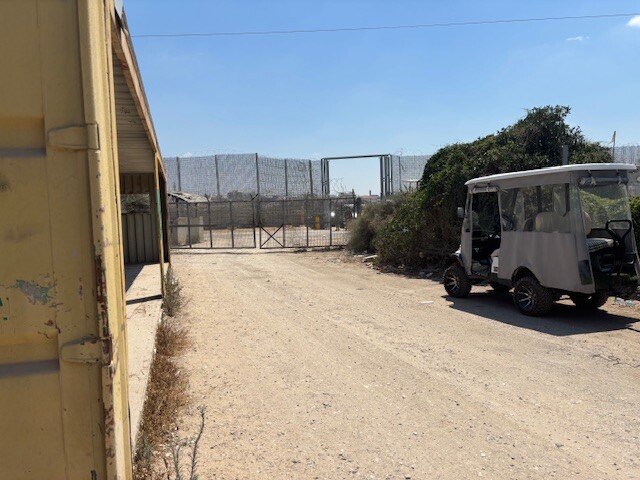 Nina SebaAug-18-2025Habla: The gate is in the process of closing
-
Jayyus North (935)
See all reports for this place