
Eliyahu Crossing, Habla, Jubara (Kafriat), Te’enim Crossing, Mon 28.11.11, Morning
Habla, 109, Beit Jimal, Jubara, the road to Tulkarm up to the rear crossing to the Te’anim crossing (near Izbat Shufa) and back via Khaja and Funduq to Route 55, 109 and then home
07:02 Habla
The gates are locked and there are no soldiers. Many Palestinians wait on the Habla side. The elderly guard waits with his “vehicle” on the side where the plant nurseries are located.
07:04 The first children’s bus arrives, and the second follows immediately. We telephone the DCO; they know about the delay – someone will be there right away.
07:07 A civilian car with four soldiers speeds along the security road toward the gate. They rapidly start getting organized; in response to my question, the checkpoint commander says there was a problem with the vehicles this morning.
07:14 The MP lets the bus drivers and the guard in, and passes them through quickly without inspection. The first group of five laborers also enters; they come through five minutes later.
07:17 The second group of five enters, and exits at 07:20.
Inspections continue rapidly, even though there are only four soldiers.
07:45 Despite the rapid inspections, about 100 Palestinians are still waiting to cross, and people argue about their place in line. The MP pulls a woman out of line and sends her through.
When we read recent descriptions of the situation at checkpoints like 'Azzun 'Atma, or, even worse, at Qalandiya, we know things are better here, but it’s still hard to accept that every day people going to work must traverse an obstacle course, and do so again on their way home.
07:50 We leave.
08:35 Falamya agricultural gate
The gate is open from 05:00 until 17:00. This is the gateway for farmers from Jayyus, Falamya and Kafr Jimal, whose lands are very far away. Some of them are allowed to drive along the security road to another gate in the inner fence, and from there on the internal roads, some of which are blocked by concertina wire and aren’t always opened, even during the olive harvest. During the summer they’re locked, and opened only after coordinating with the DCO.
As usual, there’s a steady trickle of people crossing here.
I ask one man I know how things are. “So-so…,” he says.
The bad part, which doesn’t change, is that he needs the permission of the soldiers to reach the land belonging to him and his family, along with inspections and questions and prohibitions. The other part is the rest.
We meet a guy from Falamya who doesn’t have a permit; he hoped the soldiers would let him through because he came with a man who has fields of za’atar and employs laborers, including this guy’s brother. We put him in touch with Sylvia.
He takes us to the Falamya seasonal gate which is connected directly to the village. He says that the gate was open during the olive harvest, but it’s now closed again, even though keeping it open could make life much easier for the residents.
We pass his family’s house on the way to the gate, and then a well next to which is a lovely hut, orchards and vegetable fields. We meet two women who lived for many years in Lebanon and now have returned to the village and their land. The guy helps us explain to the women who we are; they shake our hands in appreciation. They speak French, telling us about their life in Lebanon.
He tells us he attended university in Jordan. He is a construction engineer but can’t find work in his field so is looking for an agricultural job. He too is not willing to emigrate in order to find a job.
09:30 We leave our new friends and continue to Kafr Jimal. Z. isn’t in his shop; we continue along the road toward Tulkarm. We turn left onto a dirt road below Sla’it, drive to the Sla’it gate – it serves farmers holding permits who are going to their olive groves and laborers working in the settlement. The checkpoint is open Sunday through Thursday morning from 05:30 to 06:00, and from 15:00 to 15:30 in the afternoon. Maybe that would be a good time to go there and talk to people.
10:30 We continue to the Jubara gate and turn toward Tulkarm, drive up to the rear gate of the Te’anim crossing which is next to Izbat Shufa, and are happy to run into our friend K., the taxi driver from Beit Lid, who worked the Tulkarm – Beit Iba route during the period when things were worse. We talk to him and catch up.
Since this gate is open to Israeli Arabs only from 11:30, and we don’t know whether they’ll let us through, we return by the same route, via the Zayit plaza toward Funduq, go through Khaja, turn right at Funduq onto Highway 55 toward the Eliyahu crossing (109), and then home.
Eliyahu CP (109) / Crossing
See all reports for this place-
Eliyahu CP (109) / Crossing This checkpoint, also known as the Fruit Crossing, is one of the main checkpoints between Israel and the West Bank. It is located on Route 55 between Alfei Menashe and the turn to Qalqilya and Zufin, more than 4 km east of the Green Line, in the separation fence, which separates Qalqilya from its lands to the south, thus leaving Alfei Menashe West of the fence - the Seam Zone. This checkpoint, a few kilometers across the Green Line, is intended for "Israeli settlement in the West Bank and the population of the Seam Zone." It is managed by a civil company. Palestinians with a special permit for their lands in the seam area are also allowed to pass through it, on foot, and sometimes by car.
-
Habla
See all reports for this place-
Habla CP (1393)
The Habla checkpoint (1393) was established on the lands of the residents of Qalqilya, on the short road that
connected it for centuries to the nearby town of Habla. The separation barrier intersects this road twice and cut off the residents of Qalqilya from their lands in the seam zone.(between the fence and the green line).
There is a passage under Road 55 that connects Qalqilya to the sabotage This agricultural barrier is used by the farmers and nursery owners established along Road 55 from the Green Line and on both sides of the kurkar road leading to the checkpoint.
This agricultural checkpoint serves the residents of Arab a-Ramadin al-Janoubi (detached from the West Bank), who pass through it to the West Bank and back to their homes. The opening hours (3 times a day) of this agricultural checkpoint are longer than usual, about an hour (recently shortened to 45 minutes), and are coordinated with the transportation hours of a-Ramadin children studying in the occupied in the West Bank.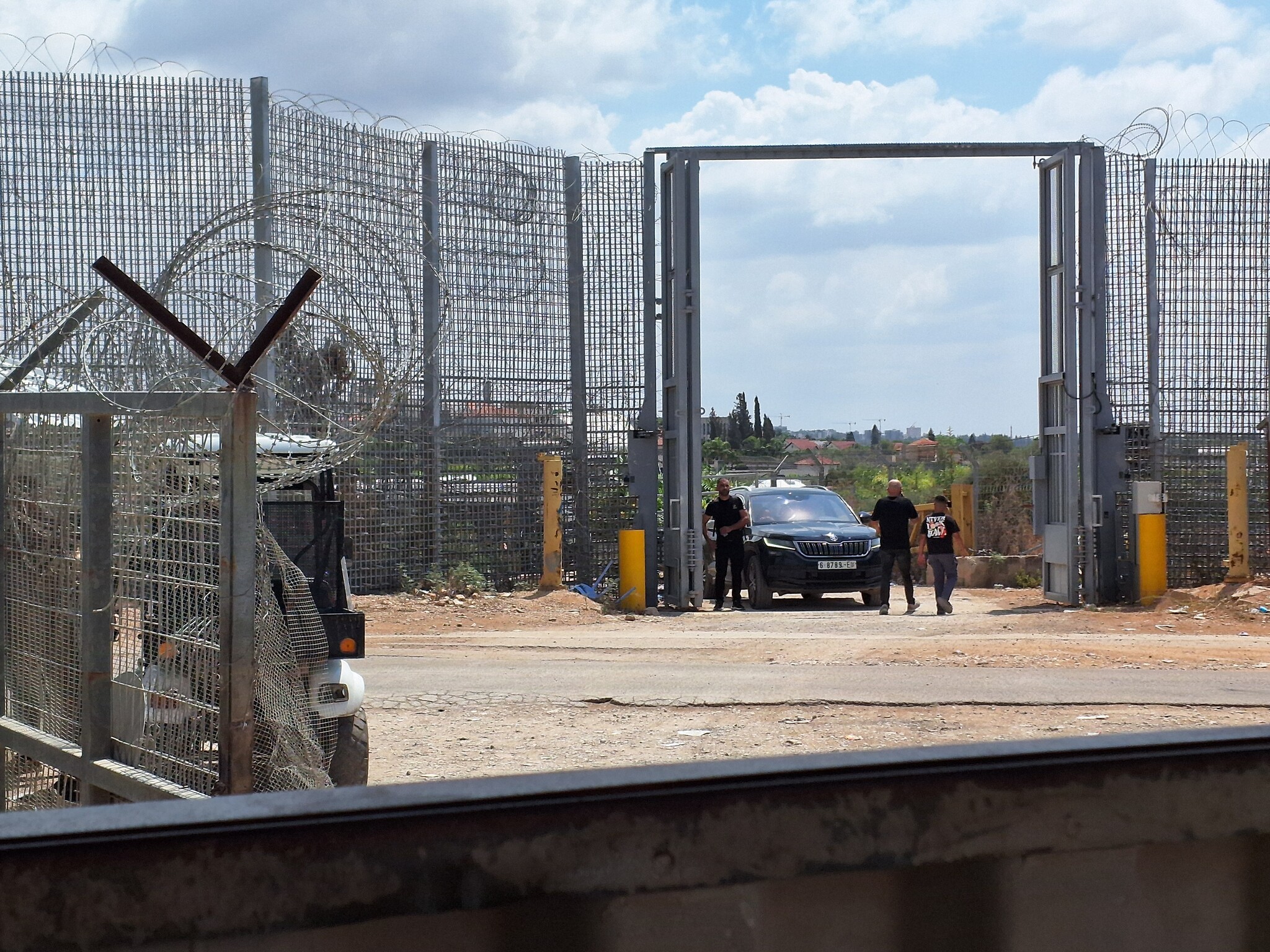 Ronit Dahan-RamatiAug-31-2026Habla. The gate is open
-
Jubara (Kafriat)
See all reports for this place-
The Jabra checkpoint was on Road 557, south of Tulkarm, on the side of the Figs Pass, which is located within the Palestinian Authority (a few kilometers east of the Green Line), and serves as an entry barrier from the territories to Israel. The checkpoint to the village of Jubara, which until 2013 was in the seam area, blocked and surrounded by a fence, was intended for the passage of the family members of the house next to the checkpoint, and also for the MachsomWatch volunteers (with special permission only), on their way to checkpoint 753. on the other side of the village. The soldiers supervising the "fig crossing" also supervised the crossing at this checkpoint, in our shifts we often waited a long time until the key was found and the gate opened. The checkpoint was abolished and became part of the separation fence that was moved west following the High Court.
-
Te'enim Crossing
See all reports for this place-
Te'enim Crossing The Figs checkpoint, located on Road 557, east of the Green Line and the Ephraim Checkpoint (Road 444), is a vehicle crossing, open 24/7 all year round. It serves the Israeli population, including those authorized to enter the Palestinian Authority. The passage of foreigners holding international passports recognized by the State of Israel is approved. In exceptional cases will the passage of a Palestinian be allowed here.
-
