
Eliyahu Crossing, Habla, Ras ‘Atiya, Thu 11.2.10, Afternoon
Summary
Innumerable bans have been enforced on the Palestinian people by the Separation Barrier – restrictions of: the right to reach and cultivate their lands, the right to work, to move freely and to claim any rights normally enjoyed by an indigenous population. Permits are issued by the Civil Administration to cross at a certain agricultural gate, opened at the whim of the authorities; friends and relatives may not visit, people should not become ill or have babies in the middle of the night (the "gates" are closed, usually from 18:00-6:00); they cannot bring large quantities of food, cannot get electricity, their sheep may not safely graze since there is little land for them to graze on – it's all designed to suffocate those living in the so-called Seam Zone.
The enclaves around the many settlements in the northern West Bank are hardly spoken about; often do not appear on maps, and certainly not on Israeli maps. But this is where much of the action in today's 42 year old occupation lies. The enclaves are pockets created by the ever growing Separation Barrier as it winds its way often five kilometers to the east of the Green Line. Communities of Palestinians are trapped between the line and the Separation Barrier. The authorities already seem to consider this "Israel" proper. The policy is put into place by the army, the civil administration, the defense ministry, the municipalities. It's all the same: that's Israeli policy. Land has been appropriated from its Palestinian owners for building of a pristine "Jerusalem stone" type wall, for more Separation Barrier, for settlers already there and more to come (Alfei Menashe, Zufim). The beautiful spring time scenery is for Israelis only. The Palestinians have to suffer. Yet none of this "policy" is spelled out. It's what we deduce, what we monitor and report on from checkpoints that still exist or that were, and from going to the Separation Barrier that is and the Wall that is becoming.
11:20 Gate 1392 Habla
The gate has just opened, but on the far side, only half of it is, in fact, fully opened, making it hard for vehicles to pass. There's a crowd, on both sides. Men wait on the side where we stand, and a line of vehicles, bearing nursery products like young palm trees, can be spied on the far side of the Separation Barrier. The door of the concrete hut, where IDs, etc. are checked, away from our sight, is open. It's hot, 25C or more, and it's not even the middle of February!
Passage for pedestrians, waiting on either side of the Separation Barrier, is very slow. We call over to the commander, who pretends not to hear, then says, "It's OK:" For whom? Certainly not for the patiently waiting Palestinians. And we get no further enlightenment from the army here.
On the other hand, we learn, from the man we call the "cowboy" and his friend, the nursery owner, how hard it is for the former to graze his sheep and make it back and forth — with sheep — through Gate 1392 at the hours authorized for opening by the army. There's hardly any grazing land left between Qalqiliya and the Separation Barrier, certainly not enough for what sheep usually need.
There's not a MachsomWatch shift where we don't learn about yet another constriction on life for Palestinians (and their animals).
Leaving Route 55, we travel towards Alfe Menashe, where the cranes are clearly visible building anew, and the new roadway in the wadi on the south side continues to progress, slowly, as a new road and/or checkpoint. No work on the new Wall, it's finished, complete, and a statement, yet once again, of a "fait accompli," a fact on the ground where lands – olive groves, the mainstay of the economy here — of the nearest village, Ras Atira, have been seized. We move on, winding our way through the unusually green landscape, to the Seam Zone village of:
12:30 Ras Atiya
The minibus donated by the Italian government, the one with a white dove on its side, the one we saw just four days ago wending its way, shuttle style between the Seam Zone village and the secondary school at Khirbet ad Daba, is stopped by soldiers at the Separation Barrier and made to turn around. The driver is incensed. "It's the second time this has happened," he laments. "Are you part of Edna's group?" We nod in the affirmative, and he asks for help. First, of course, we ask the army, and Nadav, the sergeant commander, seems astounded that, just this past Sunday, there were no problems. He's not open to reason, goes into a long diatribe about teachers and their permits and what they must do when they cross from their home village in the morning, and what is expected when they want to return home.
We tell the driver that we will call the DCO, and do so via Tami, to whom the driver talks, thinking, at first, that it's Edna! Everything is at a standstill. The minibus stands near where our car is parked, and other people can't cross the Separation Barrier. A middle aged teacher joins us, showing us his three "permits." An ID, a teacher's permit and one to allow him to cross at this particular checkpoint. All in order. But not for this group of soldiers. The teacher, a long time teacher, comes from Kafr Thulth, a village that can only be reached by crossing the Separation Barrier. "Look," Hamdallah continues, "There's my car on the other side. I left it there this morning. Now they won't let me get back to it." The absurdity of the situation is one that would appeal to Beckett. But to day's reality is brought on by the authority of the Israeli army.
12:55 — suddenly, the well known white jeep of the DCO, followed by the equally well known blue police car of the Israeli Police, appear on the scene, as if by magic. No, not exactly, Tami's phone call has reaped results!
The DCO stops his jeep in the middle of the Separation Barrier, dismounts and talks to the soldiers huddled in the middle, and then moves away and makes a phone call. The blue police car positions itself outside the concrete construction that houses the computers through which inhabitants of the village of Ras Atiya have to pass before crossing out of the enclave.
13:00 — the mini bus, still full of passengers, many women teachers, positions itself now as if to cross the checkpoint, the Separation Barrier. Indeed, although the driver tells us that the soldiers insist that his passengers must dismount, and he says they will refuse (after all they're going home), as we prepare to leave, the minibus finally crosses, passengers remaining inside, and the blue police car leaves just as we do. End of another "incident" without provocation on the Seam Line.
13:05 — Eliahu Gateway is clear, the police positioned inside their new booths, and we wend our way to the village of Nabi Elias to recuperate!
Eliyahu CP (109) / Crossing
See all reports for this place-
Eliyahu CP (109) / Crossing This checkpoint, also known as the Fruit Crossing, is one of the main checkpoints between Israel and the West Bank. It is located on Route 55 between Alfei Menashe and the turn to Qalqilya and Zufin, more than 4 km east of the Green Line, in the separation fence, which separates Qalqilya from its lands to the south, thus leaving Alfei Menashe West of the fence - the Seam Zone. This checkpoint, a few kilometers across the Green Line, is intended for "Israeli settlement in the West Bank and the population of the Seam Zone." It is managed by a civil company. Palestinians with a special permit for their lands in the seam area are also allowed to pass through it, on foot, and sometimes by car.
-
Habla
See all reports for this place-
Habla CP (1393)
The Habla checkpoint (1393) was established on the lands of the residents of Qalqilya, on the short road that
connected it for centuries to the nearby town of Habla. The separation barrier intersects this road twice and cut off the residents of Qalqilya from their lands in the seam zone.(between the fence and the green line).
There is a passage under Road 55 that connects Qalqilya to the sabotage This agricultural barrier is used by the farmers and nursery owners established along Road 55 from the Green Line and on both sides of the kurkar road leading to the checkpoint.
This agricultural checkpoint serves the residents of Arab a-Ramadin al-Janoubi (detached from the West Bank), who pass through it to the West Bank and back to their homes. The opening hours (3 times a day) of this agricultural checkpoint are longer than usual, about an hour (recently shortened to 45 minutes), and are coordinated with the transportation hours of a-Ramadin children studying in the occupied in the West Bank.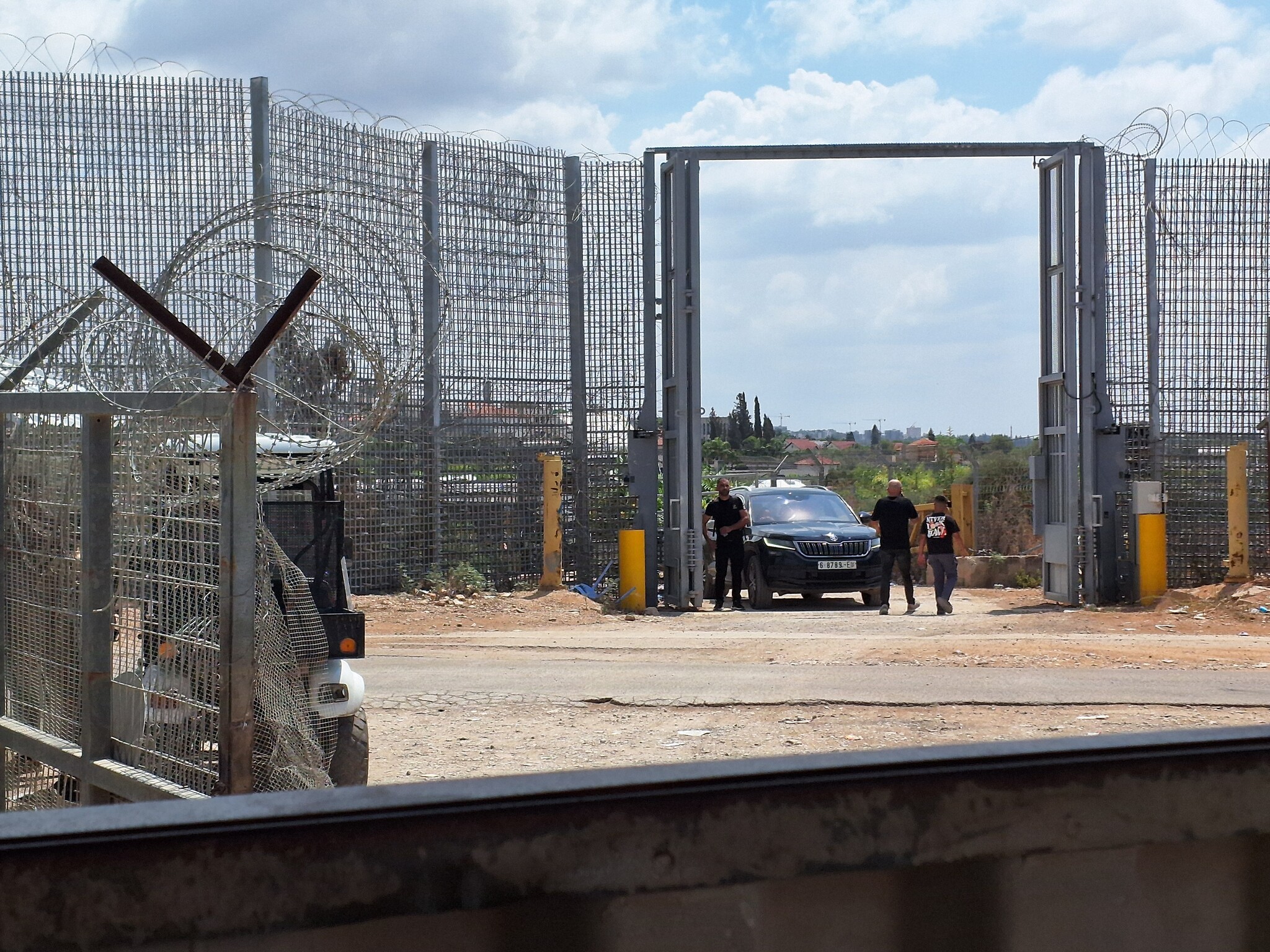 Ronit Dahan-RamatiAug-31-2026Habla. The gate is open
-
Ras 'Atiya
See all reports for this place-
The checkpoint is presently on the Separation Barrier roadway, manned and open 12 hours a day, from 6:30 to 18:30. West of it is the large Seam Line village whose school is attended by children from the nearby villages east of the Barrier and many of whose inhabitants have permits to work in Israel. How long this checkpoint will remain in place is unknown, since construction of the Separation Wall, just by the settlement of Alfe Menashe, east of the present Separation Barrier, is endless, as is the creation of a new road and, obviously, a new checkpoint.
-
