
Etzion DCO - documenting the sanitary condition by Channel Kan 11

Continuing with the idea of Raya, which is about to be accomplished, we travelled to the 2 locations (DCO Etzion and Qalandiya checkpoint) in order to assist the journalist from “Kan” station 11 in reporting about the upkeep and conditions in those areas.
DCO Etzion
We met with the team and also with Shlomit and Natania at the DCO Etzion. We were astonished at the small size of the DCO, in face of its purpose to serve a very large population. All of the Bethlehem area, and at this time also Hebron, since they have been renovating the DCO office there for a long time, in fact up until now. Shlomit was able to describe exactly the plumbing problems at the DCO as well as the stench just outside it. But this will not be on the TV program.
The people waiting here, most of whom arrive in order to get a magnetic card, which today is required even for single entries, tried to create some order within all the disorder. One of those waiting collected all the documents from everyone and, every time that the door opened, 5 women entered, in the line’s order. We could not go inside because of the dense crowding. Of course, the entrance is intended for Palestinians who receive this service.
A four-year magnetic card costs 150 NIS. The magnetic card will soon (maybe already) will allow entrance into Israel without any further papers. That is, one needn’t arrice at the DCO to get a permit, it will be recorded in the computer. This offers some consolation. The state gets its income and those who receive this service are saved extra trouble.
Coffee break in the Malha Mall
Three women met in the Mall for a glass of juice and a Jabatta and discover that all 3 of them were born in the Maternity Hospital in Afula! Raya already wrote about this. A subject worthy of conversation until the juice is finished.
Qalandiya Checkpoint, the new and the old
Really, the old one looks old and neglected and it is hard to believe that it lasted so many years. The new one is not so great either. The designer does not deserve much credit. But maybe the State didn’t give him a detailed description of what was needed. Looks like a jail. But, there are a lot of exit desks which allows for a quick passage. The whole area is still being built, a road, parking, etc. Chaos.
To photograph rest rooms was never my life’s goal, nor did I ever think that MachsomWatch needed to document the rest rooms of the Palestinians at all. I didn’t like doing this or the attending meanings of the act.
Nevertheless, I photographed with one hand and blocked my nose with the other. A Buddhist koan.
Also the facade of the new checkpoint. I was surprised that the public broadnasting company, “Kan”, needed us even though the reported had a photographer along.
Etzion DCO
See all reports for this place-
serves residents of Bethlehem and surrounding villages who need magnetic cards, work permits for Israel, permits for one-time entry for religious or health reasons, various police permits, etc.
-
Qalandiya Checkpoint / Atarot Pass (Jerusalem)
See all reports for this place-
Click here to watch a video from Qalandiya checkpoint up to mid 2019 Three kilometers south of Ramallah, in the heart of Palestinian population. Integrates into "Jerusalem Envelope" as part of Wall that separates between northern suburbs that were annexed to Jerusalem in 1967: Kafr Aqab, Semiramis and Qalandiya, and the villages of Ar-Ram and Bir Nabala, also north of Jerusalem, and the city itself. Some residents of Kafr Aqab, Semiramis and Qalandiya have Jerusalem ID cards. A terminal operated by Israel Police has functioned since early 2006. As of August 2006, northbound pedestrians are not checked. Southbound Palestinians must carry Jerusalem IDs; holders of Palestinian Authority IDs cannot pass without special permits. Vehicular traffic from Ramallah to other West Bank areas runs to the north of Qalandiya. In February 2019, the new facility of the checkpoint was inaugurated aiming to make it like a "border crossing". The bars and barbed wire fences were replaced with walls of perforated metal panels. The check is now performed at multiple stations for face recognition and the transfer of an e-card. The rate of passage has improved and its density has generally decreased, but lack of manpower and malfunctions cause periods of stress. The development and paving of the roads has not yet been completed, the traffic of cars and pedestrians is dangerous, and t the entire vicinity of the checkpoint is filthy. In 2020 a huge pedestrian bridge was built over the vehicle crossing with severe mobility restrictions (steep stairs, long and winding route). The pedestrian access from public transport to the checkpoint from the north (Ramallah direction) is unclear, and there have been cases of people, especially people with disabilities, who accidentally reached the vehicle crossing and were shot by the soldiers at the checkpoint. In the summer of 2021, work began on a new, sunken entrance road from Qalandiya that will lead directly to Road 443 towards Jerusalem and Tel Aviv. At the same time, the runways of the old Atarot airport were demolished and infrastructure was prepared for a large bus terminal. (updated October 2021)
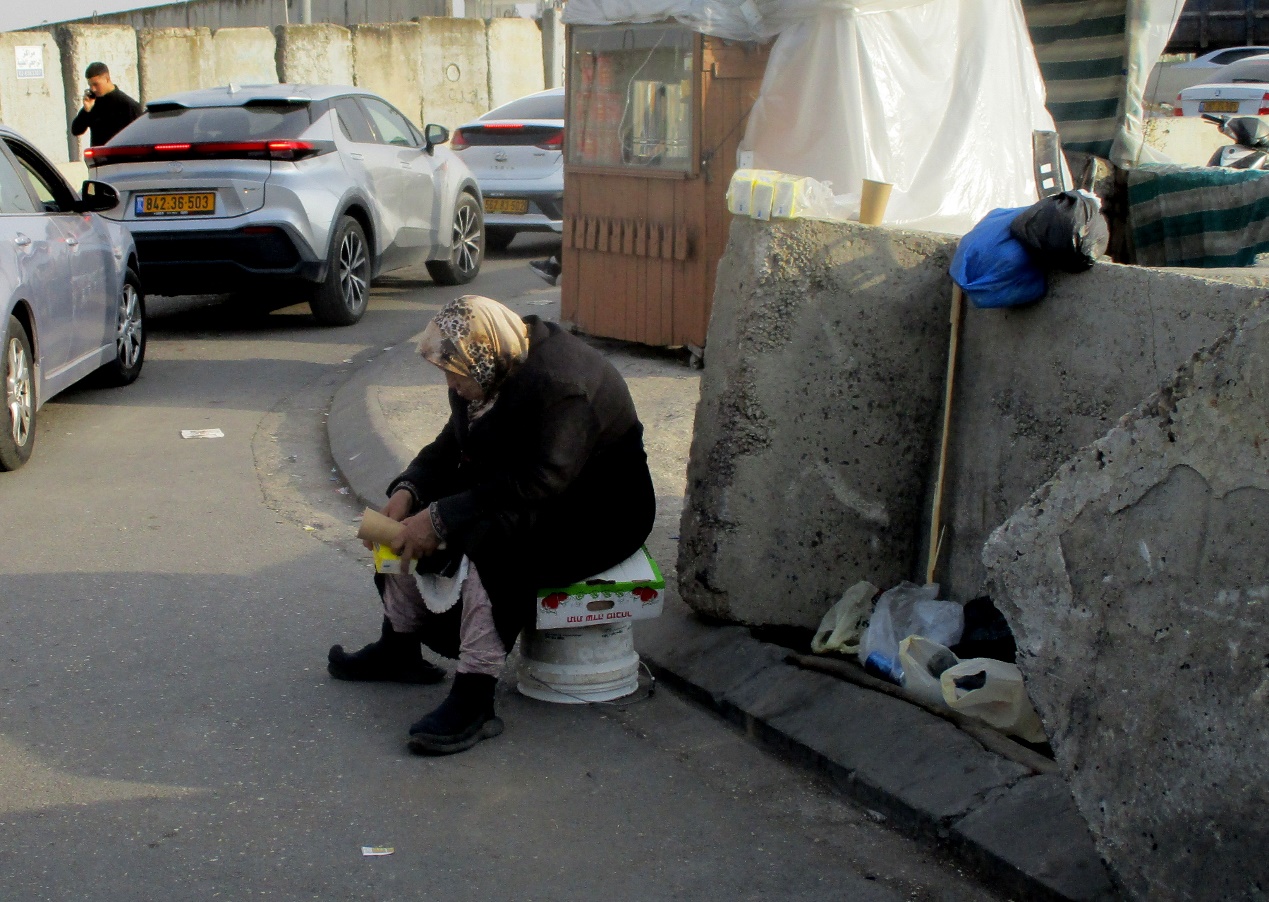 Tamar FleishmanOct-11-2026Qalandiya. Female Beggar
-
