
Eyal Crossing, ‘Anabta, Beit Iba, Deir Sharaf, Habla, Jubara (Kafriat), Shave Shomron, Sun 12.9.10, Afternoon
Summary
It’s a New Year for many, the third day of Eid el Fitr for others. The
problem is that after 43 years of occupation, and Israel’s continuing
determination to maintain sovereignty and confiscate land, generations
of Israelis have ceased to see the other side, the Palestinians, as
human beings. Whereas, of course, MachsomWatch volunteers go into the
West Bank to monitor violations of human rights, the fact is that, we
also assume a “people to people” approach, visiting those we’ve gotten
to know over the years, at or near checkpoints, outside terminal
buildings or at agricultural gates. True, we are there to “bear
witness,” but we are also there to meet and greet our fellow human
beings who, just like us, wish to live a “normal” life.
Habla
14:00 we are there at the usual opening time, and the gates are open.
But since it is the first day of the “fall back” clock, we ask about
gate opening. So far, only the evening opening time has changed, now
from 16:45-18:00 (instead of an hour later).There are people waiting on
both sides of the Separation Barrier, more on the Habla side, about 15
that we can see, half that number on the side where we watch. Since it
is a holiday, there are less horse or donkey drawn vehicles than usual
and not one tractor.
14:10 — the gates are closed by the three soldiers working
lackadaisically on a not too hot late summer day. Why are the gates
closed? “There’s been an incident.” Nevertheless, an elderly man and his
cart are let into the middle of the Separation Barrier road, and his
sweetly, aromatic guavas, hidden beneath a blanket, are uncovered for
inspection. On the far side of the checkpoint, the metal barricade,
which has been closed, is now swung open, and this cart passed. A
similar incident with another guava carrying cart, with its owner having
to leave the cart and horse, as usual, to go to the concrete bunker
which serves as a checking booth before proceeding.
14:20 — a white jeep, “police” written on its side, arrives and
soldiers and police talk. People wait, nothing moves. A usual situation.
The speed, sorry, slowness by which the soldiers function has nothing
to do with the heat but with overall policy: let them wait, check
everything over and over (even of people who pass not once but twice a
day, etc. etc.)
Nothing to report on Route 55 other than many military vehicles
on the road. The only rolling checkpoint, if indeed it was to be one,
was at the old entryway to Shavei Shomron where a group of soldiers
stood at the side of the road with two Hummers. Anabta is busy with fast
flowing traffic, no soldiers in view and just one vendor – of figs.
Once again, we took the newly paved road past Jit and Sarra and drove
down to Beit Iba on the new asphalted stretch of road given “by the
American people to the Palestinian people.” Below, Beit Iba is as dusty
and forlorn looking as ever, its days of full time checkpoint duty and
harassment over.
Deir Sharaf
We could be in an Israeli town, since the parking place outside the
minimarket is filled with cars bearing yellow license plates. The
Palestinian Israelis have been so busy shopping in Nablus and its
surrounds, that the minimarket was open around the clock in the days
before the start of Edi el Fitr, and even today, business is brisk.
Shavei Shomron
We drive up Route 60 to the checkpoint and, not unusual, we attract the
attention of the sleepy soldiers on duty here, and two of them come over
as we prepare to turn and go back down the hill. As last time, the
commander, who still seems to know little of who we are and what we do,
has to shush his officious underling who wants to ask questions of us.
Jubara
16:05-16:40 Just like the other Israeli cars, we stand in line and wait
and wait. There are hundreds of vehicles it seems, waiting to go back
into Israel proper, and we see, from afar, a long line of vehicles also
entering the gateway from Tulkarm directly: the first time Jubara has
been used as a junction in many years.
Irtah
16:50 There’s a barricade across the roadway, no entry into the terminal
parking lot. Few returning Palestinian workers, but a number of mini
vans offload workers near by.
'Anabta CP
See all reports for this place-
'Anabta CP
The checkpoint is located south of the village of 'Anabta, at the intersection of Road 60 (leading to Nablus at the entrance to Area A), with Road (57, 557, 5576) facing west towards the Einav settlement and the checkpoint at the exit from the West Bank - Figs checkpoint. Until 2010 we used to watch the intersection and report the long columns created due to a slow inspection of the vehicles in both directions.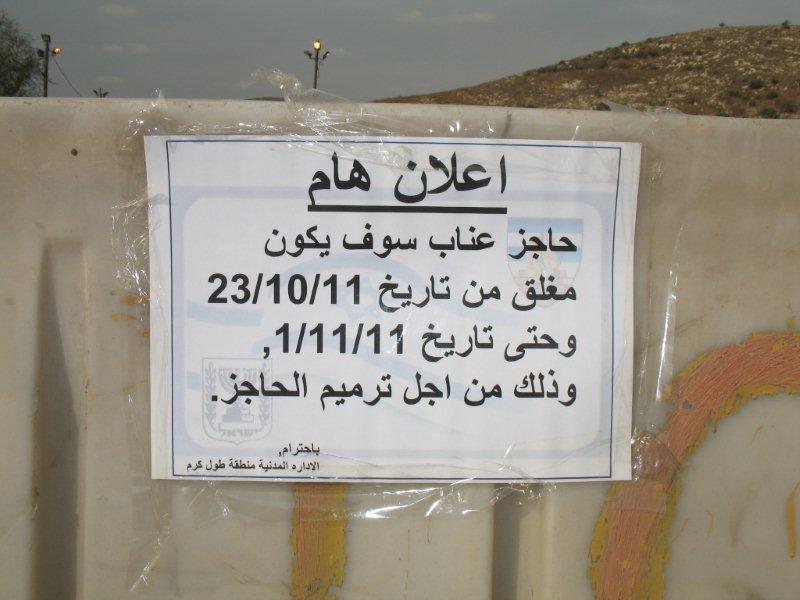 Oct-28-2011Anabta checkpoint 24.10.11
-
Beit Iba
See all reports for this place-
A perimeter checkpoint west of the city of Nablus. Operated from 2001 to 2009 as one of the four permanent checkpoints closing on Nablus: Beit Furik and Awarta to the east and Hawara to the south. A pedestrian-only checkpoint, where MachsomWatch volunteers were present daily for several hours in the morning and afternoon to document the thousands of Palestinians waiting for hours in long queues with no shelter in the heat or rain, to leave the district city for anywhere else in the West Bank. From March 2009, as part of the easing of the Palestinian movement in the West Bank, it was abolished, without a trace, and without any adverse change in the security situation.
 Jun-4-2014Beit-Iba checkpoint 22.04.04
-
Deir Sharaf checkpoint
See all reports for this place-
Deir Sharaf checkpoint is located west of Nablus and south of the settlement of Shavei Shomron, at the entrance to the village of Deir Sharaf on the road leading to Nablus. The checkpoint was activated in early March 2009 after the Beit Iba checkpoint was closed. Palestinians are allowed through the checkpoint , but not for Israelis. Unlike the checkpoints leading to Qalqilya and Tulkarm, crossing of Israeli Palestinians is only allowed on Saturdays.
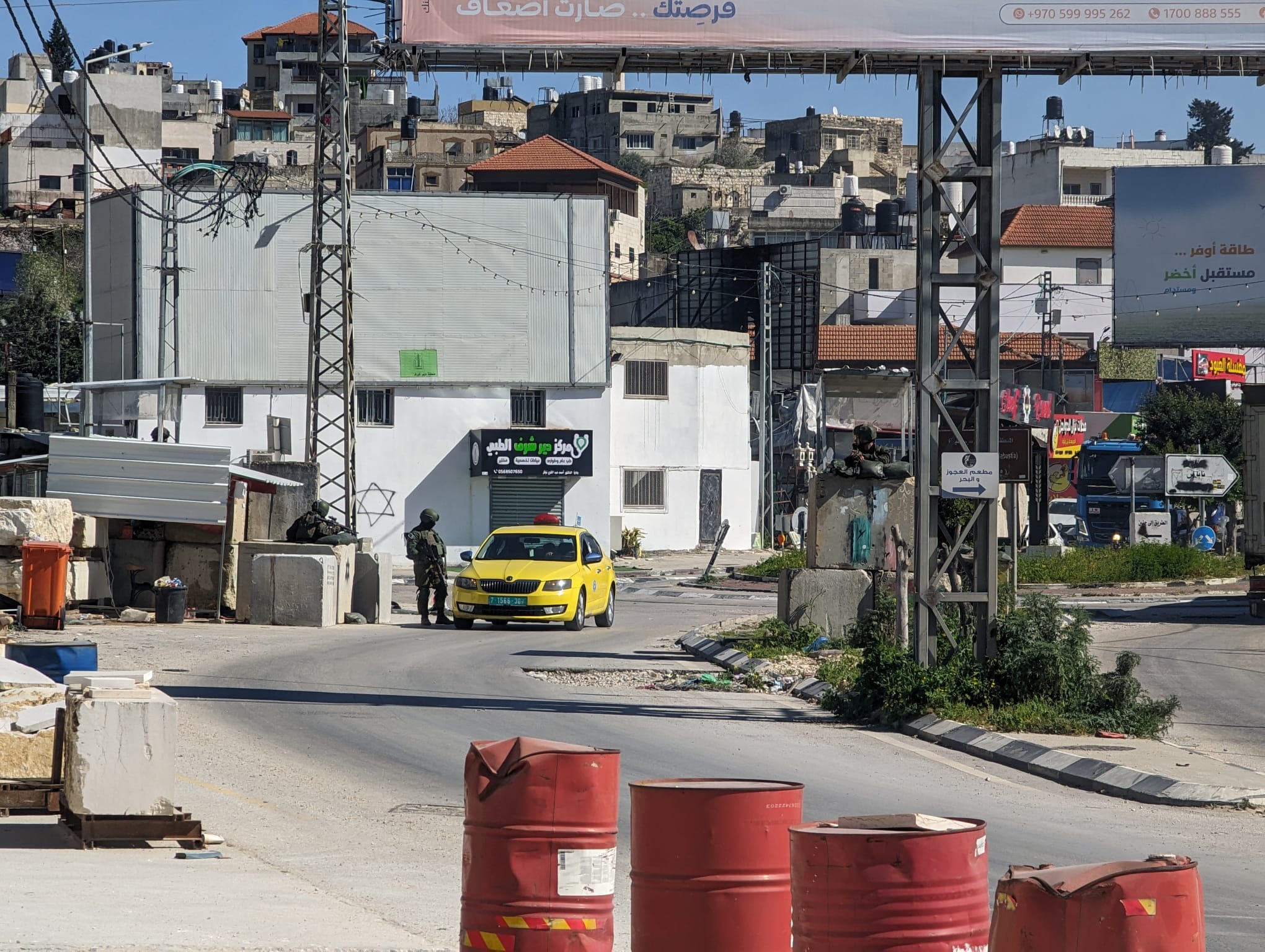 Nina SebaFeb-28-2024Deir Sharaf - the entrance to the village
-
Eyal Checkpoint / Crossing
See all reports for this place-
Eyal Checkpoint is intended for pedestrians and Palestinians only. This is the main barrier for workers to cross from the center of the West Bank. Workers with a work permit to enter Israel can pass through it for trade, medicine, and visiting prisoners. The checkpoint was built on the Green Line north of Qalqilya in the separation barrier that surrounds the city. The checkpoint began operating in 2004 by the military. Opening hours on weekdays from 04:00 to 19:00. We started holding shifts there in 2007. We arrived at the checkpoint before it opened at 4 in the morning. We reported on the difficult conditions and the long and cramped queues of workers who must continue their journey by commuting to work throughout Israel. At the end of June 2009, the checkpoint was operated by a civil security company, The transit time has been gradually shortened, today it is faster, but the Palestinians still have to arrive very early to make it to the transportation. Usually, about 15,000 people pass through.
-
Habla
See all reports for this place-
Habla CP (1393)
The Habla checkpoint (1393) was established on the lands of the residents of Qalqilya, on the short road that
connected it for centuries to the nearby town of Habla. The separation barrier intersects this road twice and cut off the residents of Qalqilya from their lands in the seam zone.(between the fence and the green line).
There is a passage under Road 55 that connects Qalqilya to the sabotage This agricultural barrier is used by the farmers and nursery owners established along Road 55 from the Green Line and on both sides of the kurkar road leading to the checkpoint.
This agricultural checkpoint serves the residents of Arab a-Ramadin al-Janoubi (detached from the West Bank), who pass through it to the West Bank and back to their homes. The opening hours (3 times a day) of this agricultural checkpoint are longer than usual, about an hour (recently shortened to 45 minutes), and are coordinated with the transportation hours of a-Ramadin children studying in the occupied in the West Bank.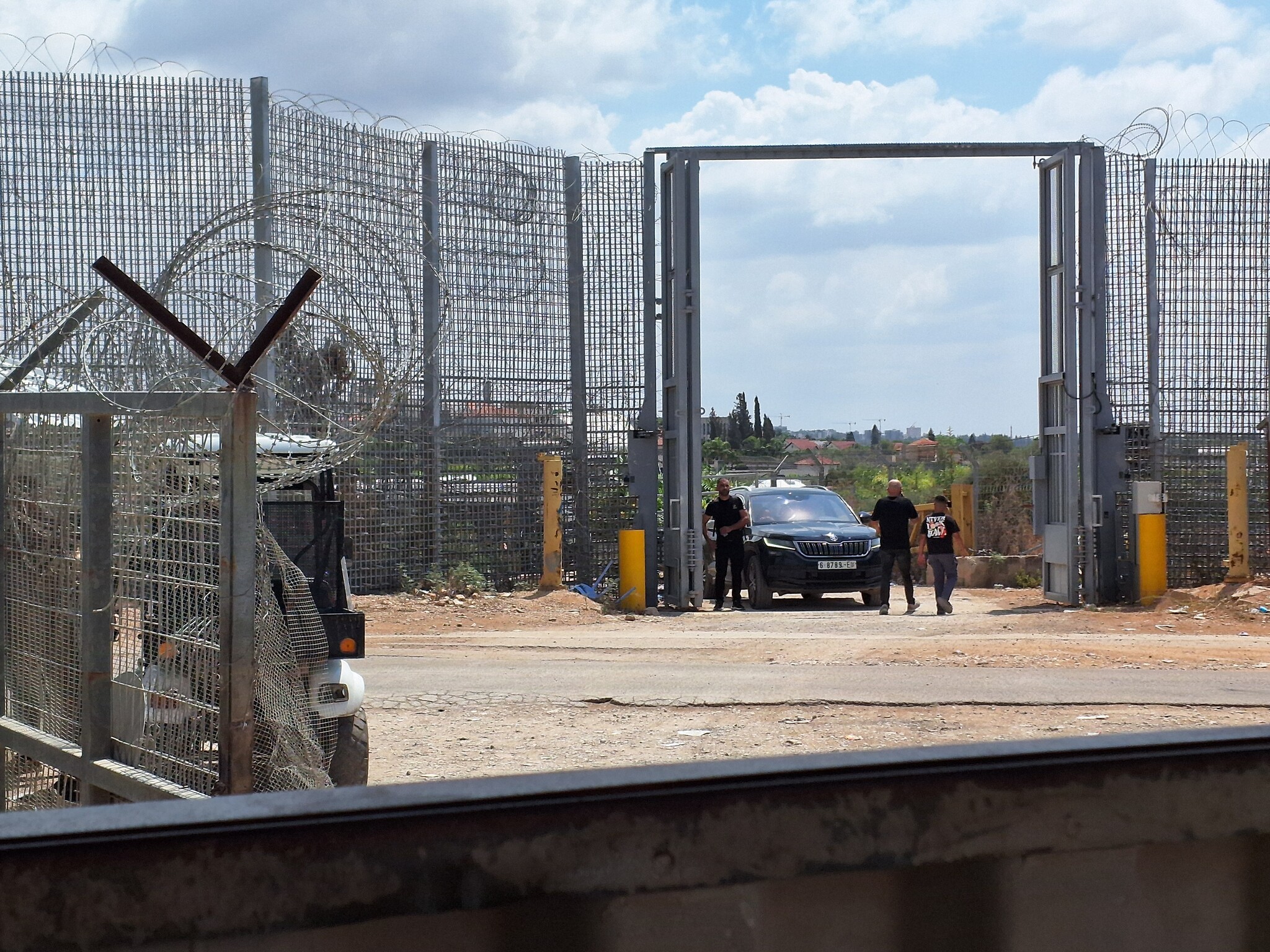 Ronit Dahan-RamatiAug-31-2026Habla. The gate is open
-
Jubara (Kafriat)
See all reports for this place-
The Jabra checkpoint was on Road 557, south of Tulkarm, on the side of the Figs Pass, which is located within the Palestinian Authority (a few kilometers east of the Green Line), and serves as an entry barrier from the territories to Israel. The checkpoint to the village of Jubara, which until 2013 was in the seam area, blocked and surrounded by a fence, was intended for the passage of the family members of the house next to the checkpoint, and also for the MachsomWatch volunteers (with special permission only), on their way to checkpoint 753. on the other side of the village. The soldiers supervising the "fig crossing" also supervised the crossing at this checkpoint, in our shifts we often waited a long time until the key was found and the gate opened. The checkpoint was abolished and became part of the separation fence that was moved west following the High Court.
-
Shave Shomron Checkpoint
See all reports for this place-
The checkpoint is on Route 60 (the main road to the northern West Bank), opposite settlement. Has been blocked to Palestinians since disengagement from Gaza and northern Samaria.
-
