
Eyal Crossing, Habla, Irtah (Sha’ar Efrayim), Tzofim CP.
Irtah/Sha'ar Efrayim, dawn shift; the routine has improved.
05:00 The gates are open, also the women’s gate as Mr. Kariv, the checkpoint manager, had promised us in our meeting on March 20: But that doesn’t alter the fact that men who realized it’s possible force their way in to enter through this gate along with the women. After the gate closes they start climbing through the hole above. As usual there’s great congestion. We keep our eye on someone from the moment he enters the area to see how long it takes him to exit to Israel.
05:10 We meet an old acquaintance on our way to the Israeli entry side; he’s already exited, tells us today everything’s flowing well, nine booths are open (again, as we were promised). And, in fact, people come through smiling today, and the women also tell us it’s good today.
The person we chose comes through in 13 minutes. It is a good day.
A man approaches us saying that even though he’d received a work permit with an attorney’s help after he’d been blacklisted, he’s detained each morning anew, his permit very carefully examined – which involves phone calls to various places. He asks whether we can help. We’ll try.
05:30We went to look again at the entry to the facility on the Palestinian side; the congestion is gone, people calmly go through the entry lane straight to the revolving gates, through to the courtyard and into the facility.
We left for Eyal crossing.
Eyal crossing
There was no longer congestion at the entrance when we arrived; the announcements over the loudspeaker were made politely, without shouting, explanations in Hebrew and in Arabic. People exiting say everything’s ok.
Tzofim checkpoint
06:10 On the way Analin picked up a woman from Qalqilya who works in Tzofim. She says that because they’ve changed the clocks there aren’t many people; they don’t know about the change. She begins work at 07:00; thanks to the ride she arrived early. The settlement looks like any satellite community of single-family homes in Israel (and many sites under construction). According to Peace Now there’s much construction which hasn’t received permits. The high standard of living is obvious.
Habla gate:
06:35 The gates are open, few people crossing. A man coming through says the gates are open for about two hours each morning; sometimes they close early if no one’s crossing. Today there are fewer people, perhaps because the clock had been changed. The plant nurseries are also still closed.
07:00 We left.
.
Eyal Checkpoint / Crossing
See all reports for this place-
Eyal Checkpoint is intended for pedestrians and Palestinians only. This is the main barrier for workers to cross from the center of the West Bank. Workers with a work permit to enter Israel can pass through it for trade, medicine, and visiting prisoners. The checkpoint was built on the Green Line north of Qalqilya in the separation barrier that surrounds the city. The checkpoint began operating in 2004 by the military. Opening hours on weekdays from 04:00 to 19:00. We started holding shifts there in 2007. We arrived at the checkpoint before it opened at 4 in the morning. We reported on the difficult conditions and the long and cramped queues of workers who must continue their journey by commuting to work throughout Israel. At the end of June 2009, the checkpoint was operated by a civil security company, The transit time has been gradually shortened, today it is faster, but the Palestinians still have to arrive very early to make it to the transportation. Usually, about 15,000 people pass through.
-
Habla
See all reports for this place-
Habla CP (1393)
The Habla checkpoint (1393) was established on the lands of the residents of Qalqilya, on the short road that
connected it for centuries to the nearby town of Habla. The separation barrier intersects this road twice and cut off the residents of Qalqilya from their lands in the seam zone.(between the fence and the green line).
There is a passage under Road 55 that connects Qalqilya to the sabotage This agricultural barrier is used by the farmers and nursery owners established along Road 55 from the Green Line and on both sides of the kurkar road leading to the checkpoint.
This agricultural checkpoint serves the residents of Arab a-Ramadin al-Janoubi (detached from the West Bank), who pass through it to the West Bank and back to their homes. The opening hours (3 times a day) of this agricultural checkpoint are longer than usual, about an hour (recently shortened to 45 minutes), and are coordinated with the transportation hours of a-Ramadin children studying in the occupied in the West Bank.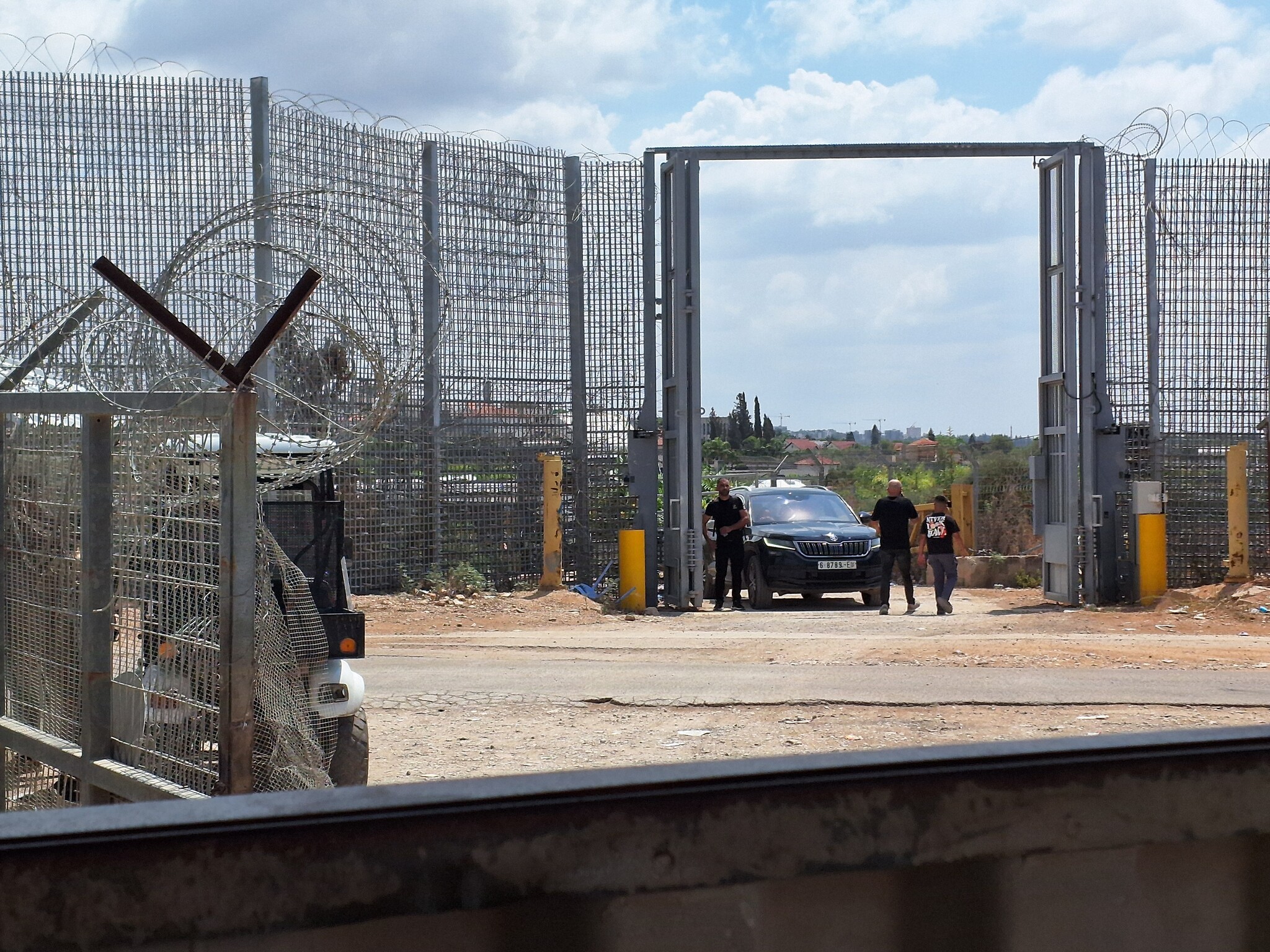 Ronit Dahan-RamatiAug-31-2026Habla. The gate is open
-
Irtah (Sha'ar Efrayim)
See all reports for this place-
The checkpoint is for Palestinians only. It is the main barrier to the passage of workers from the northern West Bank to Israel. Workers with a permit to work in Israel and also for trade (with appropriate permissions), medicine, and visiting prisoners. One can cross the checkpoint only on foot. The checkpoint is located north of Road 557 and south of Tulkarm. Operated by a civil security company, opening hours: between 4:00 and 19:00 on weekdays. As members of Machsom Watch, we began our shifts to this location in 2007. We arrived before it opened at 4 in the morning and report since, on the harsh conditions and the long and crowded queues of workers. The workers who pass by continue their journey by transportation to work throughout Israel. In the first period of its activity, about 3,000 and then 5,000 people passed through this checkpoint every day. Due to the small number of checking points and arbitrary delays for long periods of time in the "rooms", workers feared losing their transportation. Hence workers leave their homes at 2:30 at night to be among the first. Today, 15,000 pass and the transition is faster. Workers are still leaving their homes very early to get past the checkpoint at 7 p.m. In an adjacent compound, there is a terminal for the transfer of goods on a commercial scale, using the back-to-back method.
-
